

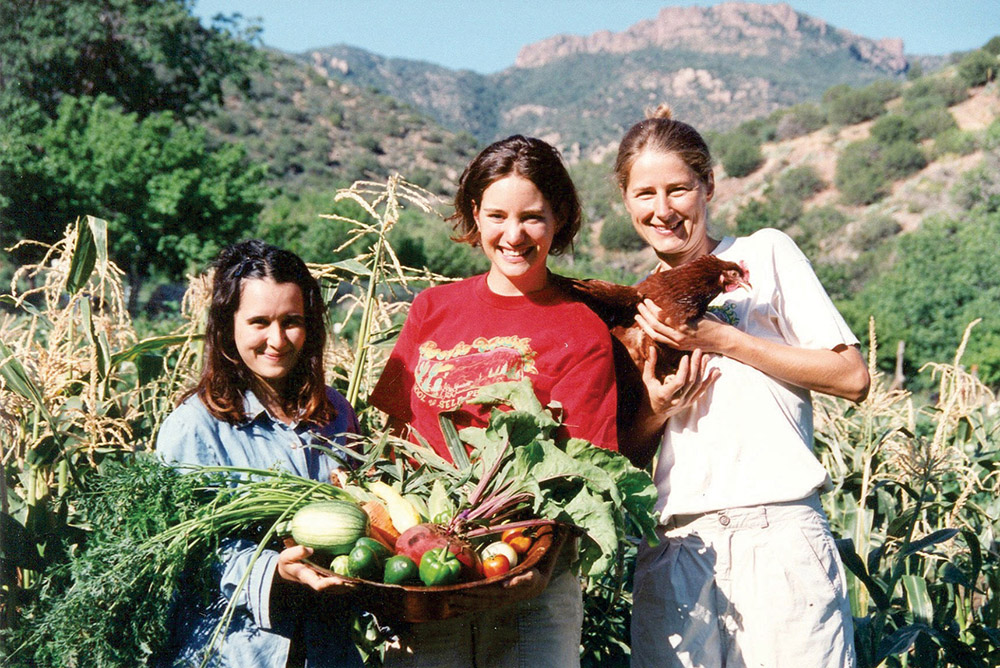
It is only when we deal with the dis-eased character of modern sexuality and the ecological crisis as a single problem that is rooted in an erotic disorder that we can begin to discover ways to heal ourselves of our alienation from our bodies and from nature.1
—Sam Keen
“Contact! Contact! Who are we? Where are we?”2 Henry David Thoreau’s words ring just as true now as they did when he wrote them up on the highest mountain in Maine over 150 years ago. Permaculture—rewilding—ecosexuality—these may be terms that resonate more strongly with today’s crowd, but the urge is the same: a calling to immerse oneself in the raw forces of nature, to remember that being human means we are part of this Earth, and to relearn how to draw our sustenance and nourish our souls from the very places we call home.
In an age dominated by individual isolation, virtual reality, and the information economy, the hunger to partner with Life in its eternal dance and to experience the depth of real human connection is palpable. The primal energies of nature are as alluring as they are frightening, they invigorate us as much as they humble, they show us how fragile it is to be made of flesh and bone. Beneath the superficiality of the Twitter, Instagram, and Facebook posts, the soul of the millennial generation is crawling, naked and knowing, across the forest floor seeking the marrow that can nourish it back to life.
There is a movement underfoot. Alongside the software programmers and coffee-shop baristas, there are those who are returning to the forests, building with cob, practicing permaculture, creating community, sipping on bone broth, tanning hides, and fermenting everything from fruit and veggies to milk and grains. Thousands of young women across the country are meeting on the new moon to honor the cycles of their blood, others are embracing the wildness and sacredness of their sexuality, still others are practicing as herbalists, midwives, death doulas, and as practitioners of other traditional arts.
You could chalk this up to youthful exuberance or a primitive backlash against the sterility of cubicle life, but I think that this trend strikes at a vein that runs deep into the human psyche. Ever since the beginning of the industrial revolution, nature writers have grasped at words for our relationship with this Earth—a relationship they describe with increasing intimacy the further it slips out of our outstretched hands.
Standing amidst the towering trees and exalted rock faces of Yosemite in the early 1900s, John Muir exclaimed that “no holier temple has ever been consecrated by the heart of man.”3 For Aldo Leopold in the 1940s, the relationship focused on engaging with the land “as a community to which we belong.”4
By the early 1990s, Wendell Berry described his experience with the land he called home in far more intimate terms: “bone of our bone, flesh of our flesh.”5 And it was Terry Tempest Williams who cut through any remaining artifice to urge activist, academic, and farmer alike to remove our masks and “admit we are lovers, engaged in an erotics of place.” As if to give us permission to acknowledge what we already know in our bones to be true, she added, “There is nothing more legitimate and there is nothing more true…We love the land. It’s a primal affair.”6
● ● ●
As the spectrum and complexity of sexual expression becomes more readily accepted, the veil of shame that has cloaked sexuality since the dawn of agriculture is slowly beginning to lift. Sexuality finally has the opportunity to be understood on its own terms. Far from seeing the erotic as obscene or sexual desire as offensive, philosopher Sam Keen describes eros, or erotic energy, as the motivating principle of all life; it is eros that drives the acorn to become the oak. Erotic energy exists in all of nature, and it moves through us and around us, intertwining us with all Life. Sexuality is a potent and precious expression of this life energy, and it represents our primal desire to merge with Life itself.
This cosmetic-free and barefoot expression of sexuality is the adult child of the 1960s sexual revolution. Sobered by the prevalence of STIs and humbled by the rate of divorce and date-rape, intention and consent now take precedence over experimentation and drug use. Today’s hunger is more for authenticity and community, holistic health and sustainability, and it translates into an acceptance that our bodies are born from this Earth. Gender norms slip away. Categories become cages. Nudity becomes nakedness. Do not look away. This is who I am. I am of this Earth.
● ● ●
The impulse to embrace the Earth—wildness, bodies, sex, death, food, community, each other—is simultaneously an act of love and instinct. The urge to protect the very things that give us life is a basic instinct of survival. The drive to extend ourselves to others with courage and compassion in a time of crisis is love. As a social movement, ecosexuality emerges out of the deep place in our bodies that is retching in the pain we are are inflicting on the world—on ourselves—and is grasping for the only thing that can bring it to an end: the rapture and pleasure of humbly submitting to intimacy so profound we begin to feel the Earth simultaneously as lover and as self.
Beneath the complexity and confusion of the ecological, economic, political, and erotic crises of our time lies one simple cause—disconnection. What more intuitive or logical response could there be to a crisis of disconnection than to once again hold the things that actually matter so close that we can feel their beating hearts—our bodies, the earth that sustains us, the places we call home, the people we call community? For in partnering with a place and its people, we draw strength and sustenance, purpose and meaning. Perhaps enough to even heal our self-inflicted alienation from this embodied world.
The search for reconnection with the natural, the embodied, and the authentic is what drives many branches of the ecological movement today. Permaculture seeks intimacy with the living systems that provide for our sustenance. Rewilding aims to reconnect the inner and outer wild landscape, to embrace it and live within it. Fostering communication, trust, and love with fellow humans so we can better live together is a focus of many intentional communities. Ecosexuality integrates all these elements with an explicit invitation to come back into our bodies and embrace the erotic energy that animates us and all of Life.
The path towards such profound intimacy with land and community requires time, knowledge, and ultimately love: we cannot love what we do not know, and we cannot know what we do not spend time with. It also requires skill, discipline, and patience. Whether it be with tree, rock, or person, letting another in, in their wholeness, requires that we suspend belief, let go of fantasy, and be exquisitely present.
● ● ●
Like wind, water, or any other force of nature, erotic energy moves through our communities, organizations, and landscapes. It can be empowering and invigorating, and it can be destructive and debilitating. Yet, rather than acknowledge sexuality as a force of nature that greatly influences every social endeavor, it is often cast aside as a private matter—as being of little relevance to efforts to live communally, share power, deepen knowledge, develop alternative economies, pass wisdom down through the generations, and create a culture that respects all of nature and all those who call Earth home.
Isolating sexuality is foolish at best. Wendell Berry offers far more condemning words: “the failure to imagine sex in all its power and sanctity is to prepare the ruin of family and community life.” For sexual love lies at the heart of a community and ecological life, “it brings us into the dance that holds community together and joins it to its place.”7
In embracing sexuality and erotic energy as an inherent part of our communities, and responding to the deep hunger we carry for intimacy in this time of such profound disconnection, ecosexuality offers a proactive approach that can heal and transform.
Imagine the world we will co-create together when we:
● Meet our needs through deep intimacy with Earth, self, and community, instead of goods and services;
● Design our relationship networks with as much care and intention as we design our permaculture gardens and community governance systems;
● Allow our love for this Earth to transform all aspects of our lives, including our intimate relationships;
● Channel erotic energy to benefit the ecosystems we love just as we might channel wind, water, and other energies of nature;
● Engage with the Earth as a lover and partner who we tend to, care for, and respect in a mutual relationship where we give more than we take;
● Be as intentional about sex as we are about what kind of foods we eat, which products we buy, and what plants we sow in the garden;
● Allow pleasure to be a guiding principle as we engage whole systems thinking within our communities;
● Allow ourselves to experience the sensual in nature and the nature in our sensuality;
● Give ourselves in service to the lands that feed us, the ecosystems that keep us healthy, and the communities that support us;
● Love our bodies as ecosystems and our ecosystems as bodies.
● ● ●
Every year, earth-lovers from all walks of life journey to the forests I call home on the plateau that descends off of Mount Adams in southern Washington for the EcoSex Convergence. Infused with a level of intentionality, sobriety, and intimacy unusual for a summer festival, the gathering aims to build a regional community of ecosexual practitioners who support each other in the transition to a love-based, sustainable culture.
For many, these five days in the forest are a time to reunite with old friends, develop new ones, and strengthen their personal relationship with the land. Others come drawn by the opportunity to teach and learn practical skills or to experience a place where sexuality is treated with intelligence and authenticity alongside conversations about food systems and gift economies. For some it’s a rare opportunity to be able to make love in the forest under the night sky or feel the primal energies evoked by the rhythm of drums and the light of fire. But for all, it’s a place where the wholeness of who they are is welcome and held by community, creating an all too rare experience where they are able to express their deepest longing, deepest sorrow, and deepest joy for the Earth we know as partner, lover, and self.
For, only when we create a container that is loving enough and strong enough to embrace the erotic, do we create a container that is loving enough and strong enough to embrace all of Life itself.
Can we really afford anything less?
Lindsay Hagamen is a steward of the Windward Community in southern Washington. She is coauthor of Ecosexuality: When Nature Inspires the Arts of Love and co-creator of the annual EcoSex Convergence. Lindsay enjoys immersing her hands in rich garden soil, giving belly rubs to her pigs, and being a lover of the Wild.
1Sam Keen. The Passionate Life. 1992.
2Henry David Thoreau. “Ktaadn.” The Maine Woods. 1864.
3John Muir. “The Hetch Hetchy Valley”. Sierra Club Bulletin, Vol. VI, No. 4, January, 1908.
4Aldo Leopold. Sand County Almanac. 1949.
5Wendell Berry. “Conservation is Good Work.” Sex, Economy, Freedom & Community. 1992.
6Terry Tempest Williams. “The Erotics of Place: Yellowstone.” 1991.
7Wendell Berry. “Sex, Economy, Freedom & Community.” Sex, Economy, Freedom & Community. 1992.
Keep the conversation going with these pieces
There are no available blogs
Subscribe to our newsletter for fresh stories and community updates delivered to your inbox.
Get unlimited access to courses, exclusive member events, and a supportive network of community builders
Access all courses, books, and premium content
Member-only workshops and community builders
Member-only workshops and gatherings
We use cookies to improve your experience on our site. By using our site, you consent to cookies.
Manage your cookie preferences below:
Essential cookies enable basic functions and are necessary for the proper function of the website.
These cookies are needed for adding comments on this website.
Statistics cookies collect information anonymously. This information helps us understand how visitors use our website.
Service URL: policies.google.com (opens in a new window)
A residential project: people live here as their primary home.
An institution, business, network, or project that isn’t a residence (e.g. a learning center, farm, or network with no one living there full-time).

{{ item.label }}
{{ item.value ? item.value : currencyFormat( item.amount ) }}
Subtotal
{{ currencyFormat( pricing_summary.total_amount ) }}
There are no results matching your search

We’re introducing new Plus features — including community reviews, Profile Match, and unlimited Needs & Offers posts — while keeping most of FIC free for everyone. Membership costs less than two coffees a month.

