

Regenerative Victory Gardens

Placeholder image for Foundation for Intentional Community website.
Christopher Kindig
  • October 15, 2018
  • Economics & Law
  • Sustainability
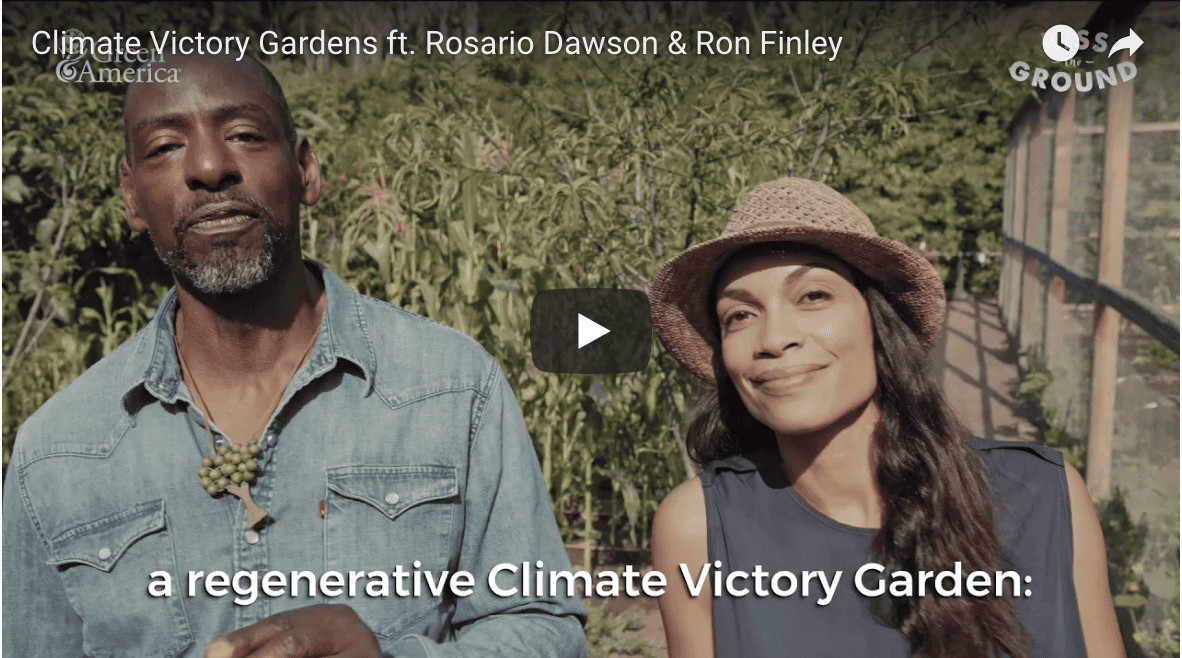
Climate Victory Gardens featuring Rosario Dawson and Ron Finley.

Stacking Benefits of Gardens

When you plant a garden, you are doing more than practicing a resilient skill, and cultivating mouth watering beefsteak tomatoes.

You are reducing food miles by creating sustenance locally, without the need for costly and dirty energy inputs. You can skip the application of dangerous pesticides and fertilizers, and instead of harvesting early to prolong shelf-life, you get the ripest, best tasting, most nutritious version of your vegetable.

But it goes even further than that. Regenerative gardening can help to reverse climate change. Soil is a giant carbon sink, and healthy soil devours and stores CO2 in the ground.

Regenerative Victory Gardens

During the World Wars people in the US proudly and patriotically grew gardens in theiryard, to better localize their food production to reserve resources and labor for battle efforts.

Today we are called to face an even bigger and more wide ranging global threat, dangerously positioned to tear apart the delicate ecosystem we and all other species depend on.

Enter Green America’s new campaign, rallying people around the world to plant a garden that grows local produce while sequestering greenhouse gas.

In the video below, Rosario Dawson and Ron Finley walk you through how to plant your very own Climate Victory Garden!

Take Action with Green America’s current green economy campaigns, focused on tackling climate change, building fair trading systems, stopping corporate abuse, protecting our food, and growing the green economy: https://www.greenamerica.org/take-action and to learn more about this campaign, see: https://www.greenamerica.org/climate-victory-gardens

Fertile Soil for Cleaner Skies

To create a regenerative garden, you want to keep as much carbon in the soil as you can, which thankfully, also can increase your soil health, water and nutrient conservation, and ultimately yield and quality of your produce. Here is a quick list of their tips:

5 Ways to Make your Garden Regenerative

  1. Ditch the Chemicals
  2. Keep the Soil Covered
  3. Encourage Biodiversity
  4. Grow Food
  5. Compost

For more information on gardening, permaculture, and cultivating great soil, check out the Permaculture + Sustainability selections in Communities Bookstore!

Comments

Featured Blogs

Keep the conversation going with these pieces

Saul Of-Hearts
Thu Mar 2017
  • Sustainability
Curious about how you can apply permaculture principles in your community or ecovillage? There’s no better way than to visit a community in person and learn from hands-on workshops and immersion programs. Here are two very different programs – one an affordable “spring break” at a community in Wa…
Nick Licata
Mon Sep 2008
  • New to community
Author: Nick Licata Published in Communities Magazine Issue #140 I opened my morning paper anxious to read the first article on my race for a position on Seattle’s City Council. I was living in PRAG House, an old mansion in the Capitol Hill neighborhood that a group of us had converted into a c…
Molly
Thu Nov 2007
  • New to community
  • Sustainability
Troy Gardens Cohousing in Madison, Wisconsin, a project of the Madison Area Community Land Trust has won a 2007 Livable Communities Awards. This new award is granted by the AARP and the National Association of Home Builders. Madison Area Community Land Trust (for Troy Gardens in Madison, WI) This 3…
Kim Kanney
Sat Nov 2018
  • Sustainability
Top 5 Questions to Ask When Building an Ecovillage A Look Inside Wisdom of Communities Volume 4 by Kim Kanney, Community Bookstore manager Finally! Our fourth and final volume of the Wisdom of Communities series has been released! Now you can get your own copy of Volume 4: Sustainability in Communit…
Christopher Kindig
Sat Apr 2015
  • Sustainability
The Archimedes is a unique new design in alternative energy. It is a nautilus shaped wind turbine, in that it’s blades are shaped like a Nautilus shell. This design allows it to point directly into the wind to capture the most amount of energy, while remarkably producing very little sound. …
Christopher Kindig
Tue Jun 2013
  • New to community
  • Life Transitions
Forget meadows. Seattle’s food forest will be filled with edible plants, and everything from pears to herbs will be free for the taking. Read more here: http://www.takepart.com/article/2012/02/21/its-not-fairytale-seattle-build-nations-first-food-forest
Saul Of-Hearts
Thu Sep 2016
  • Living in community
  • Governance
For over 20 years, a small community in Kenya has been embarking on a rare experiment: a community without men, where women are the homeowners and breadwinners. Around 50 women and 200 children live in Umoja, a small village several hundred miles north of Nairobi, in the dry grasslands of the Sambur…
Helen Iles
Sat Jan 2017
  • Living in community
  • Relationships
The erosion of the commons by private interests is a disaster for modern human settlements; a community without shared spaces is barely a community at all.
Christopher Kindig
Wed Mar 2013
  • Searching for community
  • Life Transitions
It’s Ready for the World! The One-of-a-kind Film that Redefines Community. http://p0.vresp.com/8DVBNK #withinreachmovie

Insights & Stories from the Communities Movement

Subscribe to our newsletter for fresh stories and community updates delivered to your inbox.

Join the Communiversity Community

Get unlimited access to courses, exclusive member events, and a supportive network of community builders

Unlimited Learning

Access all courses, books, and premium content

Community Network

Member-only workshops and community builders

Exclusive Events

Member-only workshops and gatherings

Update to a Public Profile

  • Log in
  • Go to your profile page
  • Toggle on the "Add my profile to the directory"
  • Save your profile

Information

Communities

A residential project: people live here as their primary home.

Organizations

An institution, business, network, or project that isn’t a residence (e.g. a learning center, farm, or network with no one living there full-time).

Plus Community Membership

  • Find people with Profile Match
  • Access to your community listing statistics
  • Create Discussion Groups
  • Access to our affiliate program
  • Member badge on your community profile
I am an official member of this community
Disclaimer
I affirm that my information is accurate and I am authorized to manage this listing
Foundation for Intentional Community FIC Member badge logo.

Free Plan

Free Membership
Free

Intentional Advertising

  • Subtotal

    {{ currencyFormat( pricing_summary.total_amount ) }}

Icon representing community connections and collaboration for intentional communities.

Plus Membership

  • Find communities with Profile Match
  • View detailed reviews about communities
  • Create free listings in Needs & Offers
  • Plus Member resources in CommUniversity
  • View communities detailed reviews
  • Plus Member badge on your profile