

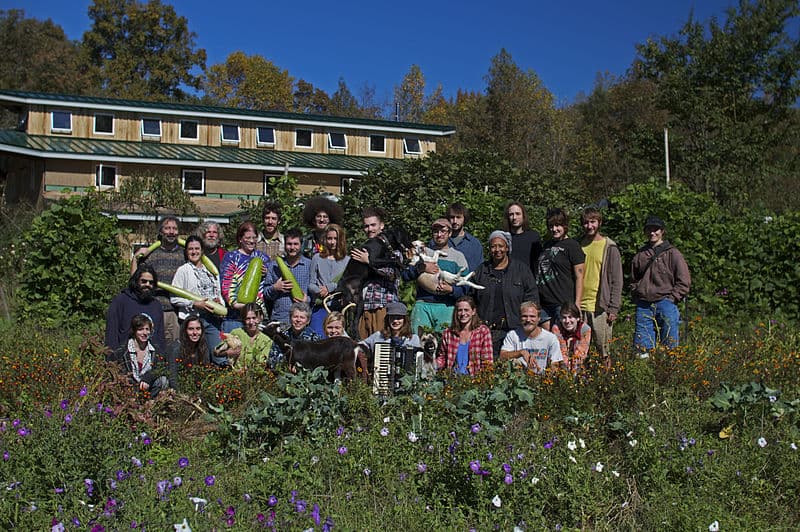
When I first heard about the concept of income-sharing communities, I was pretty skeptical. It had been hard enough for me stabilize my own finances after graduating from college during the recession. I wasn’t sure I’d be up for sharing finances with a spouse – never mind an entire community.
But the more that I learned about it, the more I realized that many of us are de facto income-sharing already. The difference is that we often think of it as expense sharing. If you’ve ever lived in a group house, been part of a meal plan, or co-owned a vehicle, you’ve essentially been income-sharing. But because the focus was on what you paid for, and not on what you earned, it didn’t feel that way. Pooling resources and sharing expenses feels safe; giving up control over our income is scary.
I’ve found it helpful to think of income sharing less as an either-or option, but as a spectrum. At the Twin Oaks community in Virginia, everyone has to take part in the system or it won’t function. Residents work a full-time week on community projects – ranging from community businesses to cooking to childcare. In return, everyone’s expenses are covered – housing, food, health insurance, transportation, along with a monthly stipend for personal needs and travel. According to the Twin Oaks website:
“Sharing income frees up individuals to do less income-generating work than they would need to do if they were living independently as long as the group as a whole is doing enough income generating work. This is one way that utility maximization comes in by allowing more specialization (social efficiency) and personal flexibility.”
The way that Twin Oaks residents see it, they have access to more resources than any single person could afford individually – even if their individual incomes are lower than they would be working a mainstream job. And while a 40-hour workweek might seem like the antithesis of a carefree communal life, it’s actually pretty reasonable when you consider that household responsibilities are included toward that quota.
If Twin Oaks lies at one end of the spectrum, the Compersia Commune is somewhere in the middle. Rather than running a shared business, some residents work full- or part-time jobs outside of the community. A recent video profile shows how it all works:
Income-sharing communities turn the concept of being the “breadwinner” on its head. Instead of valuing work to the degree that society values it, income-sharing communities can set their own values. In this community, one resident’s income as a lawyer allows the other residents to focus on freelancing, maintenance work, and child care. According to the From Point A blog:
“Income-sharing reduces economic precarity and instability in the same way that a CSA share does. When you buy into a share up front before the growing season begins, you benefit from the produce raised by your local farmer, and share the risk of the growing. If the growing season is weak, you may have a slightly smaller share, but the farmer doesn’t go under and can continue to produce. Similarly, a bumper crop increases your share of the produce, all for the same up front investment.”
Sharing income can serve as a buffer for all residents, ensuring that no one loses their home or access to food simply because of a job transition or medical emergency.
The Federation of Egalitarian Communities, which helps communities transition toward income-sharing, lists several core values that its members must meet. These include:
Currently, there are seven communities that are members of the FEC, and nine that are “in dialogue” to move toward full income-sharing.
Curious if income-sharing is right for you? Check out the FEC website to learn more, and see if you can arrange a visit to a community near you. Visit From Point A for even more resources on how to start or join an income-sharing community.
****
Image of Acorn Community by AcornWiki (CC BY-SA 3.0)
Keep the conversation going with these pieces
There are no available blogs
Subscribe to our newsletter for fresh stories and community updates delivered to your inbox.
Get unlimited access to courses, exclusive member events, and a supportive network of community builders
Access all courses, books, and premium content
Member-only workshops and community builders
Member-only workshops and gatherings
We use cookies to improve your experience on our site. By using our site, you consent to cookies.
Manage your cookie preferences below:
Essential cookies enable basic functions and are necessary for the proper function of the website.
These cookies are needed for adding comments on this website.
Statistics cookies collect information anonymously. This information helps us understand how visitors use our website.
Service URL: policies.google.com (opens in a new window)
A residential project: people live here as their primary home.
An institution, business, network, or project that isn’t a residence (e.g. a learning center, farm, or network with no one living there full-time).

{{ item.label }}
{{ item.value ? item.value : currencyFormat( item.amount ) }}
Subtotal
{{ currencyFormat( pricing_summary.total_amount ) }}
There are no results matching your search


