

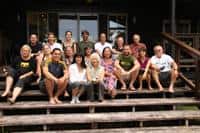
At the Foundation for Intentional Community we get a steady flow of inquiries from people who are seriously shopping for a life in community. A significant fraction of those are older than 50—for convenience, let’s label them “seniors.” Overwhelmingly, seniors want an intergenerational community—not a seniors-only enclave. To be sure, there are some for whom it is a greater priority to have a reliably adult decibel level at common meals (one more conducive to congenial conversation, especially for those with compromised hearing) and less danger of stray toys on the sidewalks, yet this is a distinct minority. Mostly seniors want to live in a community with a full age range, where there’s the option to engage with those in different stages of life as feels appropriate.
One of the prospects of community that attracts seniors (and seniors-to-be) is the hope of graceful and dignified aging in place. In an intergenerational community it is easier to imagine how the many can be a support network for the few (providing that a community doesn’t accidentally get too top-heavy—it won’t work so well with 70 percent of the population in wheelchairs at the same time). This dream is much more than just on-site elder care and dying in your own bed. It’s the hope of being able to make meaningful contributions as late in life as possible.
To be sure, seniors often are not able to contribute with the same physical strength and stamina of younger folks, yet there are many others ways to contribute. While they may not be as stout stoking boilers, shoveling snow, or pouring foundations, they can show up strong when it comes to research, mediation, problem solving, and committee work. (While people don’t necessarily get wiser just because they get older, they’ve had more passes at the trough of knowledge and surely some of them have been drinking.)
If you conduct a cost/benefit analysis based only on the factors above, seniors may seem only of marginal benefit: increased care needs measured against limited capacity as an asset in the labor pool. But there is much more to the story.
Modeling a Better Quality of Life
Communities purposefully strive to provide a superior life for all residents, regardless of age. On the younger end, for example, there is ample evidence that community is a terrific place to raise children, no small part of which is the support parents get from other adults (often seniors, by the way) in regularly spending time with their kids—providing both enrichment for the young’uns and a much needed break for the ’rents.
When it comes to the older end of life, the mainstream culture does an abysmal job. In a culture built around the concept of the nuclear family (which is in sharp contrast with the intergenerational model that has predominated for the vast majority of human history) either you succeed in saving enough money to take care of your elder years or you face the bleak prospect of being warehoused in some institutional setting.
Further complicating the equation is that the mainstream culture is competitive, which means there’s a tendency to push seniors out of the workplace prior to their desire to leave, to make room for younger employees who can be hired for less money. Essentially, profit and return on investment come ahead of people and relationship.
Thus, even if you had planned carefully for your retirement, a cold-hearted employer might have decided it was time to trim payroll prior to your having worked long enough at peak earnings to have salted away sufficient funds in your 401k.
In community, we’re trying to move deliberately away from defining security in terms of bank balances, and towards a wealth of relationship. In short, we’re trying to address a major societal need without relying on a governmental safety net. Further, we want to do that with dignity, which generally means finding ways for everyone—young and old alike—to contribute meaningfully to the health of the whole.
Time
Seniors, by virtue of being either near the end of or beyond their full-time careers, tend to have a great deal more discretionary time in their lives. Even when you factor in decreased stamina, they tend not to have dependents at home or jobs that claim their attention 40 hours/week. It’s not unusual for seniors to be contributing way beyond their numbers to the work needed to maintain and develop the community. Independent of their skill and wisdom, they simply have the time, and many communities would struggle mightily without a willing cadre of seniors to be in harness to the myriad needs of a vibrant community—you can expect to extract only so much blood (sweat, and tears) from the turnips that are working parents with kids at home.
Mentoring
In addition to the above, seniors can offer groups much more than merely more oars in the water. In many cases they possess a wealth of experience, some of which may be highly useful to younger folks hoping to acquire it. While many seniors are attracted to the concept of mentoring younger members (passing on what they know), there are a number of potholes on the road to this aspect of elder heaven, and I want to focus the remainder of this essay on what I label Misadventures in Mentoring.
—Pothole #1: Misalignment of Interest and Skill
The senior’s knowledge may not be of interest to other community members, or their knowledge may not be as valuable as they think it is (perhaps because it relates to conditions that no longer apply, or relies on technology that is obsolete—for example, I could teach people how to use a slide rule or how to cut a mimeo stencil, but who gives a shit?).
—Pothole #2: Misalignment of Teaching Style and Learning Style
The senior may have useful knowledge yet may be weak at transmitting it. Doing and teaching are different skills; they may be solid at the former yet poor at the latter, or at least have a teaching style that doesn’t work well for the person interested in learning that skill. The senior may well take that as a rejection of them as a useful person, when what’s really going on is a rejection of their teaching style. It can be tricky.
—Pothole #3: Misalignment of Culture
One of the important things about intentional community is that it’s an attempt to create cooperative culture, which stands in direct contrast with the mainstream competitive culture in which we were raised. When younger members join, they are most commonly fresh from that competitive culture. Even though they may be purposefully trying to move away from it, they have been deeply conditioned in it and thus are likely to bring with them a fairly well-defined sense of individuation that results in their not being so likely to approach others for advice about how to do things. This tendency undercuts the creation of a culture where mentoring thrives. If it depends on the seniors taking the lead in blowing their own horns, there will not be much trumpeting, or at least not much that will be heard as a clarion call by the younger set.
● Honoring elders is fine in theory, but how do we actually shift to it? Hint: It has to be more than asking them to call in the Four Directions on pagan holidays, or reserving for them a front-row seat at house concerts.
● How do we encourage younger members to reach out to seniors for advice? Hint: Mitch Albom’s 1997 bestseller Tuesdays with Morrie is the tender story of a young man in the prime of his career seeking out the company of a former sociology professor who is nearing death from ALS. In the course of their 14 Tuesdays together, Mitch is touched by his mentor’s wisdom—even though that’s not what motivated him to visit in the first place. How do we encourage mentoring under less dramatic conditions?
● How do younger members even find out what seniors know? Hint: This will not magically happen on its own; it’ll need help. I think it could be approached from either direction:
—a) Residents could be encouraged to let the whole group know what they’re looking to learn, which could entail anything from a 10-minute download/demo to a formal apprenticeship.
—b) Seniors (or anyone willing to mentor others, regardless of the mentor’s age) could be asked what they think they could teach. This could come out as part of a getting-to-know-each-other-better ritual where all residents take turns telling their life story (one per night, every other Thursday until you’re done?), or it could be something as mundane as a posting on the community’s website, updated as people are inspired. Part of new resident orientation would be to make sure that everyone knew that the postings existed and was encouraged to add their own offerings.
● ● ●
This mentoring challenge interests me a great deal because my instinct is that the solution will have to arise from the mentees—not from the seniors—and that group, almost by definition, is least equipped to understand the cultural shift needed to make it happen. Let me conclude with a story that illuminates my point:
About 20 years ago at Sandhill Farm, when my son was a young teenager (think smart aleck), we had a member in her late 20s who was highly frustrated with the community’s standard that adults were expected to give children a reason when asking them to do something or limiting their behavior, and that they were further expected to listen and engage constructively if the child objected (not that kids had the same power as adults—in the end they had to go with the adults’ limits—but they did have rights).
That was decidedly not the way she had been raised and it grated on her that she was getting the worst of it both ways: as a child, she was supposed to shut up and take it; as an adult, she was expected to be courteous and engaging with obnoxious junior lawyers. Yuck!
I tell this story because this woman was: a) young and Sandhill was her first taste of cooperative living; b) a cherished member of the community; c) someone who was determined to develop her own niche in the community, and therefore not likely to ask others for advice; and d) someone who often experienced the community’s attempts at culture shift as more awkward than advantageous.
While it’s not so hard to grow amazing fruit on the tree of community life, accessing that nourishment through mentoring can be a tough nut to crack.
Laird Schaub is Executive Secretary of the Foundation for Intentional Community (FIC), publisher of this magazine, and cofounder of Sandhill Farm, an egalitarian community in Missouri. He is also a facilitation trainer and process consultant, and authors a blog that can be read at communityandconsensus.blogspot.com. This article is adapted from his blog entry of December 27, 2013.
Keep the conversation going with these pieces
There are no available blogs
Subscribe to our newsletter for fresh stories and community updates delivered to your inbox.
Get unlimited access to courses, exclusive member events, and a supportive network of community builders
Access all courses, books, and premium content
Member-only workshops and community builders
Member-only workshops and gatherings
We use cookies to improve your experience on our site. By using our site, you consent to cookies.
Manage your cookie preferences below:
Essential cookies enable basic functions and are necessary for the proper function of the website.
These cookies are needed for adding comments on this website.
Statistics cookies collect information anonymously. This information helps us understand how visitors use our website.
Service URL: policies.google.com (opens in a new window)
A residential project: people live here as their primary home.
An institution, business, network, or project that isn’t a residence (e.g. a learning center, farm, or network with no one living there full-time).

{{ item.label }}
{{ item.value ? item.value : currencyFormat( item.amount ) }}
Subtotal
{{ currencyFormat( pricing_summary.total_amount ) }}
There are no results matching your search


