

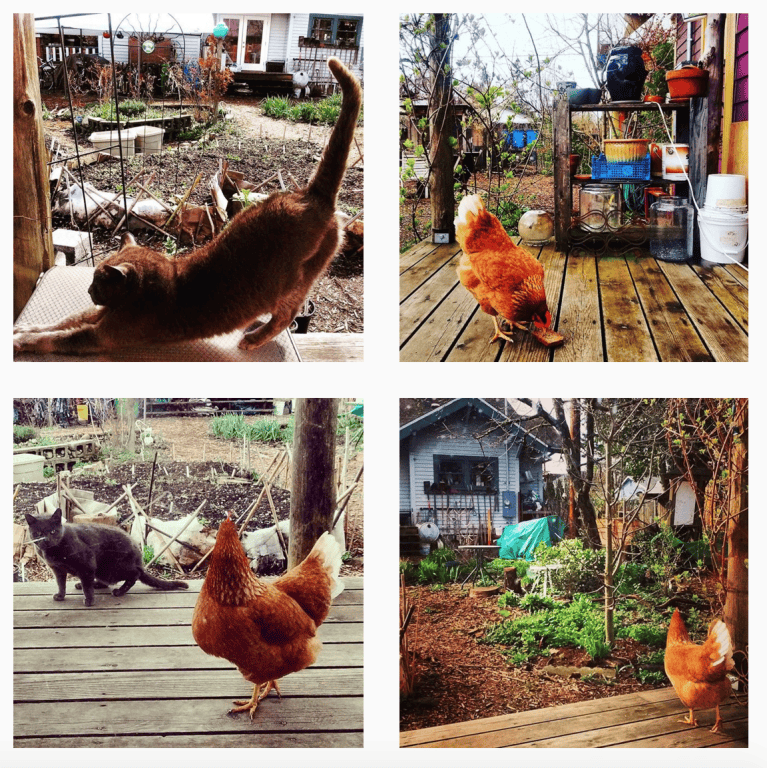
Hi, I’m Saul, the new Social Media Manager here at FIC. I’m excited to join the team from my home at Foster Village, an urban eco-community in Southeast Portland, OR! If you have any feedback or suggestions for a future blog post, you can reach me via e-mail or on Twitter.
Living in an urban eco-village brings with it its own unique sense of place. Here at Fosterville, we’re both part of the social fabric of the city, and a little apart from it. From the sidewalk, you wouldn’t know that our three houses and the garden between them make up an 11-person community that shares meals and resources together.
And if you visited from another IC, you may not know that we’re on three separate city lots, and that we’re trying to find a way to purchase the entire property collectively.
Our chances look pretty good right now, but the city’s housing crisis and rising rents could present some challenges. A few miles away, a collection of tents along the creek shows how quickly homelessness is growing in our city. And a block from where we live, a proposed bike lane has local businesses up in arms, worried about the new traffic patterns that will be coming to the neighborhood.
In the midst of these changes, some groups see collective living as an important part of Portland’s future. A local realty hosted an event to showcase properties that would be ideal for starting a co-housing community or a tiny house village. One mayoral candidate, a friend of some of our residents, promises to address housing affordability and support eco-villages like ours.
The ability to connect with so many like-minded people is one of the things I love most about living in Portland! Still, it’s easy for ICs like ours to focus inward and keep doing our own thing. Who knows how many more communities exist in the city that we haven’t even heard of yet? There’s a lot to do here at Fosterville, from caring for the ducks and chickens, to strategizing about our financial goals, to tending interpersonal relationships.
Life in a city pulls us in many directions, and most of us have day jobs outside of the village. Some of them overlap with our lives here, and provide us with resources to share with the wider community. We try to keep in touch with other ICs in the city for meals and activities, and to find ways to support each other in an urban environment.
Recently, a few of our residents have been pulled outside of the city, to spend time at rural communities in southern Oregon and Washington. Some of us wonder what the rapid changes coming to the city will mean for communities like ours. Will developers try to replicate our co-housing models in neat, millennial-friendly packages? Or will more and more city dwellers consider moving back to the land?
For now, Foster Village is a refuge from the busy streets of downtown, a little bit of country life in an urban setting. We hope that, as we move toward collective financing—and sort through all the red tape—we can be a model for other ICs going through the same process.
We’d love to see more of our neighbors take down their fences, tear up their driveways, and join the growing network of co-ops and eco-villages in our city.
Keep the conversation going with these pieces
There are no available blogs
Subscribe to our newsletter for fresh stories and community updates delivered to your inbox.
Get unlimited access to courses, exclusive member events, and a supportive network of community builders
Access all courses, books, and premium content
Member-only workshops and community builders
Member-only workshops and gatherings
We use cookies to improve your experience on our site. By using our site, you consent to cookies.
Manage your cookie preferences below:
Essential cookies enable basic functions and are necessary for the proper function of the website.
These cookies are needed for adding comments on this website.
Statistics cookies collect information anonymously. This information helps us understand how visitors use our website.
Service URL: policies.google.com (opens in a new window)
A residential project: people live here as their primary home.
An institution, business, network, or project that isn’t a residence (e.g. a learning center, farm, or network with no one living there full-time).

{{ item.label }}
{{ item.value ? item.value : currencyFormat( item.amount ) }}
Subtotal
{{ currencyFormat( pricing_summary.total_amount ) }}
There are no results matching your search

We’re introducing new Plus features — including community reviews, Profile Match, and unlimited Needs & Offers posts — while keeping most of FIC free for everyone. Membership costs less than two coffees a month.

