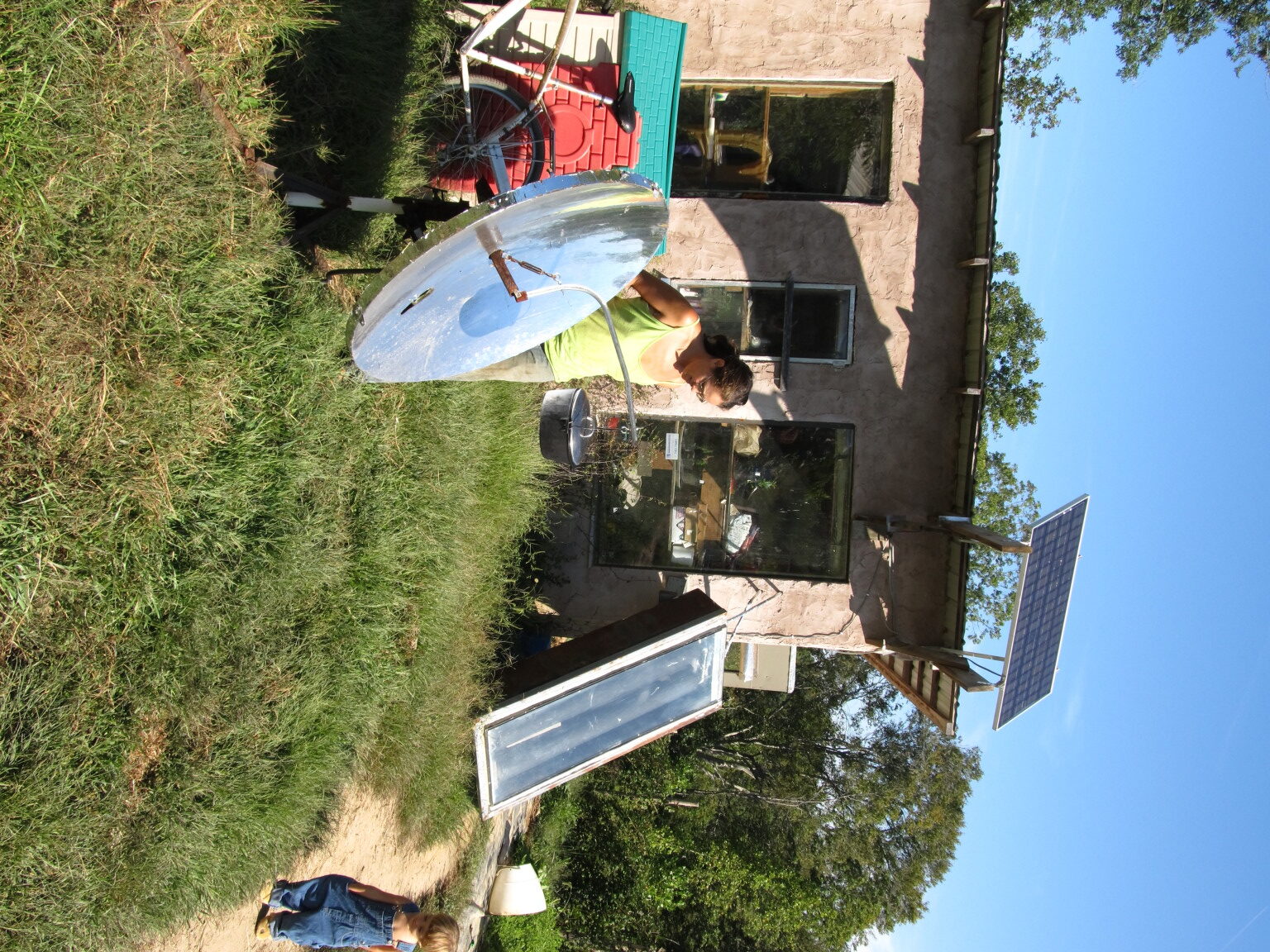
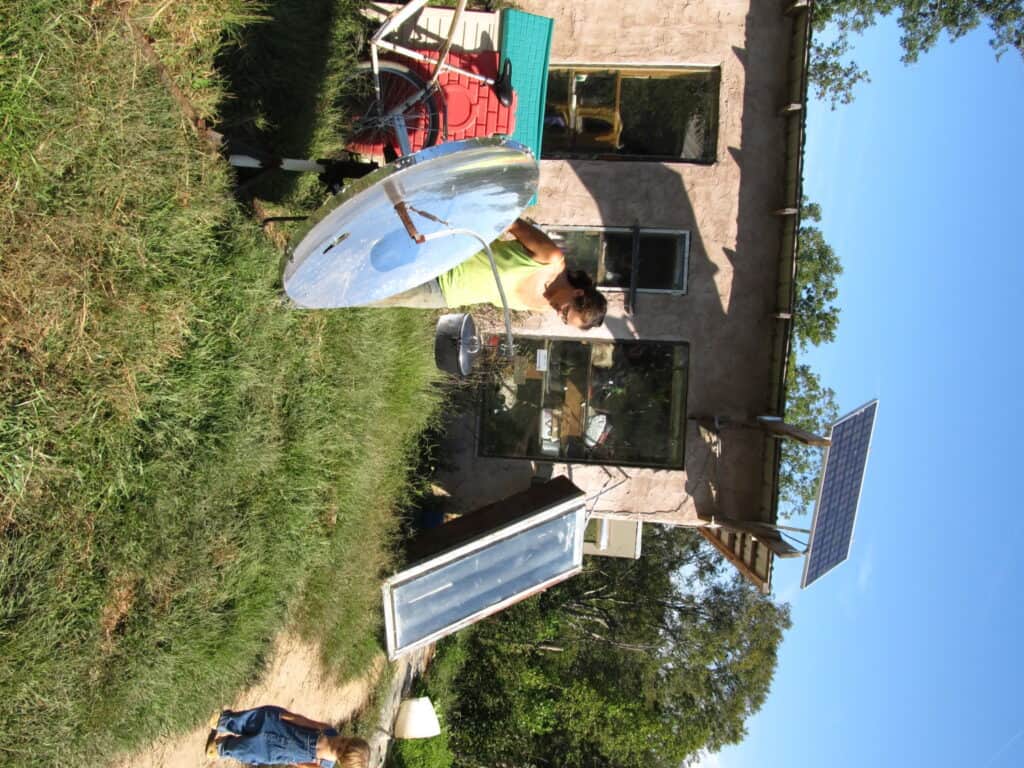
Person working on solar water heater at Living Energy Farm.

Living Energy Farm

  • Communities

About the Communities

  • Established
  • Ecological
  • Rural

Founding year

  • 2010

What we do

We are an intentional community farm and sustainable technology research, development and education center. We serve as a viable demonstration that a fulfilling life is possible without the use of fossil fuel. Our mission is to serve as an example and actively promote lifestyles and technologies that are truly sustainable, and to make these sustainable technologies accessible to all persons regardless of their income or social position.
We operate an organic farm that grows vegetable and also commercial grain seeds. We produce all of our own electricity in an integrated system we call a DC Microgrid, which emphasizes conservation, efficiency, and direct use of solar electricity. We are working to transition our tractors to run on biofuel, we use solar thermal to heat our homes and water, and we cook our food with biogas, solar and wood. We grow a large percentage of our own food, and preserve the harvest by drying and canning. Through our outreach programs, LEF teachs about the importance of sustainable technology in context, and about when and where such technologies are effective and when they are not. The most powerful sustainable “technology” we employ is cooperative living.

Our Mission

Living Energy Farm is an intentional off-the-grid community whose goal is to develop and promote sustainability technology for the health of the planet.

  • Purpose
  • Ecological
  • Community type
  • Coliving
  • Ecovillage
  • Sustainability practices
  • Renewable energy systems
  • Activities
  • Farming
  • Experiences
  • Networking
  • Services Business

Commemorative dates

  • January 1, 2010
  • Started planning
  • January 1, 2012
  • Started living together
  • 3 Total members
  • Open to new members
  • Open to visitors
Total
9

How to join

Those interested in contributing to our mission of building sustainable and self-determined communities are to email or call us to receive a questionnaire/application, and attend a community tour. If all goes well, we might decide to set up a membership visit. Membership visits may be arranged without a tour, if applicants are coming from a distance. Prospective membership visits are usually three weeks. Towards the end of the visit, we will arrange an interview between the visitor and the membership of LEF. After the visit, the applicant leaves the farm for usually at least one week, while both parties decide if they want to pursue provisional membership.

Basic expectations or agreements for members

E-mail or call us in advance if you want to visit.
DO NOT you drop in unannounced, and without our approval. If you are interested in applying for membership, we recommend that you come out for a tour first. We offer tours by appointment, arranged by email. If you are interested in membership but coming from a distance such that a day trip is not practical, contact us by email and we will send you an application/questionnaire

Primary decision-making authority

  • Small Leadership Group

A few people (not elected by the broader community) make the major decisions.

Decision-making process

  • Modified Consensus

Generally seek agreement, but have backup methods when consensus isn’t reached.

Governance structure

  • Collaborative/Horizontal

Power and responsibility are shared relatively equally among members.

Economic model

  • Partial Income-Sharing

Members contribute a percentage of income to community funds.

Economic scenarios for this community

  • Members need to pay fees, dues, or similar to live there on a per month or per year basis
  • There is a labor obligation

Additional economic information

Regular fees: Yes
Labor: Yes (30 hrs/week)
Our members are not required to share all their income, but all members contribute towards our communal expenses. Work done for a farm-based business may count towards a member’s expense share contribution, if approved by the manager of the farm business.

Shared resources and amenities that are accessible to everyone in the community

Common House, Garden(s), Vehicle Share, Workshop, Outbuilding(s), Outdoor Kitchen, Large Scale Kitchen, Tractor & Farm Equipment, Swingsets & play areas, Internet

Frequency of communal meals

  • Approximately all meals

Significant food acquisition practices

  • Locally sourced

Community activities and engagement

  • Volunteer, Internship, or Apprenticeship, or WWOOF’ing
  • Ethical Business, Investment Group, or Alternative Currency
  • Organization, Resource, or Network
  • WWOOF'ing, Guest Farming
  • Festivals, Conferences, Events

Substance use culture

  • Substance use occurs primarily at celebrations or ceremonies

Gender composition

  • Roughly balanced (no group over 60%)

Age demographics

  • Multi-generational (all ages well represented)

Property status

  • Privately owned

Property owner

  • By a Land Trust, Home Owners Association, or corporation

Setting

  • Rural

Countryside locations with significant distance from urban centers.

Community type

  • Coliving

    Shared living spaces with private bedrooms/bathrooms and communal
    kitchens, dining, and social areas.

  • Ecovillage

    Integrated communities designed around ecological principles with sustainable living practices.

Sustainability approach

  • Renewable energy systems

Self-produced energy

  • Over 66%

Energy sources used

  • Photovoltaic Solar
  • Biomass (from wood or other organic materials)

Self-produced food

  • 33 - 66%

Local, organic, or fair trade food

  • 33 - 66%

Food systems

  • Community garden
  • Land area size
    120 acres

Guest Book

Written reviews are available for plus members. Click here to upgrade.

Location

  • Virginia, United States

Living Energy Farm

Needs and Offers

Connecting people and communities through an intentional online marketplace

  • Promoted
Offer
  • Real Estate For Sale
1 week ago

Beautiful 3+ Bed, 2.5 Bath Townhome in Established West Emerald CoHousing, Seattle

A rare home is available at West Emerald Cohousing, an established all-ages intentional community in West Seattle. For those considering a move to the Pacific Northwest—or hoping to join a mature community rather than one still in the forming stages—West Emerald offers decades of community life, beautiful gardens, shared resources and a peaceful setting within the city in a convenient location since 1999. This unit has a unique floor plan that is ideal for co-buying, co-living, or for one household. The home itself offers a flexible 3+ bedroom, 2.5 bath layout: Garden-level room with a separate exterior entrance and half bath—ideal for a home office, studio, guest space or client-facing business Main-level bedroom and full bath, laundry, making one-level living possible Open great room with large windows overlooking gardens filled with birdsong Well-designed kitchen with generous storage and pantry Two additional light-filled spacious bedrooms and a full bath upstairs Thoughtfully maintained and updated Located at the end of a common pathway for added privacy and garden views, Just feet from parking, which is out of view West Emerald community amenities include: Common House with gathering and activity spaces Community meals and events Mature gardens and shared outdoor spaces Workshop/maker spaces and bike barn Exercise room EV charging opportunity Excellent Metro access to Downtown Seattle just minutes away Nestled into a dell, it’s Seattle’s best-kept secret South Seattle College and lifelong learning, NW Wine Academy, the Seattle Chinese Garden are nearby, with easy access to Alki Beach, Lincoln Park, magnet schools, ferries, and the shops and restaurants of the West Seattle Junction. 6000 17th Ave SW, Seattle, WA Is a wonderful opportunity to have your own comfortable, private home while becoming part of a vibrant and well-established Seattle all-ages cohousing community. For more information contact the friendly Realtor at 206-579-9066, or at ki**********@**********te.com who will be happy to meet you there or do a facetime tour.
  • Promoted
Offer
  • Communities with Openings
3 months ago

Do you feel called to help co-create a small, newly forming eco-spiritual community?

Old structures are crumbling. New ways of living are calling. We are answering that call. Wild Grace is an eco-spiritual community located in the Sierra foothills 30 minutes from Grass Valley, California. We recently completed new homes for those who feel called to our vision. Currently there are four of us living on this sacred 80 acres of land although we are a hub for an expanded neighborhood community. Many join us weekly for potlucks, expressive dance, Qi Gong, monthly musical gatherings, and seasonal celebrations in our temple, as well as tending to our orchard. We are excited to welcome others to join us on the land who are dedicating their lives to spiritual growth and ready to live in a more focused and intimate heart-centered lifestyle. Might that be you or someone you know? The fundamentals are simple. Spirit. We listen personally and collectively together most mornings, usually starting with a musical offering, a prayer, or a short reading, followed by about 40 minutes of what we call “sacred silence.” Heart Circles. About once a week we gather to share and listen. We are informed by authentic and compassionate communication practices. Nature. The land itself—an 80-acre oasis of field and forest perched above the wild and scenic South Yuba River—calls for our stewardship in the gardens, orchard, greenhouses, and general care. In turn, nature feeds us abundantly, both literally and spiritually. Interbeing. We join with others to share inspiration and connection as we host monthly gatherings of song, story and prayer that draws from the larger community in addition to other events we share with our closer neighbors. As we attend to these fundamentals, Grace flows to and through us—often in “Wild” or unexpected ways. Grace catalyzes through us, but is not something we possess. Because we all are connected, we feel that Grace actively transforms n
Offer
Offer
  • Professional Services
6 days ago

Community Planning, Facilitation & Coaching for Intentional Communities

Through Radicle Collective, I support intentional communities and the people within them as they navigate the practical and relational work of building life together. My work can include visioning and community planning, facilitated conversations and retreats, decision-making and governance design, conflict transformation, establishing group agreements, culture-building, and individual or group coaching. I work with communities at many stages – whether it’s a few people exploring whether to live together, a fledgling community developing its foundations, or an established community in transition or conflict. I draw from training in psychology, coaching, urban and regional planning, facilitation, Nonviolent Communication, permaculture, and related practices to approach community as a living system – one shaped by individual needs, relationships, shared structures, place, and the connections between them. Rather than bringing a single model for how community should work, I help groups understand what is happening across those different layers, surface what matters, work honestly with difference, and create structures and practices that support connection, agency, belonging, and the values that brought them together in the first place. I’m based in Berlin and available to work online or in person, depending on location and scope. I offer sliding-scale pricing and am open to creative forms of exchange where appropriate. If your community is forming, stuck, changing, or simply wants some skilled outside support for an important conversation, I’d be glad to explore what might be useful. You can learn more about my work and get in touch at radiclecollective.com.
Offer
Need
  • Communities with Openings
6 days ago

Looking for a family-friendly farm, cohousing, or intentional community

This might be a little hard to explain, but I’m going to try. I’m 28, Colombian-American, and I have a seven-year-old daughter. Our life is a little unconventional. I travel, my work is not a normal 9–5, and I’ve realized I don’t want to keep building our life around temporary housing, hired help, and having to recreate a support system everywhere we go. I keep wondering whether there is somewhere we could actually belong. Not necessarily an “intentional community” in the formal sense. It could be a farm, a group of families, cohousing, an intergenerational household, or something I don’t have the language for yet. What I want is for my daughter to grow up around people she really knows. Other children. Adults who become familiar and trusted over time. A place where people notice when someone needs help, where meals or childcare or work sometimes overlap naturally, and where community is more than everyone living near each other. And for myself, I want people I can actually think and build with. I care a lot about spirituality, inner work, land, education, caregiving, and learning how to live differently. But I also care about power and about whether the communities we create reproduce the same things we say we’re trying to get away from. I need to be around people who can acknowledge things like racism, class, gender and systemic inequality without becoming defensive or treating those conversations as inherently divisive. I’ve been developing some of my own thinking around all of this through a framework I call Conscious Colombia, Participating Wisely, and Contemporary Sādhana. A lot of it comes down to a question I keep returning to: how do we become people who can participate in community wisely, while also creating structures that remain accountable and open to correction? I don’t have a fixed location in mind and I’m not looking to rush into anything. I’m really just trying to find the people and places where this kind of life is already being attempted — imperfectly, seriously, in real life. If you’re building something like this, living in something like this, or even asking similar questions, I’d love to talk.

Update to a Public Profile

  • Log in
  • Go to your profile page
  • Toggle on the "Add my profile to the directory"
  • Save your profile

Information

Communities

A residential project: people live here as their primary home.

Organizations

An institution, business, network, or project that isn’t a residence (e.g. a learning center, farm, or network with no one living there full-time).

Plus Community Membership

  • Find people with Profile Match
  • Access to your community listing statistics
  • Create Discussion Groups
  • Access to our affiliate program
  • Member badge on your community profile
I am an official member of this community
Disclaimer
I affirm that my information is accurate and I am authorized to manage this listing
Foundation for Intentional Community FIC Member badge logo.

Free Plan

Free Membership
Free

Intentional Advertising

  • Subtotal

    {{ currencyFormat( pricing_summary.total_amount ) }}

Icon representing community connections and collaboration for intentional communities.

Plus Membership

We’re introducing new Plus features — including community reviews, Profile Match, and unlimited Needs & Offers posts — while keeping most of FIC free for everyone. Membership costs less than two coffees a month. 

  • Find communities with Profile Match
  • View detailed reviews about communities
  • Create free listings in Needs & Offers
  • Plus Member resources in CommUniversity
  • View communities detailed reviews
  • Plus Member badge on your profile