

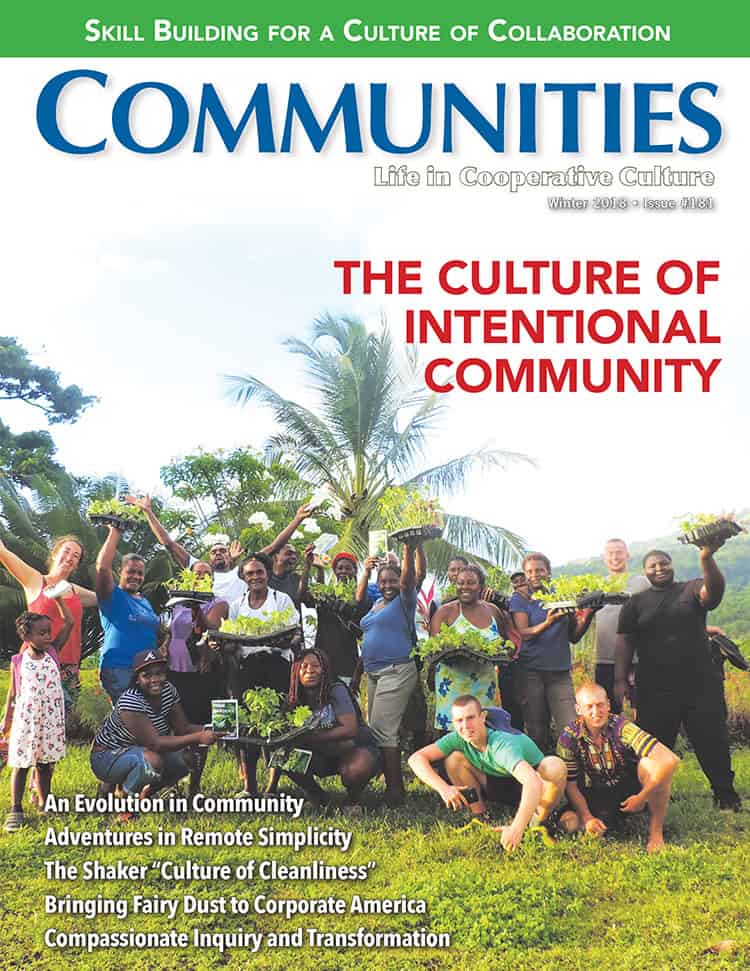
Excerpted from the Winter 2018 edition of Communities, “The Culture of Intentional Community”—full issue available for download (by voluntary donation) here.
As someone who has lived in intentional community for the past four decades, I long ago became aware of a feeling of comfort and familiarity when I interact with other communitarians. I live in a secular, non-income sharing, rural community, but I get the same feeling when I am with cohousers, income sharing folks, urban communitarians, or spiritual community members.
I am also comfortable in our larger society as I have worked both at community-run businesses and as an employee in private and nonprofit companies, venture out into the larger world on a regular basis to shop, attend cultural events, go to restaurants, visit family and old and new friends and acquaintances, travel, and live uncloistered in central rural Virginia. But the experience of being with other communitarians has a different quality and ease of interaction.
My intuitive explanation for this is that there is a shared culture amongst communitarians of all sorts. I can define what this is and how it expresses itself, but I generally find that greater credibility is obtained by citing an “expert,” even if said expert uses the same language I would have. In this case I will quote Bill Moyers, a well known, long-term reporter, investigative journalist, contemporary observer and philosopher, and discerning commentator on current events and larger issues of our times. Amongst his many accomplishments, he was a key figure in the early days of the Peace Corps. In his 2008 book, Moyers on Democracy, he offers the following: “the Peace Corps is more than a program or mission. It is a way of being in the world”—one which values “the culture and customs that gave meaning to a particular life.” (Italics in the original.)
What is this way of being in the world that creates a cultural bond and sense of the familiar between myself and others who live in intentional community? I think that the various articles in this issue will expose the key elements in the telling of the stories. The essential factor is the dedication to creating a cooperative society. Note the references to cooperative, collective effort; the value of interpersonal relationship; communication; and collaborative decision-making.
As we look to the long history of exports to the larger society of innovations emanating from community, there would be none more significant than spreading a culture of cooperation.
Marty Klaif is a member of the FIC’s Board of Directors, Oversight Committee, and Editorial Review Board, and is also the liaison between the Communities staff and the FIC Board. He has lived at Shannon Farm community for the past 17 years. His article “A Day in the Life” appears on pages 14-16 of this issue.
● ● ●
Magazine News
“The Culture of Intentional Community” marks the fourth consecutive issue available for digital download free or by donation—an initiative that started with our “Class, Race, and Privilege” issue, #178. We thank everyone who has helped spread the word and increase the readership and impact of Communities. Please let others know that they, too, can find the magazine, in whichever format they prefer, at ic.org.
We also need monetary support to continue this model (and to publish at all). We very much appreciate your subscriptions, gift subscriptions, book orders, back issue orders, advertisements in the magazine and online, and donations. Your dollars sent to the FIC to publish Communities and undertake aligned projects have an outsize impact on our budget compared to most other places you could spend that money—and make possible our work to foster more cooperation, community, and long-term well-being for people and planet.
Issue sponsorships have helped the magazine survive over the past decade; please contact us if you are interested in supporting or partnering with us to publish an issue on a specific theme. For the current issue, we want to express our gratitude to Marty Klaif, who not only suggested the theme but also secured funding to support it. Thank you Marty!
—Chris Roth
Excerpted from the Winter 2018 edition of Communities, “The Culture of Intentional Community”—full issue available for download (by voluntary donation) here.
Keep the conversation going with these pieces
There are no available blogs
Subscribe to our newsletter for fresh stories and community updates delivered to your inbox.
Get unlimited access to courses, exclusive member events, and a supportive network of community builders
Access all courses, books, and premium content
Member-only workshops and community builders
Member-only workshops and gatherings
We use cookies to improve your experience on our site. By using our site, you consent to cookies.
Manage your cookie preferences below:
Essential cookies enable basic functions and are necessary for the proper function of the website.
These cookies are needed for adding comments on this website.
Statistics cookies collect information anonymously. This information helps us understand how visitors use our website.
Service URL: policies.google.com (opens in a new window)
A residential project: people live here as their primary home.
An institution, business, network, or project that isn’t a residence (e.g. a learning center, farm, or network with no one living there full-time).

{{ item.label }}
{{ item.value ? item.value : currencyFormat( item.amount ) }}
Subtotal
{{ currencyFormat( pricing_summary.total_amount ) }}
There are no results matching your search


