

A Deeper Look
Communities Movement Research
By Ma’ikwe Ludwig, FIC Development Director (and Junior Researcher)
I’ve been looking at data again. I’ve done this on again off again for the past few years for the various nonprofits I work with, but this data is way more fun than, say, budget numbers. This data is the stuff generated earlier this year by you all, for a survey about what is working in our communities.
Welcome to a short research report from the field! A number of FIC staff, board and volunteers have spent the last two weeks at various conferences and meetings, including the National Cohousing Conference. FIC Board member Betsy Morris was part of a panel at the conference of Cohousing Research Network that presented some of their findings. Check out this amazing panel:
These papers and more are featured on the Cohousing Research Network’s bibliography page. Dr. Boyer offered this summary of the overall research presented by several parties: “cohousing residents are politically active, tend to be liberal, majority female, and aging quickly. Other research documents how the interest in cohousing nationwide is much broader than the actual constituency of the movement. Whereas cohousing residents fit a narrow demographic profile (white, highly educated, female, middle-class), when described on a survey, cohousing appeals to people irrespective of education or gender, and appeals more to lower-income individuals than middle- or high-income individuals.”
One of the most impressive things about the research scene right now is just how many universities and professors (as well as some free-lancing researchers not currently housed in academia) have taken a keen interest in cooperative living recently. You can also find a growing body of less academic writing by some people with impeccable academic credentials, such as this blog series by Dr. David Sloan-Wilson of Binghamton University.
I mentioned in another recent enews that there were a couple major international studies done in the past few years, and Dr. Sloan-Wilson was one of the lead authors, along with BJorn Grinde, Ragnild Bang Nes and Ian MacDonald, who recently published Quality of Life in Intentional Communities in the peer reviewed Social Indicators Research.
And then look for a long article in the fall issue of Communities magazine from Zach Rubin and Don Willis (of the University of Missouri) and myself with the results of our survey. We were delighted to get 301 responses from communities listed in the Directory, providing us with a large enough data-set to be able to start discerning patterns of what works well to create a satisfying experience of living together.
A couple of surprising tidbits from our research: turns out that how selective groups are in their membership process has nothing to do with how satisfied the residents are with their communities. However, several things do matter. One of the more interesting is that income sharing groups report a higher level of satisfaction with their communities. Who knew? Sharing more apparently leads to more satisfaction.
And that’s one of the main lessons of community, isn’t it?
Help support our ongoing efforts to document life in community. Please make a donation today!
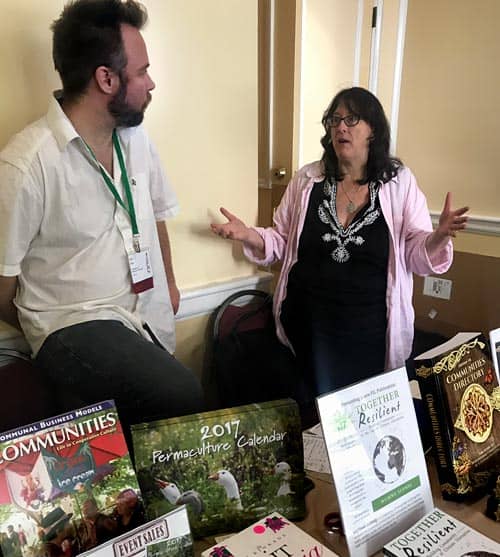
FIC Executive Director, Sky Blue, and Board member, Betsy Morris
Talking shop (and selling books) at the recent National Cohousing Meeting.
Keep the conversation going with these pieces
There are no available blogs
Subscribe to our newsletter for fresh stories and community updates delivered to your inbox.
Get unlimited access to courses, exclusive member events, and a supportive network of community builders
Access all courses, books, and premium content
Member-only workshops and community builders
Member-only workshops and gatherings
We use cookies to improve your experience on our site. By using our site, you consent to cookies.
Manage your cookie preferences below:
Essential cookies enable basic functions and are necessary for the proper function of the website.
These cookies are needed for adding comments on this website.
Statistics cookies collect information anonymously. This information helps us understand how visitors use our website.
Service URL: policies.google.com (opens in a new window)
A residential project: people live here as their primary home.
An institution, business, network, or project that isn’t a residence (e.g. a learning center, farm, or network with no one living there full-time).

{{ item.label }}
{{ item.value ? item.value : currencyFormat( item.amount ) }}
Subtotal
{{ currencyFormat( pricing_summary.total_amount ) }}
There are no results matching your search


