
Written by: Cynthia Tina
—
How can we steward a more sustainable and regenerative future for North America?
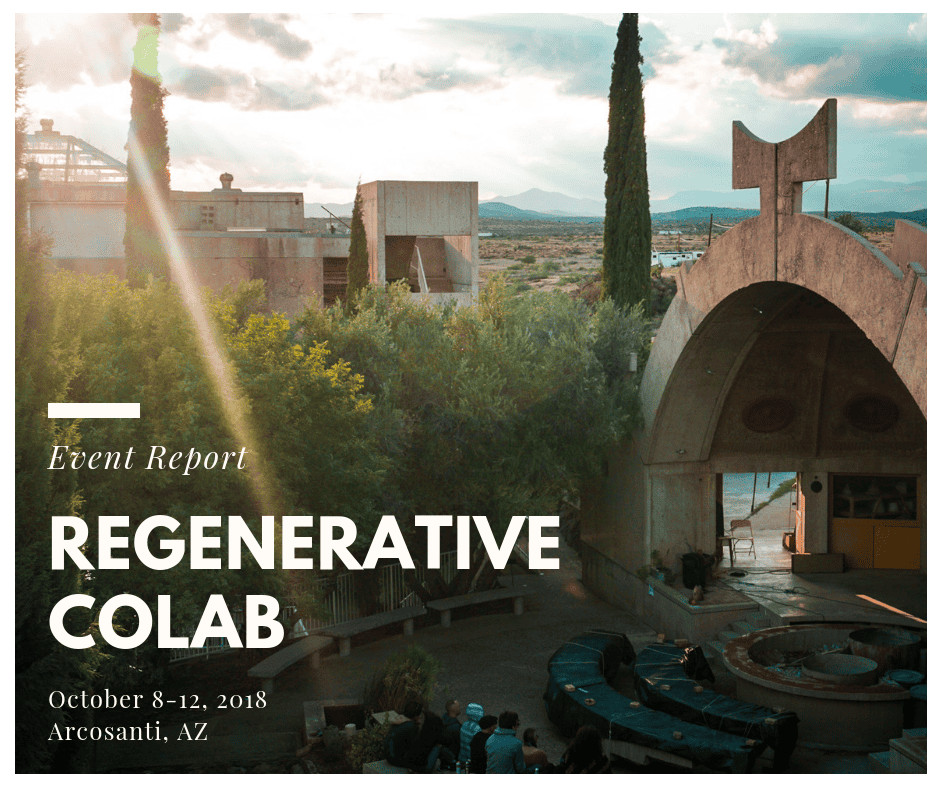
This was the central inquiry during a three day event called the Regenerative CoLab. Nearly 50 visionaries, activists, and organizers gathered in early October at Arcosanti, the legendary urban laboratory in the desert of Arizona, US. The stunning arches, stairways, and amphitheater of Arcosanti fueled an atmosphere of inspiring creativity during the CoLab days.
The CoLab (collaborative laboratory) was produced by a team within GENNA Alliance, an emerging network of individuals and organizations dedicated to strengthening the regenerative communities movement in the US and Canada. GENNA Alliance serves as the North American Region of the Global Ecovillage Network (GEN).
Current partner organizations include: GEN-US, GEN-Canada, NextGENNA, VillageLab, Foundation for Intentional Community, and NuMundo. The CoLab was produced in partnership with the Arco Cooperative and took place immediately following the Arcosanti Convergence, building on the momentum of an extraordinary sustainability, music and arts festival.
As a member of the CoLab production team, I had been eager to return to Arcosanti since hosting our GENNA Alliance retreat there in 2017. During the 2017 meeting, participants collectively wrote the following vision statement describing the world we seek to create:
“We envision a world of interdependent cooperative communities stewarding the conditions of regeneration, justice, equitability, peace and abundance, in order to realize the full potential of flourishing for all life, for all generations to come.”
That vision was the driving inspiration for the Regenerative CoLab. Unlike past GENNA Alliance retreats, we invited a large number of values aligned organizations and leaders to join our 2018 gathering. We feel ready to widen and strengthen our network, while exploring new collaborations to help realize the above vision statement.
The CoLab had little in the way of pre-set agenda. Instead, we relied on lean and adaptive structures to maximize the collective intelligence of participants. We transformed one of the walls of our meeting room into a huge grid to serve as the schedule. Borrowing tools from Open Space Technology, participants pinned cards to the times and spaces where they wanted to host sessions.
The wall became an on-going hub for conversation, as collaborators considered how to construct the puzzle of our time together in ways that met the goals of those present and respected what was emerging in the space.
Morning plenary sessions featured community building activities, presentations, and announcements. Harvest sessions took place every afternoon before dinner to collect reflections from the day and track the evolution of sessions. Evening programming focused on ceremony and celebration.
For example, the second night was a “passion share” with an open floor for anyone to tell a vulnerable story, present on their life’s work, sing a song, you name it! The openness of our structure allowed for the unexpected. At the same time, a list of co-created group agreements guided the conduct of how we work and play together.
The few pre-scheduled sessions during the CoLab were focused working group meetings to move forward projects in GENNA Alliance. Project areas included: a consultancy group, education and media programs, events, wealth generation, data sharing, and mapping.
I’ll share about one project. For example, we are exploring how to create a unified map of regenerative communities. We can better understand the landscape of the regenerative movement and create a powerful organizing tool by bringing together the data of existing project maps. The challenge is to do so while respecting the sovereignty of data owners and ensuring trust amongst organizations that curate the information.
How can we be as elegant as the bees and butterflies, sharing information and pollinating our projects?
Biological metaphors suffused CoLab conversations.
Who are the tall canopy trees in our forest, providing shelter for the newer saplings below? How can we support them in releasing vital nutrients as they compost on the forest floor?
CoLab attendance was richly multi-generational. It was beautiful to witness the diversity in age, with participants in their early-20s working alongside those in their late-70s and older.
At the same time, we recognized the many voices of our shared ecosystem that were missing during the gathering. We spoke about the critical need for more diversity at future gatherings and in our regenerative movement as a whole.
Can we grow our network like the mycelium, linking all the edges of our forest? How do we address invasive species?
Transparency was a central commitment of the CoLab production and facilitation team. We didn’t have all the answers. We didn’t know what was going to happen. We shared whatever information was available, particularly around finances.
Thanks to funding from the Global Ecovillage Network through Gaia Trust, we were able to provide full or partial scholarships to 30 participants. Unfortunately, the event did not cover base costs from its ticket sales, despite us filling the venue to capacity. The organizing team was entirely volunteer, placing the importance of affordability even above subsiding our own expenses. This wasn’t a sustainable model. And, we are committed to solving the perpetual problem in our movement as to how to make our gatherings accessible to the widest range of attendance while also fairly compensating people for their contributions.
So what did we accomplish through all this effort? Did we find a way to steward a more regenerative future for North America? Was the event a success?
On the last day of the CoLab we took our ecosystem analogies to the next-level. We played with the permaculture framework of zones and sectors to graph the commitments of participants. Drawing concentric circles on a big wall, we considered these our zones of scaling levels of interest to continue collaborating (from 0-4).
Dividing the circles into eight slices like a pizza pie, these became the eight sectors of engagement (project areas) currently in the Alliance. Each person wrote his or her name in the sectors and zones of choice.
The result was a snapshot of our collaborative potential.
The potential is massive.
Maybe we didn’t need a CoLab to tell us that. But we did need a CoLab to build the authentic relationships at the heart of any thriving network. The depth of connection and alignment of intention we generated have value on their own, regardless of what happens next.
At the same time, the success of the CoLab is an unfolding story. It will depend on how we continue to show up for each other as a network in the coming weeks and months. Will we rise to meet our potential?
The Regenerative CoLab was a three day event. Yet the collaborative laboratory is a spirit we can bring to all our relationships. The regenerative future we wish to see starts with each of us embodying it’s principles and values. We modeled that during the CoLab. We created a pocket of time in which the future dream was brought into present moment. It wasn’t perfect, but we talked about what was and wasn’t working.
We had the great opportunity and privilege to question and challenge, with consent and respect, trusting each other’s good intentions. As a healthy ecosystem does – celebrating in the sun and embracing each storm.
—–
To learn more about the GENNA Alliance visit www.ecovillage.org/genna or get in touch with us at ge***@********ge.org. Your donation would be most appreciated to support the CoLab and Alliance projects by giving via PayPal to fi*@**.org or on the Donate page (note CoLab).
Keep the conversation going with these pieces
There are no available blogs
Subscribe to our newsletter for fresh stories and community updates delivered to your inbox.
Get unlimited access to courses, exclusive member events, and a supportive network of community builders
Access all courses, books, and premium content
Member-only workshops and community builders
Member-only workshops and gatherings
We use cookies to improve your experience on our site. By using our site, you consent to cookies.
Manage your cookie preferences below:
Essential cookies enable basic functions and are necessary for the proper function of the website.
These cookies are needed for adding comments on this website.
Statistics cookies collect information anonymously. This information helps us understand how visitors use our website.
Service URL: policies.google.com (opens in a new window)
A residential project: people live here as their primary home.
An institution, business, network, or project that isn’t a residence (e.g. a learning center, farm, or network with no one living there full-time).
{{ item.label }}
{{ item.value ? item.value : currencyFormat( item.amount ) }}
Subtotal
{{ currencyFormat( pricing_summary.total_amount ) }}
There are no results matching your search