

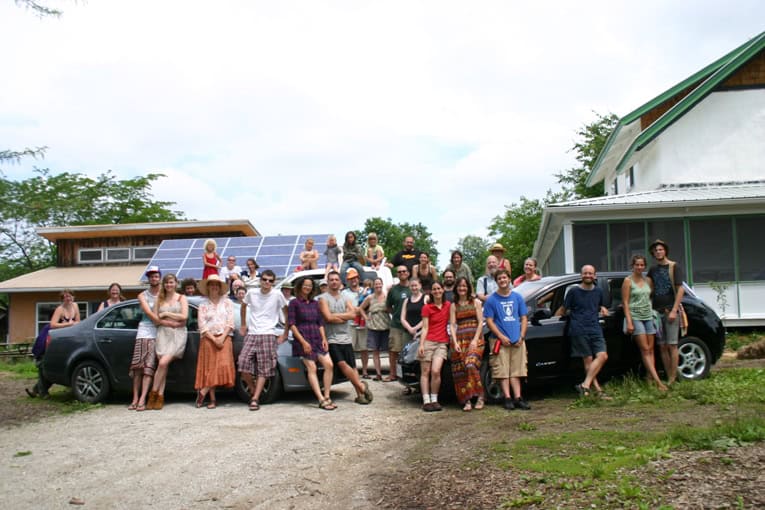
If you have been involved in the communities movement for a while, you’ve probably heard of local currencies and you might even talk positively about how they help support local businesses and local trade. However, when it comes to providing specific benefits to local businesses that can actually be measured, you probably don’t have much tangible proof to back up these claims. Sadly, most local currencies couldn’t pique the interest of your local pizza joint, much less your local chamber of commerce. Dancing Rabbit Ecovillage (www.dancingrabbit.org), one of several neighboring communities outside Rutledge, Missouri, is in a great position to change this and help spark a wave of small business interest in local currencies throughout the country.
I know, I’m making a bold claim, but it isn’t fluff. It is backed with solid numbers that I’ll share with you in a bit, but first let me tell you a little bit about our currency.
How does Dancing Rabbit Ecovillage’s alternative currency work?
The Exchange Local Money System (ELM for short) is Dancing Rabbit’s all digital local currency (www.dancingrabbit.org/about-dancing-rabbit-ecovillage/social-change/economy/local-currency). It runs on the open source software Local Exchange developed by Calvin Priest (sourceforge.net/projects/local-exchange). The currency itself is denominated in “ELMs.” With a one-to-one exchange rate with the dollar and a simple online interface, it is similar to Paypal and more convenient to use than writing checks or dealing with cash.
How successful is the ELM compared to other local currencies?
Due primarily to its ease of use, the ELM has become the preferred currency for the members of our community. In fact, as of December 2013, the ELM System had $94,075.07 worth of currency in circulation. How does this compare to other successful local currencies?
Two of the best known in the US are Ithaca Hours of Ithaca, New York and BerkShares of Berkshire, Massachusetts.
Ithaca Hours: “Since 1991, $110,000 of Ithaca HOURS, worth $10 each, have been issued and used by thousands of residents, including 500 businesses and over 100 community organizations, adding millions of dollars of trading to Ithaca’s Grassroots Local Product.” (See www.paulglover.org/currencybook.html.)
BerkShares: “The popularity of BerkShares has ebbed and flowed, but with about $130,000 worth of notes currently in circulation, the number of businesses accepting the currency has jumped to about 400 from the 100 that initially participated in 2006.” (See www.berkshares.org/Video/PBSnewshour.htm.)
In this context, having $94K in circulation makes the ELM System one of the biggest local currencies in the United States. This is a powerful accomplishment for a local currency that is accepted only by 29 businesses, nonprofits, co-ops, and community groups in rural northeast Missouri.
How has the ELM system become so successful with a small user base?
How is it possible that the ELM System has put almost as much money in circulation as two other local currencies that boast of having over 13 times as many businesses and community organizations accepting their currencies?
The answer is simple: depth of penetration. While Ithaca Hours and BerkShares have a very broad level of participation, the portion of trade conducted using these currencies in their respective regions is tiny relative to the amount of trade conducted using dollars. This is not the case for the ELM System, as we currently average over $65,000 worth of transactions per month. By my estimates this represents between 70 and 90 percent of all the financial exchanges that are taking place in the local area in which the ELM circulates.
Pizza and Beer that can be purchased with ELMs at the Milkweed Mercantile. Photo Credit: Milkweed MercantileThis depth of penetration is possible because we can pay for everything at Dancing Rabbit using ELMs, including rent, food, transportation, and childcare. Even our local pizza joint (milkweedmercantile.com/cafe) accepts ELMs! In fact, for the last three years I’ve spent only ELMs within Dancing Rabbit for all my local expenses. Plus, Dancing Rabbit’s neighboring communities Sandhill Farm (www.sandhillfarm.org) and Red Earth Farms (www.redearthfarms.org) use the currency heavily, and in the last couple of years local neighbors to these three communities are starting to use the currency as well.
EcovillageEducation.us students & organizers. Photo Credits: EcovillageEducation.usTo top it all off, the Foundation for Intentional Community itself just accepted its first payment in ELMs in December of 2013 when a member of Dancing Rabbit gave a $2,000 restricted donation via ELMs to support EcovillageEducation.us. (This donation was given to the FIC because it was the fiscal sponsor for EcovillageEducation.us in 2013.) This is a rather fitting development because earlier in 2013 the EcovillageEducation.us program provided a huge boost to the ELM economy when it exchanged $19,619.08 of US currency into ELMs. (As a side note, this represented a full 72 percent of all the money spent by EcovillageEducation.us for the year.)
The ELM didn’t achieve this depth of penetration all at once. In fact, in 2007 when our currency went all digital and took its current form, we had only two transactions conducted online in the first month for a total value of only $10. As you might imagine, it took lots of effort to build trust and use of the currency, but with lots of persistence it finally caught on.
Why should small businesses care about the local currency?
Now, how is all of this going to get the attention of your local pizza joint, much less the chamber of commerce in your own town? Furthermore, how is this going to spark interest in local currencies from small businesses all across the country?
ELM Financing As Of June 14, 2014. Photo Credit: Dancing Rabbit EcovillageThe part of the ELM System your town’s chamber and businesses will care about is its ability to provide interest-free capital financing to our local organizations. At the time of writing this article, our ELM System is providing $49,940 worth of interest-free financing to seven of the local co-ops, businesses, and nonprofits that accept the currency. In fact, a large chunk of this financing was made possible in no small part because of the previously mentioned $19K from the EcovillageEducation.us program. Just a few short months after these US dollars came flowing into the ELM economy, we sent that money right back out to work in the community by extending a similar amount of interest-free ELM financing to Dancing Rabbit’s Vehicle Co-op (www.dancingrabbit.org/about-dancing-rabbit-ecovillage/social-change/function/co-ops/dancing-rabbit-vehicle-co-op). This financing eliminated the vehicle co-op’s interest-bearing loans and resulted in a savings of $2,000 over the next five years. Expand this sort of savings across all the financing that the ELM System has provided so far, and the savings on interest payments adds up to $13,797.50 over five years. In reality our actual interest savings isn’t this high yet because most of our organizations are not fully utilizing the financing that’s been provided to them, but the opportunity is there.
$13K is a notable cost reduction in interest payments. Maybe it is even enough to get your local pizza joint interested, but likely not enough to excite your chamber of commerce, and it certainly isn’t going to spark a local currency revolution.
Don’t worry, it gets better, a lot better…
From 2007 to 2012 the ELM System doubled in size every two years. In case you don’t understand exponential growth, this is fast, really fast! In fact, it is as fast as the computer industry. (See en.wikipedia.org/wiki/Moore’s_law.)
With this last statistic, I bet the members of your chamber of commerce are raising their eyebrows, but there’s more…
In 2013 the ELM system doubled in size in just under a year. Yep, that’s right. Last year the ELM system grew twice the speed of the computer industry, and with it so did the amount of interest-free financing that we can provide to our local organizations. This is possible only because of the depth of penetration that we’ve achieved with our currency. This is something that can happen with any local currency that follows the lessons learned from Dancing Rabbit’s experience. (See en-na.ecovillage.org/ena-dancing-rabbits-successful-local-currency.)
Do you think your local chamber of commerce will want to learn how they can help the small businesses in your town to acquire interest-free financing that grows at a faster rate than the computer industry? I think so!
Do you think the success of Dancing Rabbit’s currency could spark a wave of interest from small businesses all across the country? It could, but only if they know about it. Please share this article with the small business owners in your town. Better yet, share it with your local chamber of commerce. Help make local currencies a central part of this country’s economy so we can provide critical financing to the small businesses that keep our communities connected and thriving at a local level.
Nathan Mackenzie Brown is the Secretary of Exchange Local Money System and he has lived at Dancing Rabbit Ecovillage since 2005. Nathan is a professional online business consultant who prides himself in his ability to work an average of 15 hours a week while donating half of his adjusted gross income to worthy causes. In addition to being the Secretary for the ELM System, Nathan is an Executive for Dancing Rabbit’s Cattail Cooperative, he’s a founding member of Dancing Rabbit’s Men’s Group, and he loves to play Ultimate Frisbee when it is warm and to go sledding and play broomball in winter.
Keep the conversation going with these pieces
There are no available blogs
Subscribe to our newsletter for fresh stories and community updates delivered to your inbox.
Get unlimited access to courses, exclusive member events, and a supportive network of community builders
Access all courses, books, and premium content
Member-only workshops and community builders
Member-only workshops and gatherings
We use cookies to improve your experience on our site. By using our site, you consent to cookies.
Manage your cookie preferences below:
Essential cookies enable basic functions and are necessary for the proper function of the website.
These cookies are needed for adding comments on this website.
Statistics cookies collect information anonymously. This information helps us understand how visitors use our website.
Service URL: policies.google.com (opens in a new window)
A residential project: people live here as their primary home.
An institution, business, network, or project that isn’t a residence (e.g. a learning center, farm, or network with no one living there full-time).

{{ item.label }}
{{ item.value ? item.value : currencyFormat( item.amount ) }}
Subtotal
{{ currencyFormat( pricing_summary.total_amount ) }}
There are no results matching your search


