
Somewhere along the way, the West decided that two adults and four walls was a sufficient container for raising a human being. It wasn’t always like this, and it isn’t like this everywhere. Anthropologists call it alloparenting, the ancient and widespread practice of children being held, fed, taught and loved by many adults, not only their biological parents. Among the Efe and Aka peoples of Central Africa, multiple non-parental caregivers handle infants as a matter of course, not exception. For most of human history, in most of the world, a child’s world was populated by aunts and grandparents and neighbours and older children who were themselves being raised by the same extended web. In other words, a village. The nuclear family of two people, isolated to a degree and entirely responsible, is a historical anomaly. And most parents today feel it, even if they can’t quite name it. They feel it in the desperate gratitude for a grandparent who shows up regularly, in the WhatsApp group of school parents that quietly becomes something more, in the relief of a trusted friend who simply knows their child.
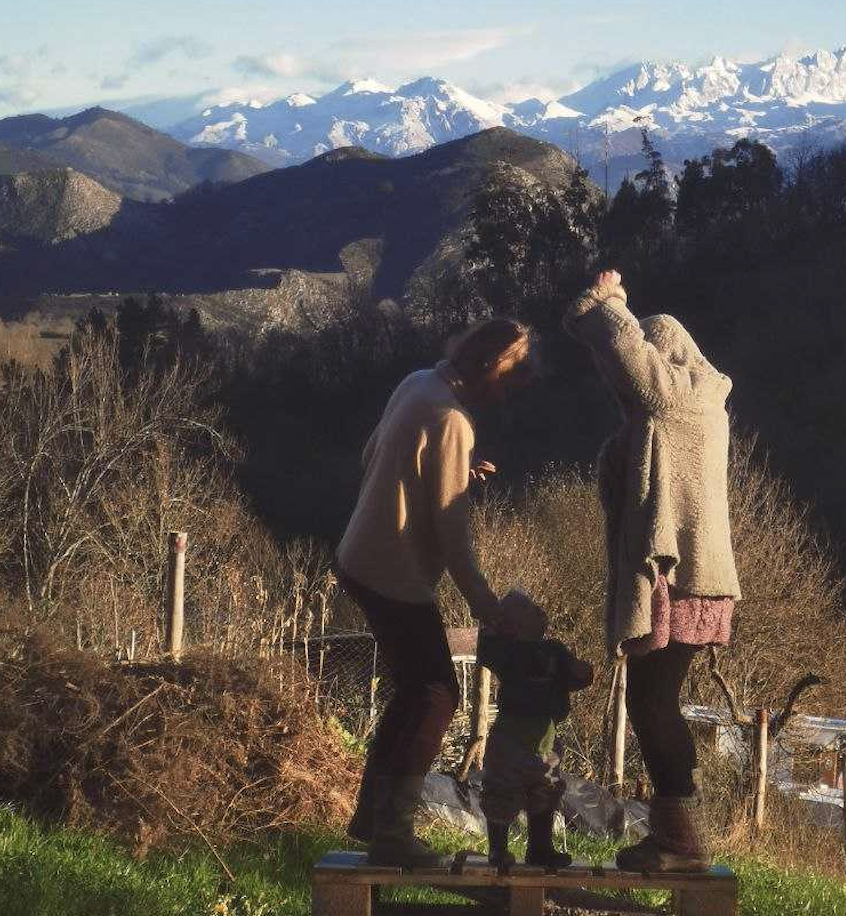
I am co-founding an intentional community in Asturias, and my daughter is growing up inside the experiment. People sometimes ask what it is like – no doubt imagining something idyllic: a child running barefoot through the forest, learning the names of plants, swimming in rivers, surrounded by the beauty of the natural world. And while those things are true, and wonderful, they are not the point. You can walk through a forest with your child from anywhere (and I recommend it). Swimming in the river doesn’t require living in a community.
People who know her not as a weekend visitor or a niece, but as a member of their household, someone whose moods and rhythms they recognise on a Tuesday morning. People who will, over the years, teach her things I cannot: different skills, different temperaments, different ways of being in the world. Frédéric Laloux, who has written beautifully about raising children in intentional community, describes this as being wired for something we have been culturally talked out of — that restlessness and anxiety rises in children denied the freedom to roam and belong among a wider group, while parents quietly drown under a weight they were never meant to carry alone.
What I didn’t expect is what the co-parenting has done to us as co-founders. There is an intimacy that comes from someone truly knowing your child that no shared vision or governance process ever quite produced. She has become, without anyone planning it, one of our strongest bonds — even as we argue about whether raising children and raising an abandoned village can really happen at the same time.
Yana Ludwig, whose decades of experience in intentional communities have made her one of the movement’s clearest thinkers, observes in her book Building Belonging that communities routinely find themselves in conflict over children precisely because parenting is one of the areas we have been told by our culture is our “personal business.” We carry deeply held, often unexamined beliefs about how children should be raised, and suddenly we are living next to people who hold different ones. Bedtimes. Screen time. Boundaries. Tone of voice. Discipline. All the invisible architecture of how we were raised, and how we swore we would or wouldn’t do it differently. Bringing these into the open is uncomfortable, painful and intimate. It is also, I would argue, one of the most quietly radical things community can offer: the chance to make conscious what was unconscious, to choose together rather than assume apart. We have the opportunity to turn back this cultural anomaly that has emerged.
Because how we raise children is not personal business, in the end. It is cultural transmission. Every value a child absorbs (cooperation, conflict, care for the land, how we treat people different from ourselves) comes from the environment they are immersed in daily. Intentional communities, at their best, are environments that have chosen their values deliberately. Children raised inside them are not just receiving an alternative childhood, they are being shaped by an alternative culture. They are growing up knowing that decisions are made together, and hopefully that they affect more than those making them. That many kinds of people can be trusted, that land is something you tend rather than extract from, that care is not a private transaction but a communal practice. This is not a small thing to pass on. This might, in the end, be the most important thing we are building — not the houses, not the governance systems, not even the relationships, as precious as those are. But the humans who will carry a different story forward, because they lived it first.
Eva Goldfarb is the Community Engagement Coordinator for the Foundation for Intentional Community. For more information, visit her profile.
Keep the conversation going with these pieces
There are no available blogs
Subscribe to our newsletter for fresh stories and community updates delivered to your inbox.
Get unlimited access to courses, exclusive member events, and a supportive network of community builders
Access all courses, books, and premium content
Member-only workshops and community builders
Member-only workshops and gatherings
We use cookies to improve your experience on our site. By using our site, you consent to cookies.
Manage your cookie preferences below:
Essential cookies enable basic functions and are necessary for the proper function of the website.
These cookies are needed for adding comments on this website.
Statistics cookies collect information anonymously. This information helps us understand how visitors use our website.
Service URL: policies.google.com (opens in a new window)
A residential project: people live here as their primary home.
An institution, business, network, or project that isn’t a residence (e.g. a learning center, farm, or network with no one living there full-time).

{{ item.label }}
{{ item.value ? item.value : currencyFormat( item.amount ) }}
Subtotal
{{ currencyFormat( pricing_summary.total_amount ) }}
There are no results matching your search


