

Excerpted from the Spring 2019 edition of Communities, “Community Land”—full issue available for download (by voluntary donation) here.
For Darryl, Kate, Cassandra, and Jerry
When Herb, my husband of many decades, died almost four years ago, I was left with an inheritance just gracious enough to realize a lifelong ambition to buy a farm in order to give it away. That is, I have dreamed of removing land from the speculative market economy and putting it into the public trust in order to challenge our assumptions about what is called “private property.” The idea of owning pieces of the earth and doing with it whatever we pleased seemed crazy to me. I didn’t believe in it for a minute, so this windfall of discretionary money could be just the ticket to challenge it.
Our family home in Berkeley, California, where Herb and I lived our whole adult lives and raised our three children, is a funky brown-shingle house that we bought in the 1960s for $28,000 and is now worth millions in the current marketplace, meaning that most young families, such as we once were, could not afford to live here.
Frankly, that gives me a stomach ache.
So I wished to model something different with the money I’d been left, and help create an affordable, not-for-profit example of diverse community on protected land in perpetuity. As an artist and healer with little savvy about finance, I had no idea how to even begin.
It happened then that Eden, a young student of mine who lived in Sonoma County and could not find anything affordable to rent there, told me about a small farm in her area that was up for sale, and was I interested? Sure, I replied, but next year, maybe, after I’ve gotten through this first year of grieving and had my life put back together. The last thing I needed at that moment was a real estate deal!
But the farm was up for sale then, and Eden and other friends in the area needed housing they could afford then, and the seller, hoping to sell to visionary folks who would use that land well, was selling low—then. It was now or never. I seemed to have no choice but to go for it, so with my heart in my mouth, I did, figuring that if not now, then when?; if not me, then who?
That’s when the magic started happening; I learned that Darryl and Sara, old friends from years before, were also seeking housing they could afford in the area, so with them and Eden and her boyfriend Dan I had a ready-made community happy to move in as soon as possible. Sara is one of my favorite gardeners, Darryl is an alternative builder interested in affordable cooperative housing, and they were as enthusiastic to help found a Trust as I was. So the stage was set and in short order we were ready to go!
That is, they were ready to go; I was still in deep mourning and really not ready to go anywhere. I needed time to grieve. But the world was in a hurry and I seemed to have no choice. Really, I had little idea what in the world I was getting into!
Aside from all the legal details and hidden costs, the inspections and the taxes and the infinite paperwork, I had not begun to imagine that I would now be defined in people’s minds as a “landowner.” One person saw an opportunity to take advantage of the “rich widow,” nearly breaking me in the process; to others, I was regarded as a “white privileged lady”; some became shy, some fawning. I was now considered almost a different species from ordinary folks.
Yikes!
I was still very vulnerable—way too shaky to have to fight off sharks—and I considered just dropping the whole thing and letting the guy who wanted to use it as speculation just have it. But then I got mad. NO! I was on my own now, and would stand up for myself. So I put up my dukes and fought—and, in the end, won the day. The sweet little farm on a lane in the floodplain of the Laguna Santa Rosa, with horses nearby and badger holes in the field, with its creek bordered by big old trees, with its old barn and sweet farmhouse, and the old chicken coop now a modest studio—was mine, to do with as I wished.
And I would turn it over to the public trust! All I had to do was figure out how.
After the hiatus of high drama, and the inevitable fits and starts of a bright idea, the magic began to happen again.
It became clear that as we fit neither the parameters of ordinary land trusts nor of low-income housing organizations—our goal being to somehow combine the two—that meant we would have to create our own niche. So when Eden noticed a blurb in the newspaper about a gathering in a local café to talk about Community Land Trusts, we showed up. There we met, and quickly bonded with Cassandra, a real estate agent, Jerry, a retired lawyer, and Kate, a founder of a small ecovillage, all of whom were passionate on the subject of affordable housing and community.
By the following weekend we knew we wanted to work (and play) together—actually, we sort of fell in love with each other! Our first move was to have a gathering of everyone we knew who might be interested, asking them to come out to the farm for a conversation about affordable housing in the area. It was a lively, passionate afternoon, and from that group we chose five people who wished to go the course with us, forming a volunteer task force to create a bona fide nonprofit Community Land Trust.
A week later we got started, the five of us agreeing to meet every two weeks until we’d done the job. And we did. It took us less than two years to work through all the bylaws and legalities, the Articles of This and That, and eventually we got our 501(c)(3) nonprofit status. A great day! We put out the word for applications to the Board, got more enthusiastic people than we even needed, chose a name—CommonSpace CLT—created a website, and with a lick and a prayer we launched.
If I may say so myself, we were brilliant!
What is so wonderful about this kind of renegade activity in hard times is that the best and the brightest seem to show up out of the woodwork, ready to combine their strengths, smarts, and humor, bring in others who are perfect fits with energy to burn, and create new things on the old horizon. We truly had the best time and it worked!
Residents have a lease and pay rent, though our goal is to have a long-term lease arrangement. Residents’ rent cannot exceed 30 percent of their income and is protected, by the CLT, from uncontrolled escalation. The rents go to the nonprofit, but residents have input and some control of how the money is used. Portions of it go to support the CLT, a portion goes to insurance and taxes, a portion goes into a long-term repair fund for large items—like a new roof, for example—and the rest goes into maintenance, repair, and new projects on the land. The vision we are trying to advance in this project is long-term, stable housing with rents kept at affordable rates, with land owned by a nonprofit and cared for as a community asset.
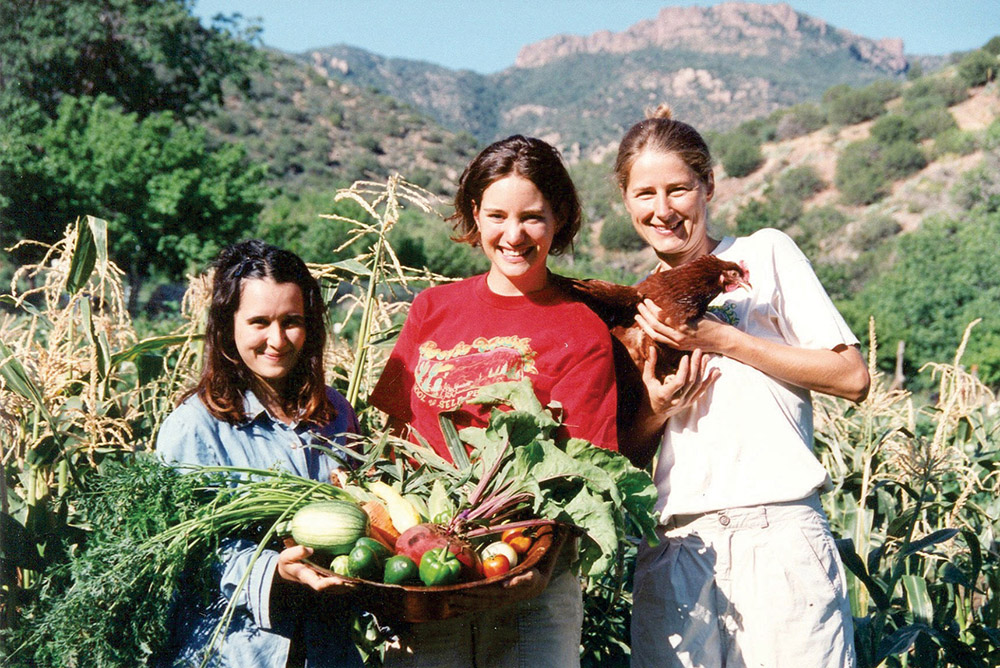
Now that the CommonSpace Community Land Trust is a reality, I am hoping that our little homestead will provide a model for others to follow. I imagine other homesteads in the neighborhood becoming community with us, exchanging help and produce, eggs and honey, farm equipment and friendship. Already, classes on beekeeping are happening there, and a labyrinth-garden for medicinal herbs. Braids of drying garlic are hanging in the barn and a small orchard is planted. I am seeing community happening naturally there by the Laguna, starting with this sweet little place with the creek flowing by and the gardens thriving.
When it was time to dissolve our wonderful cohort who had done the work, and open it up to the residents and the community at large, we knew we’d bonded like family for good.
You can meet us—Darryl Berlin and Cassandra Ferrera and Kate Yates and Jerry Green and myself, Carolyn North—on our website: www.commonspaceclt.org.
Here is our mission statement:
Note that CommonSpace is made up of several words: Commonspace, Commons, Space, and Pace, meaning peace.
May all beings find peace.
With my deep thanks to Herb who made this all possible.
You can reach the author, CommonSpace Community Land Trust cofounder Carolyn North, at carolyn.north [AT] gmail.com. Find the CommonSpace website at www.commonspaceclt.org.
Excerpted from the Spring 2019 edition of Communities, “Community Land”—full issue available for download (by voluntary donation) here.
Keep the conversation going with these pieces
There are no available blogs
Subscribe to our newsletter for fresh stories and community updates delivered to your inbox.
Get unlimited access to courses, exclusive member events, and a supportive network of community builders
Access all courses, books, and premium content
Member-only workshops and community builders
Member-only workshops and gatherings
We use cookies to improve your experience on our site. By using our site, you consent to cookies.
Manage your cookie preferences below:
Essential cookies enable basic functions and are necessary for the proper function of the website.
These cookies are needed for adding comments on this website.
Statistics cookies collect information anonymously. This information helps us understand how visitors use our website.
Service URL: policies.google.com (opens in a new window)
A residential project: people live here as their primary home.
An institution, business, network, or project that isn’t a residence (e.g. a learning center, farm, or network with no one living there full-time).

{{ item.label }}
{{ item.value ? item.value : currencyFormat( item.amount ) }}
Subtotal
{{ currencyFormat( pricing_summary.total_amount ) }}
There are no results matching your search


