
Excerpted from the Spring 2019 edition of Communities, “Community Land”—full issue available for download (by voluntary donation) here.
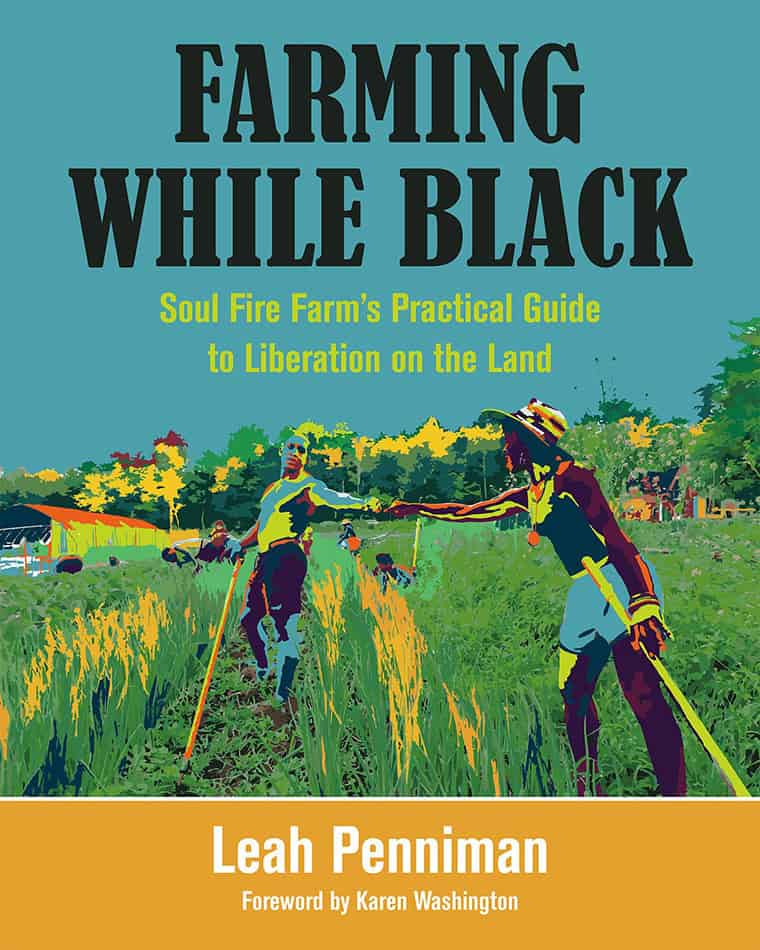
Farming While Black: Soul Fire Farm’s Practical Guide to Liberation on the Land
By Leah Penniman
Chelsea Green, October 2018, paperback (8″ x 10″), full color photos and illustrations throughout, 368 pages. Available from Communities Bookstore (ic.org/bookstore).
This is the most inspiring garden book I have read in years, and in my work with Southern Exposure Seed Exchange I read a lot of books about farming and food justice. The author Leah Penniman is a Black Kreyol from New England, where farmers of color are rare and even more so in the “Good Food” and cooperative farming circles. As a young person in love with the land and looking to become a farmer, Leah questioned whether she had a place in farming. This book is written for young Black, Brown, and Latinx people like her 17-year-old self, but it is also a gift to all of us who care about farming, equality, and justice.
Leah covers the usual farming topics well, spiced with family and cultural wisdom from African and Caribbean cultures. She also shines a light on the shameful and continuing unjust treatment of Black and Brown people who farm. I loved the section called “Uplift,” spread throughout the book, lifting up the many agricultural achievements of people in the African Diaspora. Leah also shares the hard-earned success gained by all the members of the Soul Fire Farm team as they built a functioning and productive farm, starting with degraded hillside land not deemed appropriate for farming. The farm supports itself and educates youth while offering good food on a sliding-fee basis to a community suffering “Food Apartheid.”
Farming While Black offers some the best lists of resources I’ve seen, both conventional and uncommon, including Black-led training programs for young farmers. Leah is not afraid to bring up tough subjects like the implications of white farmers asking Black and Brown people to work for no pay doing jobs that primarily benefit the landowner. She also challenges people of European descent to look at how they have benefited from wealth created by the historic unpaid labor of Black people. This historic injustice still lives when for every $100 in white family wealth, Black families hold just $5.04. Leah also shares stories of specific acts of reparations, where people of European descent have transferred part of their land to descendants of those peoples who created that wealth.
There are many excellent chapters on the nitty-gritty of farming, covering problems often overlooked―problems associated with “cheaper” land that is more financially affordable. She talks about how Haitian farmers work to remediate soil by planting perennial vetiver grass on contour and using specific plants to chelate lead from contaminated city land. Unlike many books, Leah’s includes raising livestock as a part of crop planning as well as how white allies can be helpful in uprooting racism in our food and farming system. For an excellent longer review by Pam Dawling of Twin Oaks Community, visit www.sustainablemarketfarming.com/2018/11/13/book-review-farming-while-black-leah-penniman, or better still just go ahead and buy the book! (Avoid the internet commerce giants by ordering from FIC at ic.org/community-bookstore/product/farming-while-black.) All author proceeds from this book will be donated to provide land and training for Black farmers!
Ira Wallace is a long-time communitarian, cofounder of Acorn Community in Virginia, co-coordinator of Southern Exposure Seed Exchange, 2014 recipient of the FIC’s Kozeny Communitarian Award, and author of The Timber Press Guide to Vegetable Gardening in the Southeast.
Excerpted from the Spring 2019 edition of Communities, “Community Land”—full issue available for download (by voluntary donation) here.
Keep the conversation going with these pieces
There are no available blogs
Subscribe to our newsletter for fresh stories and community updates delivered to your inbox.
Get unlimited access to courses, exclusive member events, and a supportive network of community builders
Access all courses, books, and premium content
Member-only workshops and community builders
Member-only workshops and gatherings
We use cookies to improve your experience on our site. By using our site, you consent to cookies.
Manage your cookie preferences below:
Essential cookies enable basic functions and are necessary for the proper function of the website.
These cookies are needed for adding comments on this website.
Statistics cookies collect information anonymously. This information helps us understand how visitors use our website.
Service URL: policies.google.com (opens in a new window)
A residential project: people live here as their primary home.
An institution, business, network, or project that isn’t a residence (e.g. a learning center, farm, or network with no one living there full-time).
{{ item.label }}
{{ item.value ? item.value : currencyFormat( item.amount ) }}
Subtotal
{{ currencyFormat( pricing_summary.total_amount ) }}
There are no results matching your search