

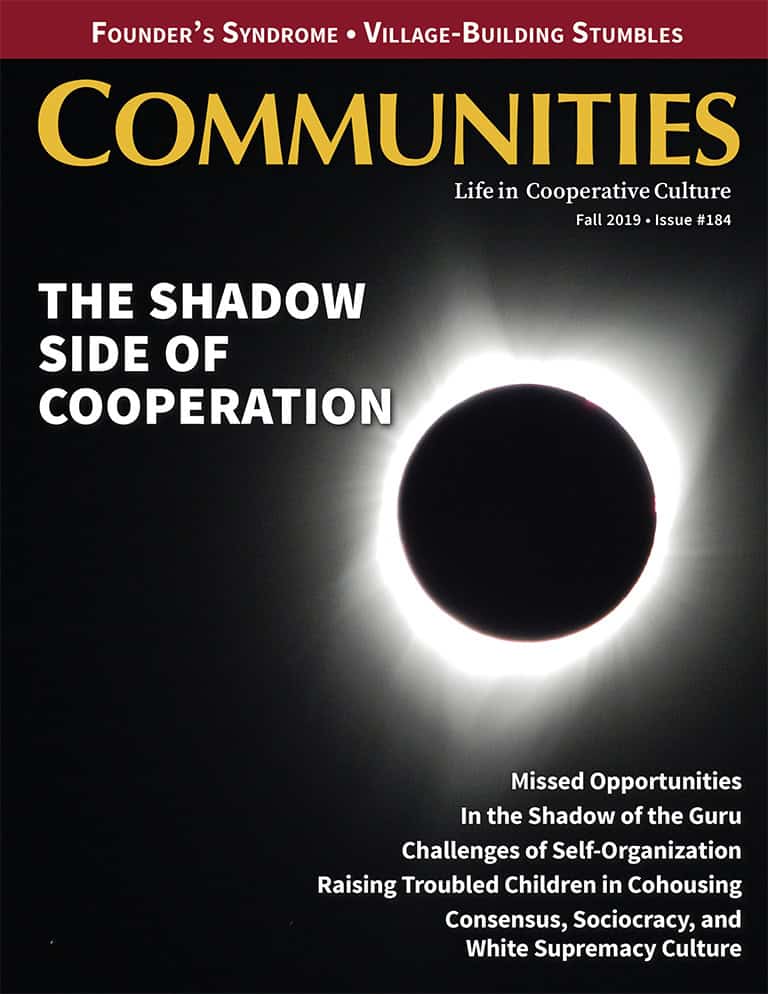
A natural follow-up to our Summer 2019 Sexual Politics issue, Communities #184 (Fall 2019) focuses on The Shadow Side of Cooperation.
We explore problems and pitfalls, disappointments and betrayals, unintended outcomes of cooperative attempts ranging in impact from trivial to tragic.
Authors’ stories describe the clash of idealism with reality, communication breakdowns, cultural patterning, internalized oppression, rights and boundary violations, founder’s syndrome, business and organizational struggles, power, ego, disempowerment, dysfunction, trauma, and strategies to address these and other challenges.
Download for free or by donation
See all the articles in this issue…
Letters
Readers reflect on sexual politics, naming names, and the case for “co” habituation.
Publisher’s Note: Facing the Hard Things By Sky Blue
In order to create healthy, thriving communities that are replicable models for a cooperative, sustainable, and just human society, we need to talk about what hasn’t worked.
Notes from the Editor: Exploring the Shadow Side By Chris Roth
A higher standard for interpersonal accountability and care makes the effect even more devastating when feelings of safety, security, and affection in community turn out to be based on illusion.
The Shadow Side of Community By Laura Matsue
The more friendliness we have towards difficult parts of ourselves and difficult aspects of living in community, the easier it will be to make the journey together.
Community Communication By Blake Wilson
“Can you put the gas in the truck, please?” A seemingly simple request provides a case study in the importance of precise, clear communication.
Village-Building Stumbles: A few of the things Earthaven Ecovillage has gotten wrong By Lee Warren
Those of us privileged enough to find ourselves in an intentional community often imagine that our environment will be free of the horrors and evils of the world. But alas, we bring it all with us.
The Expert By Joan McVilly
Wow! This woman has it all! She’s the answer to so many of our current dilemmas! What could possibly go wrong? A lot.
What Rights Do Non-Members Have in Community? By Anonymous
Having written policies that anticipate human foibles and conform to local, state, and federal law is essential if you are to respect and uphold the rights of members, potential members, and guests.
Entrepreneurship and Long-Term Planning in an Income-Sharing Community: A Report from the Frontlines By Sumner Nichols
The pace of running a competitive multi-million-dollar business like East Wind Nut Butters can clash with the often slow and seemingly disinterested pace of the community at large.
Founder’s Syndrome By Graham Ellis
The original founder, visionary, and main public point person for Bellyacres for over a quarter of a century laments that some members came to consider him “the root of all present, past, and future problems in the organization.”
Challenges of Self-Organization at Chambalabamba By Mofwoofoo (Tom Osher)
Believing that meeting the daily needs of the community he founded needs to be a desire, not an obligation, its property owner decides to rescind the group’s anarchical arrangement temporarily to remove anyone lacking a good community attitude.
Missed Opportunity at the Goat Ranch By Philip Mirkin
Ted and Sally were truthful when they said they had no idea what they were doing, either running the business or establishing a community. They didn’t, much to the dismay of their departing managers and volunteers.
In the Shadow of the Guru By Geoffrey Huckabay
Referring to himself as “the biggest asshole” in the county, a group’s spiritual teacher “told us if we could work with him and learn from him, we could deal with anyone in any situation.”
Whatever Happened to the Renaissance Community? By Daniel Brown
Despite the lethal combination of power, ego, and spirituality that brought the Renaissance Community to an end, most of its ex-members cherish their time there as a growth experience that made them better people.
Loneliness in Community By Mick Vogt
We take ourselves with us wherever we go, and in doing so we also take with us our world, the embedded malice of our culture, our sense of isolation, our hope of rescue, our quest for oneness, our grail searches.
Raising Troubled Children in Cohousing By Alicia J. George
When the antisocial behavior of adopted boys at Takoma Village Cohousing begins to impact the larger community, their parents find open communication essential in identifying a path forward.
Culture Change or Same Old Society? Consensus, Sociocracy, and White Supremacy Culture By Joe Cole, Hope Horton, and Maria Pini
Many intentional communities reproduce elements of white supremacy culture, sometimes with consensus and sociocracy as unconscious accomplices. But the seeds of change toward greater racial equity are also present.
Conflict Resolution and Satisfaction in Today’s Intentional Communities By Zach Rubin, Yana Ludwig, and Don Willis
Having techniques in place to deal with conflict when it inevitably arises is good, but the success of those appears to reflect the community’s overall health as much as the effectiveness of any one technique.
On Community: A Graduated Series of Consequences and the “Community Eye” By Diana Leafe Christian
Just knowing the community has this process in place deters people from breaking agreements. People don’t want to get a knock at the door by one fellow community member, much less three or four.
Review: Communes in America, 1975-2000 By Deborah Altus
In this engaging final volume of his trilogy, Tim Miller describes the end of the 20th century as bringing out a new communal generation with better organizational skills and greater focus on environmental concerns.
Creating Cooperative Culture: Efficiency vs. Humanity By Dan Schultz
Attending to a member’s disconnect rather than taking the most “efficient” path to a community decision represents a valuable, healing paradigm shift, reparation for our deranged western cultural values.
ONLINE ONLY
Do Communities Need Feminist Dissent? By LK
In the midst of wider social movements in the areas of gender and sexuality, communities everywhere need a place for feminist dissent and a willingness to engage in difficult conversations. Dissent is part of how we build resilience together. (Article available at Feminist Dissent.)
The Red Flag of Hypocrisy By Peter McGugan
The most troubling thing isn’t when a charismatic leader uses gangster tactics, but when the people in his office, who sing the songs of love and community values, are complicit. (Article available here.)
Does Community Heal Trauma, or Reproduce It?: Challenges for abuse survivors living in community By Matt Stannard
Survivors of traumatic abuse face many problems in trying to form and participate in community. Trauma-informed community commits to keeping the survivor safe in wide zones of ambiguity, as challenging as that might be. (Article available here.)
Excerpted from the Fall 2019 edition of Communities, “The Shadow Side of Cooperation”—full issue available for download (by voluntary donation) here.
Keep the conversation going with these pieces
There are no available blogs
Subscribe to our newsletter for fresh stories and community updates delivered to your inbox.
Get unlimited access to courses, exclusive member events, and a supportive network of community builders
Access all courses, books, and premium content
Member-only workshops and community builders
Member-only workshops and gatherings
We use cookies to improve your experience on our site. By using our site, you consent to cookies.
Manage your cookie preferences below:
Essential cookies enable basic functions and are necessary for the proper function of the website.
These cookies are needed for adding comments on this website.
Statistics cookies collect information anonymously. This information helps us understand how visitors use our website.
Service URL: policies.google.com (opens in a new window)
A residential project: people live here as their primary home.
An institution, business, network, or project that isn’t a residence (e.g. a learning center, farm, or network with no one living there full-time).

{{ item.label }}
{{ item.value ? item.value : currencyFormat( item.amount ) }}
Subtotal
{{ currencyFormat( pricing_summary.total_amount ) }}
There are no results matching your search


