

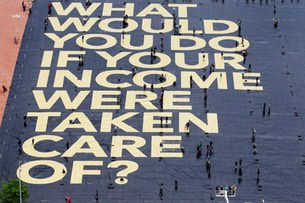
This Sunday, June 5, Switzerland will be the first country to vote on whether or not its citizens should receive a universal basic income (UBI) of $2,600 per month. The proposal would guarantee a payment to every citizen (and $650 per child), without any pre-conditions or work requirements.
Liberal advocates argue that a UBI will become necessary as jobs are replaced by automation. They say it’s more humane than a patchwork of means-tested welfare programs. Some conservatives support it because it would streamline government services, while others worry that it would take away the incentive to work.
Although the referendum is unlikely to pass (most Swiss politicians have spoken out against it), it’s an idea that’s becoming increasingly popular around the world. Finland, The Netherlands, and Canada are among the handful of countries expected to implement basic income experiments in the coming years.
The idea has long been popular in communitarian fiction. It appears in some form in the works of Ursula K. LeGuin and in Starhawk’s The Fifth Sacred Thing. Starhawk writes that, in her vision,
“Everyone has a basic, guaranteed income, that represents your fair share of common resources and the wealth of the past. Everyone then gets work credits for whatever work you do, including housework and caring for children or the elderly. If you’re an artist or a healer or someone who’s work doesn’t lend itself to counting hours, you get a stipend. And if people really like what you do, they give you gifts. Ah, how happy I’d be living in that world!”
We may soon live in that world. In addition to the Swiss referendum, a charity called GiveDirectly is launching the first long-term basic income experiment in Kenya. At a cost of $30 million, the program will provide a basic income to 6,000 Kenyans for over a decade. There’s some evidence to suggest that a basic income could increase entrepreneurship in developing countries, and GiveDirectly hopes to prove it.
Will more empirical evidence convince other countries to follow suit? The U.S. came close to passing a basic income bill in 1970 under Richard Nixon’s presidency. Although it passed the House of Representatives, it stalled in the Senate amid concerns that it could lead to a rising divorce rate. An experiment in Manitoba, Canada, ran for several years in the 1970s, but was eventually phased out.
For now, the idea may have the most potential at the state level. The Alaska Permanent Fund serves as a kind of basic income, providing up to $2,000 per year to each citizen. A proposed bill in Oregon would tax carbon emissions and distribute around $1,000 per year to state residents.
Smaller groups could give the idea some momentum too. Silicon Valley’s Y Combinator is hiring a researcher to spend 5 years studying the impact of basic income, while the My Basic Income team raised funds on Indiegogo to provide a BI of $1,250 per month to one individual for a year.
What about intentional communities? I’m not aware of any that provide a full UBI, but income-sharing communities like Twin Oaks come close. In return for a certain number of hours of work per week, members can rest assured that their basic needs, including food and shelter, are covered.
If enough intentional communities did the same, maybe we wouldn’t need a referendum or ballot measure to make it happen.
****
What are your thoughts on basic income? Would you vote for it if you were a Swiss citizen? Leave your thoughts in the comments below.
“Robots” advocate for basic income in Switzerland, April 30, 2016Keep the conversation going with these pieces
There are no available blogs
Subscribe to our newsletter for fresh stories and community updates delivered to your inbox.
Get unlimited access to courses, exclusive member events, and a supportive network of community builders
Access all courses, books, and premium content
Member-only workshops and community builders
Member-only workshops and gatherings
We use cookies to improve your experience on our site. By using our site, you consent to cookies.
Manage your cookie preferences below:
Essential cookies enable basic functions and are necessary for the proper function of the website.
These cookies are needed for adding comments on this website.
Statistics cookies collect information anonymously. This information helps us understand how visitors use our website.
Service URL: policies.google.com (opens in a new window)
A residential project: people live here as their primary home.
An institution, business, network, or project that isn’t a residence (e.g. a learning center, farm, or network with no one living there full-time).

{{ item.label }}
{{ item.value ? item.value : currencyFormat( item.amount ) }}
Subtotal
{{ currencyFormat( pricing_summary.total_amount ) }}
There are no results matching your search