

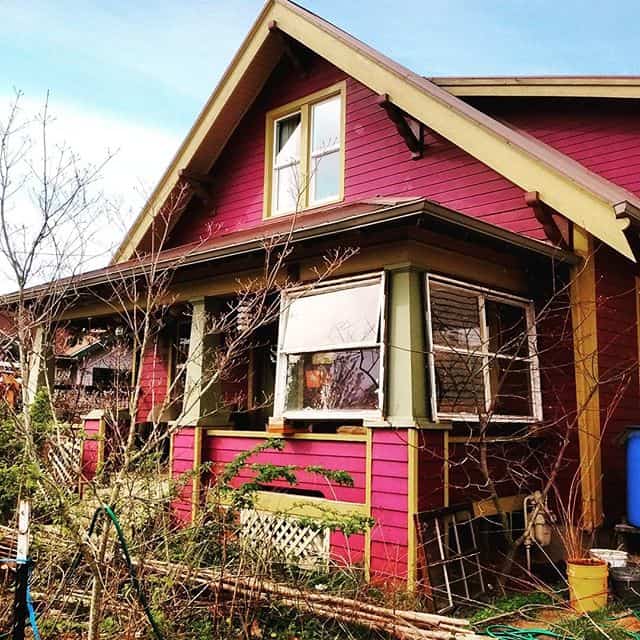
Here at Foster Village, my community in SE Portland, we share access to three houses on adjoining plots of land. Although we have plans for collective ownership, for now the houses are owned individually, but most of our expenses are shared. This means we have to think creatively about maintenance agreements.
Each member contributes an extra $10 per month to a maintenance fund for the house they live in. This covers ordinary repairs for that house. But even though a member may live in one of the houses in the village, they still share some of the maintenance responsibilities for upkeep of the other houses.
To that end, we’ve agreed that repairs to one of our houses that cost over $1,000 will be shared by the whole community, not just the residents of that house.
Our most recent project that fell into that category is a plan to re-paint an entire house. We took a temperature check of the community to see how members felt about contributing labor to the project. Did we want to hire professionals and share the expense, or do it ourselves and save on the cost?
We settled on a compromise: we would hire professionals to do the prep work (primarily to protect against lead exposure), but we would do the painting and priming ourselves.
Additionally, since members had different amounts of time and energy they were willing to contribute to the project, we agreed on a labor equity proposal to distribute the expenses most fairly. Here is how we decided to break down the project:
Each person will track the hours that they assist painting (setting up, painting, cleaning up). At the end we will determine the total hours contributed and the average per person. If each person contributed equal hours to the painting project, it would cost us each $7 per month. If you contribute 0 hrs to the project, you will contribute double that ($14) monthly to the painting project. These contributions are for the next 4 years. Let’s assume that it takes 7 hrs per person to paint if everyone contributed equally. Here’s what each person would pay per month based on their hours of contribution:
Hrs worked $ per month
0 $14
1 $13
2 $12
3 $11
4 $10
5 $9
6 $8
7 $7
The hours will change, but the dollars should stay roughly the same. If you work more than average, then your contribution will be less. The excess funds paid in by those who worked less than average will compensate others.
This is just one way to distribute maintenance expenses. Other communities may prefer to tally all kinds of labor contributions (not just for a particular project) and make sure that everyone is participating equally. Some may have a set number of hours that members are expected contribute each week.
In our case, we recognized that each person would value their contribution differently. Someone who works full time may not have the energy to help paint the house, and may prefer to make a monetary contribution. A resident who is underemployed may have more time to contribute, but less cash available.
Ultimately, the cost of the project will be added to our rent payments in small portions over four years, ensuring that no one has to pay a lump sum or front all the money.
****
How does your community handle maintenance costs? Is everyone equally responsible for upkeep? How do you strike a balance between labor and financial contributions?
Keep the conversation going with these pieces
There are no available blogs
Subscribe to our newsletter for fresh stories and community updates delivered to your inbox.
Get unlimited access to courses, exclusive member events, and a supportive network of community builders
Access all courses, books, and premium content
Member-only workshops and community builders
Member-only workshops and gatherings
We use cookies to improve your experience on our site. By using our site, you consent to cookies.
Manage your cookie preferences below:
Essential cookies enable basic functions and are necessary for the proper function of the website.
These cookies are needed for adding comments on this website.
Statistics cookies collect information anonymously. This information helps us understand how visitors use our website.
Service URL: policies.google.com (opens in a new window)
A residential project: people live here as their primary home.
An institution, business, network, or project that isn’t a residence (e.g. a learning center, farm, or network with no one living there full-time).

{{ item.label }}
{{ item.value ? item.value : currencyFormat( item.amount ) }}
Subtotal
{{ currencyFormat( pricing_summary.total_amount ) }}
There are no results matching your search


