
This is an online-only article associated with the Spring 2019 edition of Communities, “Community Land”—issue available for download (by voluntary donation) here.
Every community needs a few guiding principles and a few things to count on. For most intentional communities, the land they claim for their own provides a framework for their shared lives. For the past 40 years at Dance New England (DNE), the continuity has been Summer Camp, where about 500 people gather and the fundamental principles are dance and participation.
Like the classic musical, Brigadoon, where a village has an occasional presence, DNE appearing at the properties we’ve rented has seemed magical, with our revels rising out of the mist for a week or two, belying the hard work and preparation of volunteer committees and a small paid staff. The continuity has been a core of a few hundred who rarely, if ever, miss camp, and a rich program at a reasonable cost that draws past participants back and welcomes new.
During the year, weekends, community dances, and social events marking weddings, births, and death all reaffirm the heart of DNE. Our repertoire includes blasts of evening boogies to live and DJ’d music, classes and jams of contact improv, African drumming around a fire circle, always working collectively, creating a sweet waterfront and a lively children’s program, and engaging in earnest dialogs about sustainability, diversity, and mutual respect. We’re in our third generation, as the kids who were born into the community have maintained connection and some are back with partners and a new round of babies.
With our diverse population―cooks and carpenters, health care providers from mainstream medicine and alternative healing modalities, lawyers and folks in business―we get to know each other over time as dimensional beings with history, personalities, skills, and opinions. Most of our experiences together are positive but, when communication breaks down, we have Mediation and a Peace Council.
A permanent home has been aspirational to the DNE community. We have held our events throughout the Northeast, but each year we have been challenged to find the right mix of rental spaces. In the late ’90s, a site in Connecticut briefly caught our imagination before the deteriorated reality caught up. In 2007, we came close to a deal for a property in Maine we coveted.
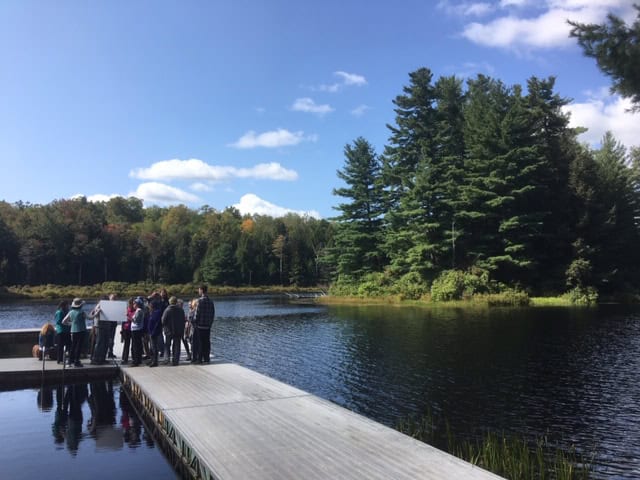
Finally in 2016, a dedicated consortium of members organized as Friends of Dance New England (FDNE) raised $1.5 million in equity and loans to purchase a 417 acre former Girl Scout camp in the western Massachusetts, Berkshire foothills. There is a small lake, semi-navigable rocky roads and paths, modestly functional buildings, upgradable sewage and electrical systems―a lot of work to be organized and managed into a program capable of covering expenses, repairs, and improvements.
The progression toward our homeplace happened in fits and spurts by applying our guiding principles of dance and participation. To begin with, Dance New England (DNE) is a 501(c)(3) nonprofit which puts together Summer Camp and associated events. We have a Board of Directors who supervise operations. Income is generated by fees, primarily from Summer Camp. Friends of Dance New England (FDNE) is a for-profit LLC with a Board elected by the 40 or so investors proportional to their equity shares. There is another nonprofit, Heartbeat Collective, which produces Unifier festivals and is also an investor with a FDNE Board representative. The maximum individual investment in FDNE is $100,000 so that no individual would be able to control the decision-making.
The missions of DNE and FDNE are aligned: to create a homeplace that secures our primary gathering. We also want to attract other organizations committed to complementary visions of sustainability and community to participate in using and managing the property. FDNE needs to run as a successful business, initially focused on rental events, and likely expanding to other ventures.
Shortly after the purchase, FDNE commissioned a study by a landscape architectural school to give us a better sense of the property’s potential. Most of the land is heavily wooded, with areas of wetlands that are inappropriate for building. Being good stewards of the land matters and we are exploring solar and permaculture. At the 2018 Summer Camp, electric carts helped navigate a relatively spread-out campus― especially important for those with young kids or limited by age and infirmity. Work weekends to paint dark cabins, build furniture, etc. have absorbed the time of up to 200 volunteers.
The property, known for now as Camp Timber Trails (CTT), felt like our homeplace from the moment we laid down the 50 ft. x 60 ft. wooden dance floor we’d been carting around through the years. I was part of the team that scrubbed it clean and one of a few hundred dancers who celebrated its arrival!
Bringing on a full-time Executive Director and Caretaker for CTT and filling out FDNE’s Committees are helping to normalize the operation and divide the work. Rentals for the summer season of 2019 are filling up yet more investment is needed to improve the facility and allow us to approach a three-season rental program. Two banks have expressed interest in extending a line of credit for expansion once our business is on a solid footing.
The opportunities for blue-sky projects and long-term development have us excited―perhaps a regional hub for trainings consistent with our values, reaching out regionally to involve compatible organizations, convening meetings and retreats. Last winter, dozens of community members joined me in brainstorming long-range possibilities for CTT and submitted them to the FDNE Board. Deciding priorities and allocating resources will keep us busy for years!
As a large and evolving community we have had our losses. Two community stalwarts passed recently―one, a member of our FDNE Board and a real estate developer, Davio Danielson; the other, a spiritual drummer, Morwen Two Feathers. The lively ceremonies Morwen led reminded me of some I attended in my West Africa Peace Corps filming days. We are sorry they are not here to celebrate this new phase of DNE.
One of our big challenges with this new investment is how to cultivate a sense of ownership by the wider community when only a portion of DNE members are investors. To give us a tangible start on resolving that issue, as part of FDNE’s Organizational Structure Committee, I’ve been developing a proposal for a Constituent Assembly. The Assembly, which has had broad support, would recognize sweat equity, committee participation, and loans, as well as investments of any size (rather than the present minimum of $5000). All those who demonstrate a baseline commitment would constitute the Assembly’s membership and, on the basis of one member/one vote, would elect one Board Member to the FDNE. Not only would the Assembly reward and encourage participation, it would be a solid statement of our intentions.
Thus far we’ve ducked the question of a residential community on site, but perhaps it’s the most perplexing. The local area is rural and low-density, which translates to few jobs. If we were to develop a residential component, would that set up a class divide, perhaps attracting retirees with steady income? As our program develops, we may have more staff jobs, and building a multi-purpose community center for smaller year-round gatherings would enhance CTT’s place in our lives. Even commuting is possible, considering CTT is situated about two hours from New York City and Boston, and less than an hour to public airline and train connections.
DNE, FDNE, and CTT celebrate the union of many communities, the power of dance and shared participation. Whatever the path, unlike Brigadoon, it seems the mist is clearing. Lo and behold, the homeplace for our community is here.
Paul Freundlich organized the first Dance New England Summer Camp in 1980, and has served several stints on DNE’s management team and Board, as has his wife, Margaret Flinter. For the new entity, Margaret is on the FDNE Finance Committee, and Paul is Chair of a Sub-Committee doing the run–up for creating a Donor Advised Fund to raise more investment capital. In a curious twist of fate, older son, Tim, once a teenage staffer in the DNE childcare program, is President of a nonprofit, Impact Assets, that manages Donor Advised Funds, and is helping FDNE explore setting up a fund. Younger son, Rob, teaches Salsa Rueda in the DNE Young People’s Program.
This is an online-only article associated with the Spring 2019 edition of Communities, “Community Land”—issue available for download (by voluntary donation) here.
Keep the conversation going with these pieces
There are no available blogs
Subscribe to our newsletter for fresh stories and community updates delivered to your inbox.
Get unlimited access to courses, exclusive member events, and a supportive network of community builders
Access all courses, books, and premium content
Member-only workshops and community builders
Member-only workshops and gatherings
We use cookies to improve your experience on our site. By using our site, you consent to cookies.
Manage your cookie preferences below:
Essential cookies enable basic functions and are necessary for the proper function of the website.
These cookies are needed for adding comments on this website.
Statistics cookies collect information anonymously. This information helps us understand how visitors use our website.
Service URL: policies.google.com (opens in a new window)
A residential project: people live here as their primary home.
An institution, business, network, or project that isn’t a residence (e.g. a learning center, farm, or network with no one living there full-time).
{{ item.label }}
{{ item.value ? item.value : currencyFormat( item.amount ) }}
Subtotal
{{ currencyFormat( pricing_summary.total_amount ) }}
There are no results matching your search