

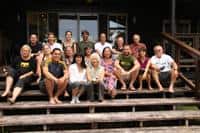
I’ve been a part of many communities in my life, many of them ephemeral: summer camp staff teams, wilderness trail crews, and urban houseshares with an ever-changing parade of roommates. Four years ago I moved to the tiny rural village of Worcester, Vermont, and found a unique and vibrant community that welcomed me immediately. After a decade of subscribing to Communities and scheming to start an intentional community one day, it struck me that I’d just stumbled into one by accident—one that was cleverly disguised to outsiders as a regular small town of just under 1,000 people.
Why do some towns and neighborhoods seem to embrace you in the arms of community, while others don’t? Let me share a few of the things that make my village feel this way:
1. Community Lunch
Every Wednesday I head down the hill to the Worcester Town Hall for Community Lunch, as does just about everyone else who’s in the village at noon on a Wednesday: young mothers, senior citizens, the local loggers, and people who work from home. While the meal is officially sponsored by the Vermont Food Bank, people from every economic class attend enthusiastically. This is where you see your neighbors every week, talk to the guy you want to buy your firewood from, find a friend who can lend you their truck, wish someone a happy birthday, and hear the local news. A core group of volunteers does the cooking every week, and they always lavishly decorate the hall for every major and minor holiday they can think of. Community spirit is palpable, and every newcomer is welcomed in without hesitation. Before you know it you’ve learned everybody’s name and feel right at home.
2. Gathering Place
Worcester has a tiny gas station, a post office the size of a closet, and a little café that closes at noon. This “commercial district” (two small neighboring buildings) is home to the morning banter of all who rise early and work hard. You can find tradesmen grabbing coffee, commuters gassing up, and local hunters displaying their take. When it’s not yet time for Community Lunch, this gathering place is where you go to see your friends and hear the latest news.
3. Online Forum
Vermont is the home of Front Porch Forum, a local online discussion board for each town. You must have a valid local address to be a member, and a summary of the posts lands in your inbox every day at 6 p.m. Whether you are selling a chest freezer, renting your cabin, announcing an event, or reporting a lost dog sighting, you know your neighbors will hear your words and respond.
4. Volunteers
Worcester’s sense of community is founded on the village’s volunteers. Community Lunch, the Fire Department & Fast Squad, the After School Play Group, the Community Garden, the twice yearly Clothing Swap, and the Fourth of July Committee are all run entirely by unpaid community members. These labors of love allow residents to serve their town and be proud of what they achieve together.
5. Long-time Residents
People tend to come to Worcester and stay. Many folks who started as renters love the community so much that they buy a house and settle down. When friendships and alliances form, they get to deepen and ripen over time. This is something I really missed in high-turnover communities, and it gives the town traditions deep roots.
6. Economic Interdependence
While plenty of people commute to work in the nearby capital city, lots of folks make their living right in our town. The loggers supply everyone with firewood while being thoughtful about forest sustainability on the small private woodlots they manage. The ladies who run the café give us a place to meet and connect. I’m proud to live on one of Worcester’s two community farms, where CSA members often volunteer in the fields to harvest the vegetables. Worcester is big enough to provide a living for those serving the community, and small enough that we all know these people by first name.
7. Celebrations of Community Pride
The Fourth of July is Worcester’s day to celebrate itself. The town proudly puts on the best fireworks display for miles around, and everyone lines the street for the tiny parade. The winters are long here, so at the height of summer we come mingle on the public field in the center of town and smile giddily with community pride.
8. Direct Democracy
Like many New England towns, Worcester is governed by a town meeting. All registered voters may attend to elect town officers, approve (or challenge) the town budget, and discuss the school board. Even if it’s only one day per year, this participation in direct democracy reminds us all that we collectively decide what Worcester will become.
9. Accepting Our Differences
Worcester has a very rural character, but it’s close enough to Vermont’s liberal capital city that values of acceptance prevail. It’s very okay to be gay (thank goodness, because I am!), neighbors of differing economic classes tend to rub shoulders with relative comfort, and the United Methodist Church co-exists peacefully with the Green Mountain Druid Order. We’re a very white town, but racial diversity is embraced when it finds its way here. Since the ’60s and ’70s Vermont has faced an influx of back-to-the-landers who sought a place in the traditional rural communities, and here the integration seems to have enriched both groups. It’s as if everybody has decided, “Well, you choose to live in our wonderful little village, which shows good sense, so I guess you must be alright.”
Reading over this list, I recognize many of the core traditions that support the success of most intentional communities. Indeed, aren’t many of our intentional communities seeking to reclaim the lost small-town solidarity of yesteryear? So I suppose Worcester is an unintentional community that has partially retained its rural heritage of community traditions and partially been enriched by fresh ideas from beyond its borders.
These nine methods of community-building could be applied to any small town or city neighborhood where the residents are willing. If you’re a communitarian soul living in the non-communitarian world, give one of them a try in the place where you live and see if the seeds of community take root. While intentional communities are crucial laboratories that teach us so much about how the human social fabric can work, the art of creating community spirit within mainstream towns and neighborhoods has at least as much potential to change the world for the better. Now, if you’ll excuse me, I have to go to Community Lunch!
Murphy Robinson is a wilderness guide and hunting instructor. When her wandering years came to an end she founded Mountainsong Expeditions in the wild forests of Vermont, where she helps people learn to be in deeper relationship with the land and each other. Your can learn about her work or send her a message at www.mountainsongexpeditions.com. She has also published Communities articles in the past under her former legal name, Mary Murphy.
Keep the conversation going with these pieces
There are no available blogs
Subscribe to our newsletter for fresh stories and community updates delivered to your inbox.
Get unlimited access to courses, exclusive member events, and a supportive network of community builders
Access all courses, books, and premium content
Member-only workshops and community builders
Member-only workshops and gatherings
We use cookies to improve your experience on our site. By using our site, you consent to cookies.
Manage your cookie preferences below:
Essential cookies enable basic functions and are necessary for the proper function of the website.
These cookies are needed for adding comments on this website.
Statistics cookies collect information anonymously. This information helps us understand how visitors use our website.
Service URL: policies.google.com (opens in a new window)
A residential project: people live here as their primary home.
An institution, business, network, or project that isn’t a residence (e.g. a learning center, farm, or network with no one living there full-time).

{{ item.label }}
{{ item.value ? item.value : currencyFormat( item.amount ) }}
Subtotal
{{ currencyFormat( pricing_summary.total_amount ) }}
There are no results matching your search