

Use New Power to Build a Movement

Placeholder image for Foundation for Intentional Community website.
Christopher Kindig
  • August 1, 2018
  • Economics & Law
  • Governance
  • Social Justice
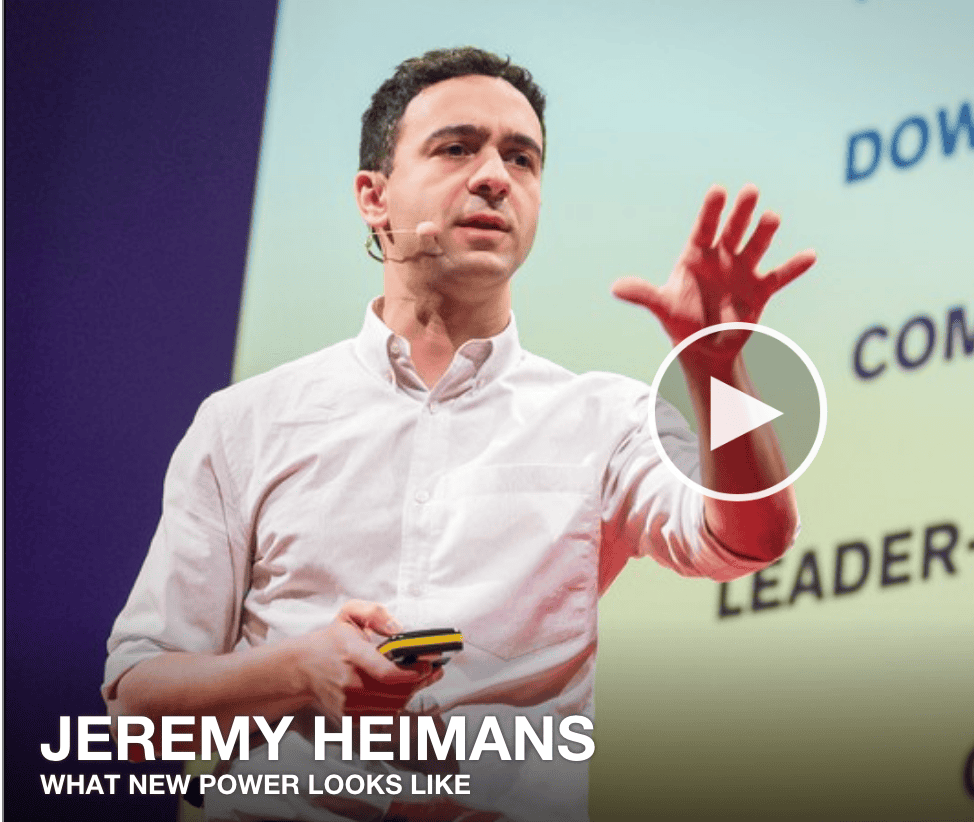
Jeremy Heimans speaking at a conference about new power dynamics.

What is New Power?

It is not just a change in technologies that is reshaping our world, our culture, and our participation in it. Our beliefs and expectations for what is possible, and what ought to be possible, is also changing.

This is eclipsing the old lessons on the right way to create and sustain movements. There are a new set of cultural and tactical rules for how to reach people, how to get them involved, and how to create real change together.

Want to start or build a community? To change some local policies? To build a movement online? Try New Power.

Old Power vs. New Power

  1. Old Power is held tightly, like Currency, whereas New Power is fluid, like Current
  2. Old Power is Held by Few, New Power is Made by Many
  3. Old Power is Hoarded, whereas New Power is Channeled
  4. Old Power tracks Downloads, New Power encourages Uploads
  5. Old Power Commands authority, New Power Shares Authority
  6. Old Power is Leader Driven, New Power is Peer Driven
  7. Old Power is Closed off, whereas New Power is Open

What New Power Looks Like

How to Build a Movement

A recent article by Jeremy Heimans from the video above, and a colleague Henry Timms, both activists for people-powered movements, is called ‘How to build a successful movement in 4 steps‘ — available on TED Ideas.

The conclusion of their research, and based on their experience, is that in order to get people’s attention, and to motivate them to act, you can follow these steps:

Step 1: Find Your Connected Connectors

Find the most influential people within your space, and connect with them strongly. Understand what they need and how to help them. They can be your absolute best allies and advocates, motivating their audiences for you.

Step 2: Build a New Power Brand

Define, talk about, and live your ethos: what do you believe, what do you stand for, and what are you doing to prove it. Shape your offering or message around empowering people to be a part of the movement you are dedicated to.

Step 3: Lower the Barrier, Flatten the Path

Make it easier to participate. Frictionless signups, notifications, surveys, petitions, donations, etc., are key. People want to be a part of something greater than themselves, and are willing to sacrifice for it. Make that easy to do!

Step 4: Move People Up the Participation Scale.

Give people small low-barrier asks for them to start helping. For those who get involved, give them the opportunity to take the next small step to help. Continue this to give people clear steps to get involved and offer more support.

The Old Power model about how to get people motivated is to make them Comply or Consume.

New Power Participation Scale

  1. Sharing – sharing other people’s content or ideas
  2. Affiliating – endorsing or joining a new power group
  3. Adapting – remixing other people’s ideas
  4. Funding – contributing money to an idea
  5. Producing – producing new power ideas
  6. Shaping – shaping new power culture

New Power is not always used by the forces of good, and New Power is not destined to be inevitably victorious. However we are only at the beginning of seeing how New Power can dramatically reshape the world of participation in a short period of time.

This all means that you and your community are more powerful than you have ever been on this planet. Use that fact to inspire you to plug in, and to start or participate in a worthwhile movement!

You can read more about this model, and how to use it, in their book: New Power: How Movements Build, Businesses Thrive, and Ideas Catch Fire in Our Hyperconnected World by Jeremy Heimans and Henry Timms.

Comments

Featured Blogs

Keep the conversation going with these pieces

J McCune Porter
Tue Jan 2015
  • New to community
Community Bookstore Special Best of Communities ― The Cream of Our Crop Seeking and Visiting a Community by June, Community Bookstore Manager Best of Communities Volume II Seeking and Visiting a Community Digital downloadable compilation PDF The Foundation for Intentional Community …
Christopher Kindig
Tue May 2015
  • Sustainability
Support the Global Ecovillage Network Summit From July 6-10th, hundreds of activists will gather at the Findhorn Ecovillage in Scotland for the GEN+20 Summit. They will celebrate 20 years of uniting people around ecological solutions, and plan the next steps to spreading sustainability around the g…
Abeja Hummel
Thu Mar 2013
  • New to community
  • Economics & Law
Life in a small rural ecovillage can mean embracing complex choices while balancing idealism with necessity.
Saul Of-Hearts
Mon Aug 2016
  • Life Transitions
When Nathanael Johnson began taking his two-year-old daughter on nature walks in Berkeley, CA, he realized that he didn’t know the names of half the trees, bugs, and other creatures she pointed to. Even the most common urban animals – pigeons and squirrels – were a mystery to him. How did they manag…
Saul Of-Hearts
Mon Sep 2016
  • Living in community
  • Relationships
Just over an hour north of Lima, Peru, a circle of cone-shaped buildings rises beside a sandy beach. These structures are called “trulys,” and they’re part of a spiritual eco-village built by Hare Krishnas on the Peruvian coast. The village is a popular stopping place for travelers looking for a pea…
Christopher Roth
Tue Aug 2019
  • Living in community
  • Governance
A natural follow-up to our Summer 2019 Sexual Politics issue, Communities #184 (Fall 2019) focuses on The Shadow Side of Cooperation. We explore problems and pitfalls, disappointments and betrayals, unintended outcomes of cooperative attempts ranging in impact from trivial to tragic. Authors’ storie…
Fred Lanphear
Mon Dec 2009
  • Living in community
  • Relationships
A community rallies in support of a long-time member diagnosed with Lou Gehrig’s Disease, discovering opportunities and possibilities for new connections with each other and becoming more present to the priceless experiences of both living and dying.
Saul Of-Hearts
Thu Nov 2016
  • Life Transitions
Stefan Geyer, a London resident active in the U.K. permaculture community, is releasing a new book called “Zen in the Art of Permaculture Design.” It’s not a guidebook to specific permaculture practices, but a reflective look at the ways permaculture principles can inspire change in our lives and co…
LK
Tue Jun 2019
  • Living in community
  • Relationships
An unwanted, rebuffed sexual advance from a previously trusted community leader spirals into numerous, serious consequences in the victim’s personal and professional life.
Christopher Kindig
Thu Jul 2018
  • Governance
Why not Join a Community? “I would live in a Community, but…” fill in the blank here. There are a lot of assumptions, fears, and misunderstandings about intentional communities that lead people to have false stereotypes of them. This list of the Top 17 Myths about Intentional Communities should h…

Insights & Stories from the Communities Movement

Subscribe to our newsletter for fresh stories and community updates delivered to your inbox.

Join the Communiversity Community

Get unlimited access to courses, exclusive member events, and a supportive network of community builders

Unlimited Learning

Access all courses, books, and premium content

Community Network

Member-only workshops and community builders

Exclusive Events

Member-only workshops and gatherings

Update to a Public Profile

  • Log in
  • Go to your profile page
  • Toggle on the "Add my profile to the directory"
  • Save your profile

Information

Communities

A residential project: people live here as their primary home.

Organizations

An institution, business, network, or project that isn’t a residence (e.g. a learning center, farm, or network with no one living there full-time).

Plus Community Membership

  • Find people with Profile Match
  • Access to your community listing statistics
  • Create Discussion Groups
  • Access to our affiliate program
  • Member badge on your community profile
I am an official member of this community
Disclaimer
I affirm that my information is accurate and I am authorized to manage this listing
Foundation for Intentional Community FIC Member badge logo.

Free Plan

Free Membership
Free

Intentional Advertising

  • Subtotal

    {{ currencyFormat( pricing_summary.total_amount ) }}

Icon representing community connections and collaboration for intentional communities.

Plus Membership

We’re introducing new Plus features — including community reviews, Profile Match, and unlimited Needs & Offers posts — while keeping most of FIC free for everyone. Membership costs less than two coffees a month. 

  • Find communities with Profile Match
  • View detailed reviews about communities
  • Create free listings in Needs & Offers
  • Plus Member resources in CommUniversity
  • View communities detailed reviews
  • Plus Member badge on your profile
