

In late March, Cassandra Ferrera, FIC Board member, and I participated in a training by the Nonprofit Democracy Network titled Tools for Collective Self-Governance. It was a 3 day exploration in how nonprofit organizations working can better embody the change they’re trying to make in the world.
There were many themes, threads, and tracks explored in small groups during the training, and this is by no means a comprehensive summary of everything that was covered, just a report on my journey through the space. This post is a companion to a more narrative post connecting ideas from this training to the cross-country communities tour I’d just completed, which you can find here.
As a frame for the training, this was the definition offered for governance from the Australian Indigenous Governance Institute:
How people choose to collectively organize themselves to manage their own affairs, share power and responsibilities, decide for themselves what kind of society the want for their future, and implement those decisions.
To do that they need to have processes, structures, traditions and rules in place so they can:
http://toolkit.aigi.com.au/toolkit/1-0-understanding-governance
In short, governance is our agreements about how we work together to reach our common goals.
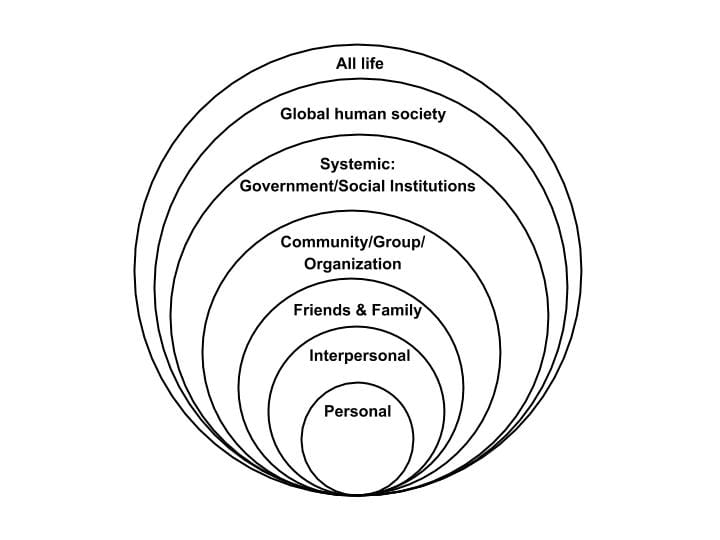
Another frame that was offered covered the different aspects of organizations:
The surprising aspect of this for me was the inclusion of rules, though I also really appreciated it. “Rules” is kind of a bad word, like leadership. But as we work to understand appropriate leadership in cooperative organizations, there’s a place for appropriate rules too, rules that are collectively agreed upon.
Accountability has a rich and nuanced meaning that morphs depending on focus and context and runs through all the Aspects of Organizations.
It was suggested that Accountability = mutual respect + trust + agreements. I wonder if accountability is about creating a collective mentality, a sense of identification with, and investment in, common purpose? Basically, it’s not about you, and it’s not about me either. It’s about creating and operating from an identify of “we.”
There are lots of core concepts to cooperative organizations that Accountability touches:
Accountability asks questions:
Accountability also asks some things of us:
We’re all traumatized by the system of white supremacy/patriarchy/capitalism, and it’s also important to remember that we’re traumatized in different ways. One of the trainers suggested that “human beings + systemic oppression = oppressed marginalized people and dehumanized privileged people.”
Here’s a great article for understanding oppression:
https://mrdevin.files.wordpress.com/2009/06/five-faces-of-oppression.pdf
Healing is critical to forming cooperative groups and ultimately to a cooperative society, because our trauma gets in the way of that work. We have to see the work of healing ourselves as integral to healing society and the planet. But you can’t make people do it. What we can do is support healing work structurally in our organizations, try to move the cultural center of gravity in that direction, and just keep doing your own work.
Organizationally, this means being honest about the challenges we face, our failures, our needs, and our capacity. We’re looking for a balance point where we can see the good in people and not create reactionary policies. Too often, I see a kind of naivete in our communities and organizations. In our efforts to design systems from a different paradigm, we somehow assume that we’ll automatically know how to function in them. And then bad things happen and we clamp down out of fear and make arbitrary yet rigid rules. All of the problems we’re trying to solve are also in us. Of course they’re going to come into play.
The challenge is to get real and tell our stories about how this stuff plays out in groups, particularly regarding power and conflict, and how we transform that. We need to practice having courageous conversations. The call is to be bluntly and compassionately honest about what where we’re are at, what we’re dealing with, and what we need to put in place to support us in the right direction.
This includes making space for grief, learning how to reduce stress, and lovingly intervening before people burn out. Making space for this is makes space for the beauty as well. As a wise older communitarian said to me recently, we’re all blessed and broken.
We have to make space for ourselves and each other as whole people, and we need each other to become whole. Part of the brokenness in society is our own brokenness, and part of our brokenness is that we’re not together, in community. Community helps us see where we’re broken and how to come back together, individually and collectively.
Part of the challenge of dealing with trauma in community is that people have very different starting points in what they’re dealing with, which affects their ability to participate and to take responsibility. I was struck with the question, whose responsibility is it to create a culture of responsibility? The best answer I could get was, whoever has the ability to respond.
Every individual in a group has shit to deal with that helps determine how much they can give and how much they need, and the group as a whole has a capacity of what it can handle and continue to function as planned or intended. Sometimes individuals in a group need so much that it challenges the group’s ability to function. The question then becomes, should the group change what it’s trying to do, disband, or remove the person(s) who have needs the group can’t accommodate?
One of my main inquiries during the training had to do with how to engage our network of communities more, inelegantly referred to as member engagement. There were a few premises I was working with:
We want to both build and focus the network. There are just over 1000 groups listed in the Directory, and we have just over 100 groups who pay annual dues to be community members of the FIC. We believe there’s the potential for there to be more in both.
We also want more groups to see themselves as builders of this movement, helping it grow, helping the public to be more aware of it, as well as to look at this work through a lens of diversity, equity, and inclusion (DEI).
Part of our work in this is to shift narrative about who intentional communities are for and why they matter. Central to this is decentering the perspectives and concerns of the privileged and centering those of the oppressed. Potentially contrary to our desire to grow the movement, we recognize that this may shift may alienate some groups, but we believe it’s the right thing to do.
With that framing, I was led to a series of questions, with a few thoughts in response:
This led me an idea. We could put out a sort of call to action that would make it very clear what we are advocating. We would see who responds and then work with those groups to begin shaping goals and directions for the FIC as organization and for the movement.
The FIC has always shied away from having direct representation from constituents. Organizing it as a non-profit with a Board that would serve the larger movement instead of supporting a specific subgroup was key to the intent of reforming the FIC in 1987. But to I wonder if meaningful involvement that gives groups more of stake in what’s happening might help build support as well as legitimacy for the FIC.
In one session, a series of questions were presented, and here’s my exploration:
Shifting to DEI focus in the service of greater relevance and social impact for ICs
Most intentional communities in some direction or another. We need to get clear on who our different constituent bodies are and have appropriate representation so that groups feel that their concerns are being addressed and that they belong.
Doesn’t seem like much. Is this the problem?
Belonging, part of something larger, mutual support and security, access to greater resources, part of network that’s there for each other. Moral and tangible support.
If we want people to feel like they belong inside a community of communities, how do we knit this movement together, particularly along race, but all the other ways its divided? How do we shift to be an organization led by oppressed and marginalized people? What does that look like and what will it take? What are our values and intention around that?
During the training, Cassandra and I also recognized that we need help answering these questions from people who are outside of our immediate, usual circle but are inside the larger circle we want to be in, who can hold us in organizational transition, survey the field, and think about things differently.
It’s a long path, but I’m very grateful for the Nonprofit Democracy Network for hosting this training and helping me take a few more steps.
Keep the conversation going with these pieces
There are no available blogs
Subscribe to our newsletter for fresh stories and community updates delivered to your inbox.
Get unlimited access to courses, exclusive member events, and a supportive network of community builders
Access all courses, books, and premium content
Member-only workshops and community builders
Member-only workshops and gatherings
We use cookies to improve your experience on our site. By using our site, you consent to cookies.
Manage your cookie preferences below:
Essential cookies enable basic functions and are necessary for the proper function of the website.
These cookies are needed for adding comments on this website.
Statistics cookies collect information anonymously. This information helps us understand how visitors use our website.
Service URL: policies.google.com (opens in a new window)
A residential project: people live here as their primary home.
An institution, business, network, or project that isn’t a residence (e.g. a learning center, farm, or network with no one living there full-time).

{{ item.label }}
{{ item.value ? item.value : currencyFormat( item.amount ) }}
Subtotal
{{ currencyFormat( pricing_summary.total_amount ) }}
There are no results matching your search


