
Military Veterans in Intentional Communities Survey

Placeholder image for Foundation for Intentional Community website.
Erin McMichael
  • July 21, 2023
  • Health & Well-Being
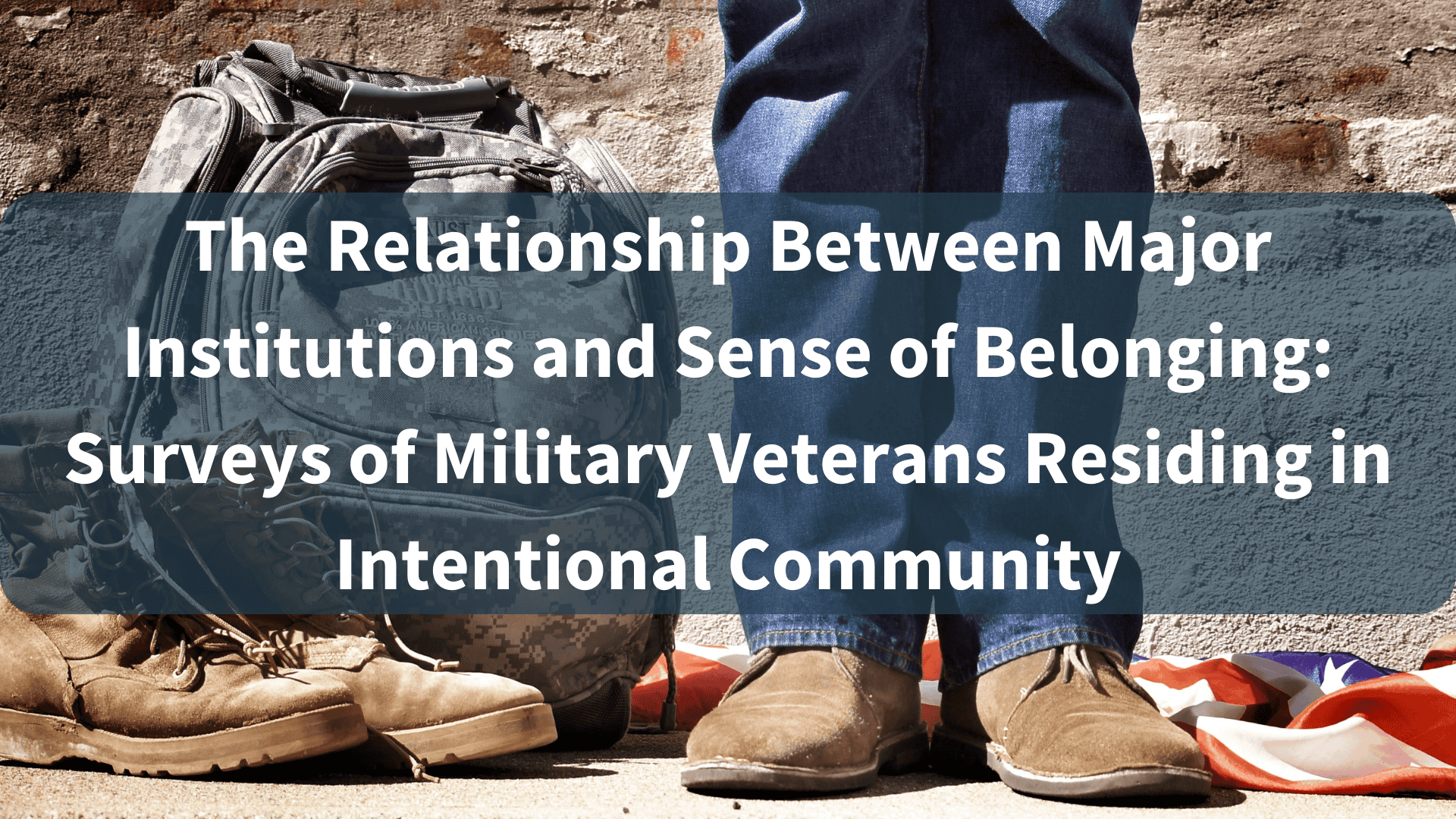
Close-up of military veteran's boots and backpack at community gathering.

The Relationship Between Major Institutions and Sense of Belonging

Surveys of Military Veterans Residing in Intentional Communities

Click here to fill out the survey

Hello fellow lovers of community,

I’m a former Navy Officer, current board member for the FIC and lover of intentional community living. I’ve often noticed a deep and meaningful connection between my time in the military and my time living in community. Back in 2021 I published a piece in Communities magazine called “How the Military Prepared Me to Live in Community” and through discussions with both the editor and readers, I realized that the connection between the two wasn’t as obvious as I thought.

I get it. When we think about intentional communities, an image that comes to mind is a group of hippies holding hands in a circle, about to break bread before an intimate evening of music and cuddling (one of my favorite things to do). When we think about the military, some of us picture a soldier with a gun in some war-torn country, carrying out the orders of a broken political system with perverse incentives fueled by the military industrial complex and our dependence on fossil fuels.

How could those be similar in any way?

As crazy as it may sound, my experience in the military was very much about things like intimacy, closeness and breaking bread together, but I didn’t use those words at the time. When we put the larger topics of why countries deploy military forces aside, what we see when we picture that soldier is something much more human, and much more relatable. My experience of being in the military was one of my first true experiences of belonging to something. It was where I understood, maybe for the first time, what it meant to put my individual interests aside for the sake of supporting the collective. I never ate alone, and when I was struggling there was often a hand reaching out, asking what I needed. Not because that person wanted anything from me, but because I belonged to the group, and that’s what we did for each other.

There are some folks right now studying the impact intentional community has on the world, especially as it relates to veterans.

This project aims to compare and contrast the experience military veterans have had during their military service, during their time living in Intentional Community, and while living as a civilian in mainstream society. This is being conducted by Dr. Zach Rubin (zr****@****er.edu) and The Next Big Step, in collaboration with the Foundation for Intentional Community and we’re asking for support in finding veterans who have spent at least 6 months living in an intentional community. There is a 15 minute survey, as well as an option to participating in an interview later this summer ($50 compensation for participants).

If you’re a veteran who has lived in community, or you know veterans who would be willing to help, we would greatly appreciate your time and referrals.

Thank you for supporting this project and the FIC!

In community,

Dave Booda

Comments

Featured Blogs

Keep the conversation going with these pieces

Charles Durrett
Fri Apr 2015
  • Living in community
  • Relationships
Cohousing can offer a much-improved quality of life to seniors and others; it’s time to break free of the self-inflicted “Oh, that’s not me!”
Maggie Sullivan
Fri Sep 2012
  • New to community
Aspiring communitarians rally support and navigate the legal hoops to establish an ecovillage in Bloomington, Indiana.
Sky Blue
Sat Nov 2017
Tony Sirna is a former Board member, ic.org webmaster, and founding member of Dancing Rabbit Ecovillage. For more 30th blog posts click here. When I took over the FIC web site in 2004 it had already been an amazing resource for a decade. Similarly the Communities Directory had completed it’s …
Foundation for Intentional Community
Tue Nov 2019
  • Living in community
  • Life Transitions
Raising children in community has different impacts than in a single family home. Alicia J. George from Takoma Village shares the most significant ways our three adopted boys’ behavior affected our cohousing community and how we worked jointly to deal with the impact.
Sky Blue
Mon Sep 2017
  • Social Justice
Intentional communities are intrinsically idealistic. They’re based on a radical analysis of social problems and are an attempt to address them. They represent a personal desire to live in a way that feels more satisfying, but also the desire for a better society for all people. They are a recogniti…
Christopher Kindig
Sun Feb 2015
  • Sustainability
For those who harvest honey, “the worst part of being a beekeeper is pulling out the honey-laden frames from the box and tearing them up to get the honey. The bees hate it and so do I. That’s why this new hive design, called Flow, is so cool.” Check out this New Beehive Design does not Disturb Be…
Saul Of-Hearts
Mon May 2016
  • Economics & Law
As interest in community living grows, it’s important that we make it easy and accessible for people to get involved with their local co-ops and coliving spaces. For many people, community dinners, art and music nights, and overnight stays are the ideal way to explore whether coliving is right for t…
Molly
Tue Jun 2008
  • Sustainability
The NBC Today show did a feature on the top 5 friendliest cities in the country and Davis, California made the list in part due to being the home of cohousing and the first city with a city-wide network of bike paths. The article doesn’t say much about cohousing but the video does. Davis is where co…
J McCune Porter
Sat Aug 2016
  • New to community
Community Bookstore Featured Communities Directory Book New 7th Print Edition by Kim Kanney, Community Bookstore Manager Communities Directory Print Book New 7th edition, August 2016 Available and shipping $35 We are so grateful for our supportive community that contributed to our …
Kelly Barth
Sun Jun 2009
  • New to community
  • Sustainability
Organized around common ecological values and a shared appreciation for the epic of evolution, a group of neighbors reduces its collective energy consumption by 25 percent.

Insights & Stories from the Communities Movement

Subscribe to our newsletter for fresh stories and community updates delivered to your inbox.

Join the Communiversity Community

Get unlimited access to courses, exclusive member events, and a supportive network of community builders

Unlimited Learning

Access all courses, books, and premium content

Community Network

Member-only workshops and community builders

Exclusive Events

Member-only workshops and gatherings

Update to a Public Profile

  • Log in
  • Go to your profile page
  • Toggle on the "Add my profile to the directory"
  • Save your profile

Information

Communities

A residential project: people live here as their primary home.

Organizations

An institution, business, network, or project that isn’t a residence (e.g. a learning center, farm, or network with no one living there full-time).

Plus Community Membership

  • Find people with Profile Match
  • Access to your community listing statistics
  • Create Discussion Groups
  • Access to our affiliate program
  • Member badge on your community profile
I am an official member of this community
Disclaimer
I affirm that my information is accurate and I am authorized to manage this listing
Foundation for Intentional Community FIC Member badge logo.

Free Plan

Free Membership
Free

Intentional Advertising

  • Subtotal

    {{ currencyFormat( pricing_summary.total_amount ) }}

Icon representing community connections and collaboration for intentional communities.

Plus Membership

  • Find communities with Profile Match
  • View detailed reviews about communities
  • Create free listings in Needs & Offers
  • Plus Member resources in CommUniversity
  • View communities detailed reviews
  • Plus Member badge on your profile