

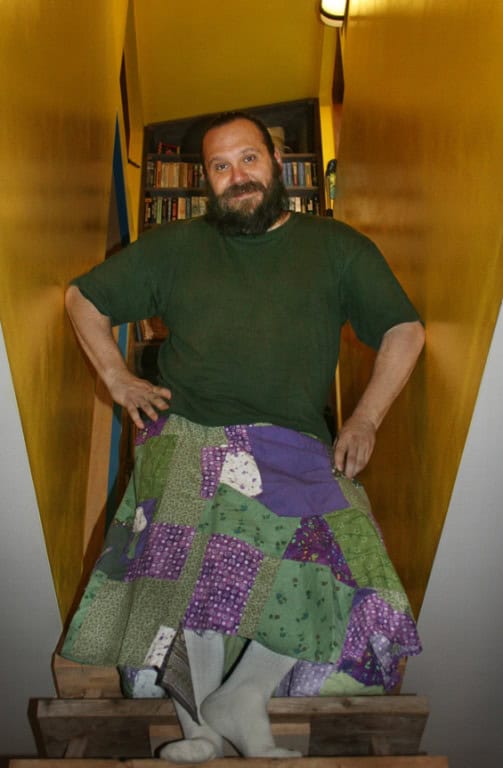
(Pictured: Dancing Rabbit member Coz Walker.)
Dancing Rabbit is a growing community outside Rutledge, Missouri, made up of about 70 individuals with different backgrounds and experiences. We’re an ecovillage, founded in feminism but not focused on it and without a unifying idea of exactly what feminism looks like. I’m offering my perspective, which is certainly not universal, on how sexism affects us here. What you’re about to read is my opinion, and not the official stance of Dancing Rabbit by any means.
Sexism
I’m a woman. I am genetically and physiologically female. I have some masculine traits but I don’t think I’m mannish. I’m pretty tall for a woman, but not at all tall compared to all humans. I have pretty strong arms for a woman, but they’re probably less strong than the average adult’s. I’m extremely messy compared to the women I know, but only sort of messy when compared to my friends and neighbors who are men.
Let me be clear: I absolutely do not think that we can make a conclusive statement about the relative heights, strengths, or messinesses of two people based on their gender. I do think we can draw some bell curves based on observations, and make statistical predictions based on what we see. Maybe the curves will change with time and culture shifts, or maybe they won’t. I might be able to pass as a tenor, but how many women are there who can pull off a baritone or bass part as well as an average man? That’s not to say that a woman couldn’t be a very good bass singer, only that those people are more rare and it’s reasonable that their representation in their field should reflect that.
Noticing, speaking, or accepting that different genders have different tendencies is not what I would call sexist. Some folks might, and I think that’s their way of helping others avoid making assumptions and decisions based solely on gender. We’re sensitive to the fact that the assumption that a person of a certain gender is necessarily incapable of a given task has led to many missed opportunities for people to rise to their full potential and created much injustice in the world. That sensitivity helps us to be aware of what sexist mistakes have been made and to avoid them.
Discrimination is what happens inside a person when they lack the information, the energy, or the motivation to make decisions based on what they see, rather than assumptions based on culture, habit, or previously observed trends. At Dancing Rabbit we’re pretty good at making many choices based on actually taking the time to look at people’s characteristics rather than just lumping them according to gender. For example, this past spring a woman announced at the WIP (our weekly meeting) that she needed “some strong people” to help with moving her propane tank. By identifying the trait she was hoping to maximize she got what she actually needed.
What if I were looking for a wet nurse? I could advertise for a “person who is lactating” instead of “a nursing mother” so I don’t exclude anyone based on their gender alone, even though I’m pretty sure the best person for the job will be a woman. In short, sexism is making decisions or having reactions based on gender instead of some more relevant characteristic.
Avoiding sexism is not as easy as I just made it sound. People are generally pretty bad at knowing why they make the choices they do and even worse at accurately communicating those motivations to others, which makes it really hard to know whether sexism is at play in a given individual action. Plus, we make so many decisions throughout our days and years, and so many of them are sub- or barely-conscious, that some amount of lumping into groups seems necessary for getting though the day.
In order for people of all genders to have the same opportunities and rights, we need to put in the extra effort necessary to consider the possibility that people might surprise us, to be open and aware enough that we can see things even when we don’t expect them. The surprise could come from a person being an outlier for their gender or from the assumptions of previous generations being wrong, or both. Such a moment could cause confusion, fearfulness, and insecurity, or curiosity, wonder, and humility. Openness to people being their very best selves, whatever their gender—that’s the antidote to sexism.
Counter-Discrimination Tactics
Folks at Dancing Rabbit are generally good at being open to the possibility that a woman might be the best choice for a job that has historically been done mostly by men, or vice versa. I’ve seen folks get really excited about it. In fact, I’ve seen us consider as a group whether we should choose a woman for a traditionally male role even if there’s a more qualified male available. During that discussion I heard from my fellow community members that the aim of this calculated sexism would be to give an advantage to women in historically male fields to help correct for disadvantage they’ve experienced otherwise. I think there’s merit in that. I also think we have to acknowledge that it is a kind of sexism, because it includes or excludes people based on gender. On the whole, I think Dancing Rabbit is in favor of this kind of corrective discrimination.
I personally have concerns that giving preferential consideration to one gender over others, especially for paid work, could have the opposite effect that folks are hoping for.
In addition to the offensiveness of the implication that a woman in a man’s world must need our help to succeed, I have concern about how giving such advantages affects the resulting workplace. Imagine, for example, that you’re hiring a work crew of six carpenters and want to have 50/50 gender balance. If you get applications from qualified candidates in a ratio proportional to the ratio of carpenters in the US as a whole, which according to the Bureau of Labor Statistics was 1.4 percent women in 2010, you have to turn down about 194 qualified men even if you hire all of the female applicants. If the three men you hire are the best three for the job, then those men are almost certainly going to be better at the job than the women, not because men are necessarily better carpenters than women overall, but because you had to hire the best, middle, and worst woman candidates available, but only the top 3 percent of the men. On the worksite, then, those guys, and those gals, are certainly going to see more evidence to back up the very stereotype we were trying to counteract.
It’s hard to be patient, but I think that’s what we need to do to effectively correct the erroneous perceptions that are harming women’s ability to earn a living, participate meaningfully in fields that excite them, and live up to their full potential. Pushing men out of the way isn’t the way to do it. My suggestion to folks at Dancing Rabbit who wish to help women who have interest and talent in very male-dominated fields is that they should run educational workshops in those fields and welcome women to join, and show them as much respect and encouragement as the men in the group.
There have been a few workshops at Dancing Rabbit open only to women. This is another example of sexism aimed at counteracting the historical trend. I appreciate that some women might not feel comfortable exploring a new skill while there are men around, and they should have a chance to learn. At the same time, though, it’s that very argument that feels degrading to me, which bothers me even more than the simple, overt sexism of excluding men and other genders out of hand. It feels degrading because it implies that women are not emotionally strong enough to do something we want in the face of discomfort or fear—that we need to be protected from our own feelings of embarrassment and inadequacy in order to succeed. To me that feels patronizing. It also seems counterproductive to building a global culture in which we are equally open to accepting the particular gifts of everyone, and in which we feel able to confidently offer those gifts, regardless of gender. While I am thankful for folks’ efforts and good intentions in offering skill-building opportunities to a segment of the population less likely to have gotten those opportunities elsewhere, I question the overall wisdom of using sexism to fight sexism.
The Boys’ and Girls’ Clubs
One of the behaviors that comes up the most for me when I think about sexism at Dancing Rabbit is the gathering of people together for emotional support, divided by gender. Men’s Group and Women’s Circle are not official Dancing Rabbit events or organizations, just gatherings of people who want to get together for a shared activity, open to anyone to participate in, with one catch: Women’s Circle is for people who identify as women, and Men’s Group is for people who identify as men. There is not yet a group of or for people who don’t identify as either of those genders.
Were a group of people to decide, after getting to know one another, that they feel safe together and want to get together to talk about some tender things, without the whole village looking on or bringing unwelcome energy, and they all happen to be of the same gender, I would not call that sexist. Choosing all woman friends does not make a person sexist, it simply belies a preference. On the other hand, being explicitly open to any woman-identifying person and closed to any non-woman-identifying person is overt sexism. Ditto with men. I don’t go because I’m not sure the kind of sexism embodied by the existence of gender-specific groups is healthy for the kind of culture I hope we’re growing here. Many people think it is healthy, the groups are well attended, and the reports I get from Men’s Group, at least, are that those who attend are better people for it.
But I can’t help wondering what the reaction would be if Dancing Rabbit had a richer racial diversity than we do and there existed something like “Whites’ Night” which anyone who identified as white could attend. They’d participate in deep sharing and mutual support in their whiteness, and everyone else was explicitly excluded, though free to form their own group if they so desired. The reason for that racism might be given as some white people not feeling safe sharing some parts of themselves in the company of other races, perhaps because in the past they’ve been hurt by a non-white person. That’s kind of how Women’s Circle looks to me.
It’s hard for me to lodge a complaint with something that my fellow communitarians find so rewarding, and it’s not totally clear to me whether the net effect will be toward an end I’m hoping for or not, but, if you ask whether the gendered support groups are sexist, the answer is clearly yes. Genderist? I’d say so. Will I participate? No thank you. Will I think less of those who attend? No. I wish we had a culture in which people could be more thoughtful about including and excluding people based on criteria more relevant than their gender, but it takes so much energy to do so, maybe that’s better spent on other things.
Gender Balance
Another clearly sexist occurrence at Dancing Rabbit is the pretty frequent talk of seeking or needing “gender balance” on a given committee. We are likely, as a group, to give preference to people who round out the gender diversity on a committee, over those who might be more interested or more proficient in the task at hand. Honestly, I haven’t seen it happen very often, but it is talked about an awful lot.
Warren Siting is the committee responsible for helping people figure out where and how to build their homes and other structures in order to be harmonious with the existing village and with the plan for growth. I heard a concern that with all men on the committee there was no one that a woman might feel comfortable talking with about the sensitive topic of where and how to build her house, that she would feel intimidated. That’s both sexist in the assumption that a man cannot be easy to talk to and disempowering in the implication that women shouldn’t be expected to communicate with a man without a woman-savvy liaison. On the other hand, it could be that it’s another kind of discrimination to not accommodate the needs of everyone, and maybe help communicating with men after a lifetime of oppression by them is a need some people have.
Our mission at Dancing Rabbit is partly to be an example for others to follow, so I can see the merit in creating a tableau of what we hope the future will naturally look like. It’s hard to know how much of the unequal representation of genders in certain fields is related to inherent differences among genders, and how much is due to cultural influence stemming from some long-standing and arbitrary or outdated bias. Maybe in a perfectly un-sexist world those committees would still end up mostly made up of one gender. We won’t know that until we live in an un-sexist world.
Are We Sexist?
Yes, there’s sexism at Dancing Rabbit. Of course. We’re a community made up of individuals who came from the wider US culture and tens of thousands of years of human history before that. Some of our sexism stems from noble intentions, some from confusion or lack of energy to examine our motives and our goals closely. At the organization level, our membership agreement contains a pledge of non-discrimination based on sex, among other things. It seems to me that we’re letting some things slide as far as overt discrimination, but at least our paperwork is in the right place.
Men wear skirts, women wear pants, and we have at least a stated norm that wherever a woman must wear a shirt, so must a man, though that last one’s not always remembered and observed. Long hair, short, whatever. Armpit and leg hair is totally acceptable, regardless of gender.
We’re also doing well insofar as sharing chores across established gender lines. Most people here take a cook shift, most people clean public and private spaces, all parents (and many others) participate in childrearing. There’re men and women in leadership roles here, and on physically, technically, and socially strenuous tasks. More importantly, there’s not the expectation or requirement that people of a certain gender are the ones who perform a certain task. We’re free to choose how to contribute based on our interests and talent—one reason I am proud to be a part of this community.
We’re far beyond most of the country in terms of accepting people for who they are and the contributions they bring, regardless of their gender. Part of that’s thanks to Dancing Rabbit’s foundation in feminism, for which I’m grateful. I think there’s room for us to be more open-minded and objective around gender, and I look forward to watching that unfold at Dancing Rabbit and beyond.
Keep the conversation going with these pieces
There are no available blogs
Subscribe to our newsletter for fresh stories and community updates delivered to your inbox.
Get unlimited access to courses, exclusive member events, and a supportive network of community builders
Access all courses, books, and premium content
Member-only workshops and community builders
Member-only workshops and gatherings
We use cookies to improve your experience on our site. By using our site, you consent to cookies.
Manage your cookie preferences below:
Essential cookies enable basic functions and are necessary for the proper function of the website.
These cookies are needed for adding comments on this website.
Statistics cookies collect information anonymously. This information helps us understand how visitors use our website.
Service URL: policies.google.com (opens in a new window)
A residential project: people live here as their primary home.
An institution, business, network, or project that isn’t a residence (e.g. a learning center, farm, or network with no one living there full-time).

{{ item.label }}
{{ item.value ? item.value : currencyFormat( item.amount ) }}
Subtotal
{{ currencyFormat( pricing_summary.total_amount ) }}
There are no results matching your search