Author: Chant Thomas
Published in Communities Magazine Issue #143
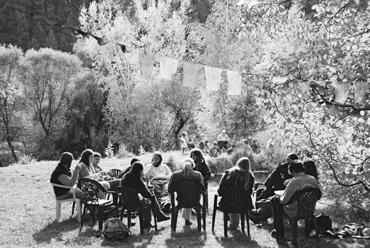
You might have been there with us…sitting in silent circle, giving thanks for the dinner we were about to eat together. Feeling so right in that moment…with a warm current of love coursing though the holding hands of a dozen friends in community. Sweet song of the river rushing over rapids outside the window, savory aromas wafting from pots and oven… A prayer breaks the silence; we laugh and pass the food.
Sounds of footsteps on the kitchen porch announce a visitor at the back door. An acquaintance, who’d been looking to buy land just upriver, opens the door before we could answer. Despite the feast, he declines our joyous invitation to join us for dinner, and with a most serious expression, he tells us he has bad news to share. “I went down to the government office in town today to check on their plans for the canyon. They showed me maps where they plan to clearcut the forest right to the property lines.” He continued, “they told me there was nothing we could do. So, I’m not pursuing the land upriver. I’m sorry to bring Trillium this bad news.” With that, he was out the door, leaving us with sinking stomachs and appetites that floated on downstream.
Truly shocking news! We were stunned! A few years before buying our Land, I had thoroughly researched land uses, wanting to avoid industrial logging, mining, and similar mischief in the vast forests of southwestern Oregon’s Siskiyou Mountains. As several of us were avid backpackers and lovers of wilderness, we knew well the power of wild pristine landscapes to uplift our spirits, helping us feel humbly embedded in the awesome embrace of Nature. We also realized our beautiful wild surroundings would provide both an important amenity for our community residents, and a valuable draw for participants in our planned cultural and educational programs. We wanted our human interplay with a wild and powerful Nature to focus and enhance our spiritual, cultural, and economic life on the Land.
After a lengthy search, we settled on purchasing a remote trout hatchery with several ponds, waterfalls, and meadows along an intimate little creek canyon that then dropped into the much larger canyon of a high mountain river. A towering peak cloaked with old-growth forests rose steeply just across the river, a powerful backdrop to our Gathering Grounds. The creek rose in a wilderness watershed with no roads, logging, or development, providing us with pure gravity-flow water. These natural features enchanted us, despite dozens of junked vehicles, appliances, and equipment. We decided that rather than buying and impacting pristine land elsewhere, we would clean up and restore this special place. Thusly, we became newly minted environmental activists and birthed Trillium Trout Farm during the back-to-the-Land movement of the 1970s.
Because our Land came surrounded by wildlands managed by the federal government, we thoroughly researched the government management plans to see what they had in store. Government managers assured us their management direction for the river canyon focused on recreation, pointing out two existing riverbank campground/picnic areas and several miles of wilderness hiking trails. They told us the forests there did not grow fast enough in the arid climate to manage for commercial timber cutting. These assurances played a major role in deciding to locate our community homestead here, so the news of clearcut logging came totally unexpected.
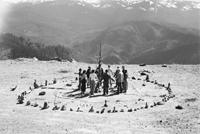
Back at the dinner table, one of the women guided us through a visualization where we pictured ourselves in the future as elderly people out on the lawn looking up at the forests of Trillium Mountain. We could see that the forests were still uncut, and no logging roads had been built across the mountain. This visualization helped us feel well enough to continue eating dinner while discussing options for action. Turns out the visualization may have done more than just help us feel better! The very next day, a neighbor who I’d been working with on government forest issues called to report that some new neighbors, a famous author and his movie-star wife, had just agreed to get involved in stopping proposed government logging above the stretch of river in their neighborhood, several miles downstream from Trillium.
Imagine getting celebrities involved in your activist campaigns! Turns out their leadership secured victory as we stopped that logging downriver. We next worked with the government agency to keep their logging out of the river canyon around Trillium. During that process, we connected with some activists from intentional communities a few valleys to the west, exchanging experiences dealing with logging on federally managed forest lands. We discussed strategies for involving neighbors, fundraising, and publicity. We also shared stories about how well, or not, our various intentional communities had embraced forest activism, and how supportive these communities were of their activist members who had become involved in campaigns to protect forest and wilderness.
We realized that many intentional communities organize around positive activism as a pro-active path toward making the world a better place. Most intentional communities understand that the very act of coming together to live on the Land in community constitutes a powerful statement of ecological and cultural activism. At Trillium, for example, we worked to start or assist in starting a local forest workers coop, a natural foods co-op and gas station, an alternative school, a national women’s herbalist conference, and a film festival in town. All these projects combined “positive activism” elements of environmental, social, cultural, economic, and community activism. However, defensive activism became the more difficult and less attractive action necessary to preserve essential components of our quality of life, such as clean water and air, peace and quiet, inspirational wildlands, and spectacular scenery, from looming threats such as logging, mining, off-highway vehicles, cattle grazing, shooters, dam construction, and development. For Trillium, like any land-based community, needed to answer several questions to determine what potential crises, such as government clearcutting, might spur us into defensive activism to secure the environmental amenities that convinced us to homestead on this particular Land: Who are our neighbors? What are the current nearby land uses and how might they change over time? What negative impacts could occur to our local environment? How could our community be affected? What are we going to do about it?
Thousands of acres of government wildlands surround Trillium, quite a behemoth neighbor! As we found out, one manager may favor recreation for our river canyon, while the next manager may see forests to cut. During the last few decades, government timber budgets expanded while their recreation budget shrank to near nothing. The campgrounds were neglected and abandoned; local hikers and equestrians volunteered to maintain the wilderness trails. Meanwhile, government plans for logging thousands of acres surrounding us proceeded beyond the initial clearcutting we’d stopped earlier. Such large-scale logging meant miles of new logging roads punched into the wilderness, providing access to hordes of hunters, shooters, OHV (off-highway vehicle) riders, toxic dumpers, and various other road-related problems. After any clearcutting, the government would spray toxic herbicides like Agent Orange, fouling the water and air. Once the landscape gets developed for industrial logging, the once quiet canyons reverberate with sounds of innumerable forest crews, their traffic and activities: road construction, logging, helicopter spraying, burning, planting, in an endless rotation of perpetual industrial management.
The high stakes convinced us that we needed to succeed! It turned out by default that I became the community’s resident activist, as relevant experience gained working in logging and for various government agencies provided me with the necessary confidence to step up to the task. While some community members assisted in the activist campaigns, most were just glad somebody else dealt with it all. Some years saw the community stepping up to support the activism by hosting activist gatherings and training sessions. Other years I had to hustle to keep up with my community work contributions, as the activist work didn’t then count toward community work time, even though I considered the activism as protecting the greater wild garden surrounding Trillium.
It has taken years, many years spanning four decades now, to protect our quality of life by working hard to actively influence the planning and implementation of government projects. With sporadic assistance from my community colleagues and some neighbors, I’ve been able to halt or work to modify most of the huge government logging projects planned for our watershed. Our wilderness drinking watershed that supplies all our gravity-flow domestic and irrigation water still shines in nearly pristine condition since I worked with a local rancher and some sympathetic government specialists to halt cattle grazing in a 28,000 acre area for over 30 years now. Using our natural food co-op/gas station as an outreach base, I was able to gather support to stop a proposed dam on our river before the process got beyond the initial planning stages.
Still, government agencies keep me busy tracking nefarious plans for huge logging projects, road building, mining, and development of vast landscapes dedicated to OHV playgrounds. However, such tasks have become a bit easier lately, even during the reign of W. During the late 1990s Trillium morphed through yet another stage in her evolution as an intentional community. We now focus more than ever before on environmental activism, primarily the education and training of future activists. Some of these new activists have settled in the area; some work as staffers for local and regional environmental activism organizations. Having these wonderful, energetic, younger activists working on similar issues makes my activist work more collegial and less demanding.
Now, when I’m asked what we grow at Trillium Farm, one of my replies is “activists!” Our organic farm intern program exposes participants to activism through growing organic food and assisting with various activist and arts programs we host through Birch Creek Arts and Ecology Center. The interns also learn, and teach us more, about our many efforts to become more sustainable with a smaller ecological footprint as a community, from recycling and buying in bulk to our vegetarian diet.
In our Ecostery program, college students come to Trillium for eight-week residential semesters where they earn 17 university credits in an interdisciplinary curriculum specifically designed to groom and educate future earth activists, land stewards, and communitarians. (See “Wilderness is our Classroom: Growing Education and Community at Trillium Farm,” Communities #108, Fall 2000, p. 36). Research conducted by Ecostery participants informs our community as we learn and adopt more innovative ways to be better earth stewards. Ecosterians (as we affectionately call them) introduced us to compact fluorescent lighting, rocket stoves, and some alternative building methods.
Ecostery activist learning opportunities range from monitoring government resource plans to studying a recently burned forest to learning to grow food organically. The Ecosterians form their own intentional learning community embedded within the Trillium Farm Community. They learn to live and work together conducting regular meetings and studying non-violent communication and consensus, all important skills for successful activists.
Well aware of the high numbers of threatened, endangered, and listed species in our local habitats, Ecosterians work in our ongoing collaboration with Oregon Fish and Wildlife to monitor a population of threatened western pond turtles in our old trout ponds. We’ve also been monitoring the only known Oregon location of endemic birch trees in our watershed. The students work with a Forest Service botanist to identify alien plants that threaten native habitat, putting that knowledge into action by working to eradicate certain alien plants at Trillium and in nearby sensitive locations. The interns and students learn about our community responses to ecological concerns and opportunities, such as our prohibition of dogs at Trillium, our enhancement of anadromous fish habitat along the river, and our environmental stewardship programs
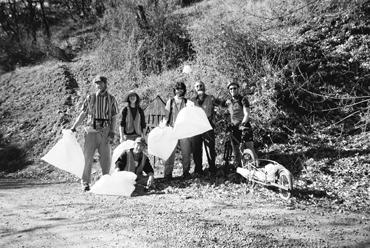
Our environmental stewardship programs present great opportunities for Ecostery students and interns to have fun outside while improving our local transportation routes. We work together to maintain several miles of nearby wilderness hiking trails, a pleasant scenic project despite the poison oak! Our most public such program provides Trillium with an invaluable opportunity to enhance our image within our local community: we pick up litter along four miles of the awesome dirt road that snakes up the canyon from the valley below. Several local folks of the conservative political stripe have expressed gratitude for our work to keep the canyon clean and beautiful.
Operating a teaching/learning center at Trillium brings us the special responsibility to walk our talk. Our interns and Ecostery students keep us on our toes, enriching our environmental sustainability efforts through their previous experiences and their research while here. Participants in our arts and cultural programs can then learn about what we’re doing at Trillium Community to lessen our ecological footprint, move toward sustainability, defend our wildland habitat, and enrich our local community. As my beloved parther Susanna Bahaar summarizes, “It all comes down to creating more love, harmony, and beauty—inside and out.”
Sidebar:
Why Vegetarian?
Back in the 1970s, significant numbers of back-to-the-land intentional communities embraced vegetarianism as an essential part of their alternative to the dominant culture, which was characterized by a diet heavy in meat consumption. From a thousand vegans at The Farm in Tennessee to our dozen vegetarians at Trillium in Oregon, a meatless diet flavored much of our Movement. As the negative impacts of industrial meat production on our planet, its people, and its animals have become more apparent during the ensuing decades, our inspirations and reasons for choosing vegetarianism are reinforced.
Back-to-the-land intentional communities have been described as Research and Development Centers for Society. Our research indicates intentional communities owe it to themselves and our larger society to adopt vegetarianism, or at least become aware of what happens to the animals they eat, from birth to plate. Consider you are what you eat:
Vegetarians suffer from far less heart disease, cancer, obesity, and other health problems than do meat eaters. Wouldn’t your community function better if your members pursued a diet that favored better health, growing stronger resilient bodies to better enjoy gardening and building, hiking, making music and love? Would there be less sickness to tend and heal?
The Land we’ve gone back to is so precious, as is the clean air and pure water. Yet, growing animals for human consumption in the US gobbles 80 percent of our farmland, causes more water pollution than all other industrial uses combined, consumes one-third of all the raw materials and fossil fuels we use. Would your community trash its land and resources in this manner?
Eating meat creates a planet of poop! In the US, meat animals produce over 130 times the feces as the human population, with no sewers! These feces constitute the largest source of airborne methane, which traps heat in our atmosphere twenty times more than carbon dioxide. Raising meat animals produces 40 percent more global warming emissions than all transportation combined. Meanwhile, a vegan diet requires 300 gallons of water per day, compared to 5200 daily gallons to support a meat-based diet. Is sustainability an important value for your community? How does your diet reflect your values?
Over 27 billion (that’s nearly 20,000 per minute!) animals are slaughtered yearly in the US for human consumption. These intelligent creatures feel pain, and have complex social and psychological lives; most suffer horrible death and torture along the way. Do you really want to be part of this karma?
Mohandas Gandhi said that a nation’s moral progress could be judged by the way it treats its animals. That concept expanded to our entire planet indicates that we need a change of consciousness at a planetary level. Heard that before? Be a part of that change now! You’ll do more to help solve problems with pollution and global warming by becoming vegetarian than by trading in your SUV on a Prius, with many more ancillary benefits for you and your community. If you’re having difficulty considering the change, then take this encouragement from a teenage vegetarian: “Don’t be a chicken! Stop being a pig! Don’t have a cow! Be the first in your community to eliminate or at least reduce your meat consumption.”
For more info, check www.GoVeg.com.
Keep the conversation going with these pieces
There are no available blogs
Subscribe to our newsletter for fresh stories and community updates delivered to your inbox.
Get unlimited access to courses, exclusive member events, and a supportive network of community builders
Access all courses, books, and premium content
Member-only workshops and community builders
Member-only workshops and gatherings
We use cookies to improve your experience on our site. By using our site, you consent to cookies.
Manage your cookie preferences below:
Essential cookies enable basic functions and are necessary for the proper function of the website.
These cookies are needed for adding comments on this website.
Statistics cookies collect information anonymously. This information helps us understand how visitors use our website.
Service URL: policies.google.com (opens in a new window)
A residential project: people live here as their primary home.
An institution, business, network, or project that isn’t a residence (e.g. a learning center, farm, or network with no one living there full-time).

{{ item.label }}
{{ item.value ? item.value : currencyFormat( item.amount ) }}
Subtotal
{{ currencyFormat( pricing_summary.total_amount ) }}
There are no results matching your search