

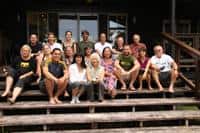
Intentional communities—people gathering to share life together, to discover meaning, and to have an impact beyond themselves—have been part of the human landscape for centuries. Many predate Christianity. Hinduism, Buddhism, and Judaism have all had communal aspects which many have chosen. Sufism (Islam), Protestantism, Anglicism, and Catholicism have had and continue to have thriving communities which take their identity from a religious tradition.
This article explores some commonalities between religious communities (both contemporary and classical) and non-religious intentional communities.
Contemporary Religious Communities
In the contemporary world many intentional communities have emerged in the last hundred-plus years which are rooted in a religious tradition, but which expand the usual meaning of communal living. For instance, the Kibbutz movement founded in 1909 continues to thrive in Israel, growing from a single community to 268 Kibbutzim in 2000. The movement was founded by young pioneers from Eastern Europe who wanted to find a new way to live on the soil of their ancestors. The Kibbutzim are organized around democracy particularly, and are not limited to an agricultural focus. A strong work ethic, a family orientation which takes into account individual needs, and the celebration of Jewish traditions make Kibbutzim an integral part of Israeli society. A Kibbutz is built around a community dedicated to mutual assistance, social justice, and common ownership of property, where each contributes according to his or her ability and needs. The development of the Kibbutz played a significant role in the establishment of the State of Israel. The Kibbutz provided support for the individual, social, economic, religious, educational, and cultural needs of its members.
A more recent communal development can be seen in the Community of Sant’ Egidio. It was started in the Trastevere section of Rome in 1968 by young adults after the Second Vatican Council. These young people, many under 20 years old, wanted to put the Gospel into action. The Community of Sant’ Egidio currently has more than 60,000 members in 73 countries worldwide. The different communities spread around the world share a common spirituality and principles:
● Prayer is central to the overall direction of community life.
● Communicating the Gospel is at the heart of the communal life. It brings meaning and life to the community.
● Solidarity with the poor and elderly is a voluntary commitment and linked to gratuitous service—“a Church for all and particularly the poor” (John XXIII).
● Ecumenism is lived in friendship, prayer, and search for unity.
● Dialogue is a way to foster peace and cooperation.
Living out these principles, the community has been able to broker peace in Mozambique, Kosovo, Albania, Algeria, Balkans, Guatemala, and elsewhere. It has worked on AIDS initiatives in Africa, a hospital in Buinea-Bisau, education, peace, and humanitarian aid throughout the world. Currently one focus of the Community of San Egidio is to eliminate the death penalty, with a special emphasis on Texas. Sant’ Egidio is truly a community without borders or walls. It is formed by friendship among people of different nations and cultures. It is the everyday way to express this international human solidarity. Living this global dimension of life together means both to be open to the world and to belong to one family, the family of Gospel disciples.
The Kibbutzim and the Community of Sant’ Egidio are very different structurally. The Kibbutzin are tightly structured with all living and most working on the same campus; the Community of Sant’ Egidio is loosely structured, with people living and working independently while gathering regularly, in many cases daily, for prayer and mission. Both of these newer forms of religious communities share many things that the more classical religious communities have in common. The Monastic communities—communities sharing a common life, values, and spirituality—emerged in the fourth through sixth centuries CE, and had a great impact on Western society. Many continue in traditional and adapted forms today.
Classical Religious Communities
In the middle of the sixth century, Benedict wrote the Rule that would subsequently be the basis of communal religious life in the Western world from about 550 to 1500 CE. Those choosing the monastic life lived together, worked together on the monastery grounds, learned together, and prayed together. Gradually in the 12th and 13th centuries those living in communal life traveled from the monastery to do apostolic work such as caring for the sick, sheltering pilgrims, preaching, and teaching in universities.
Communal life in the monasteries had a positive impact on all of society. For instance, agriculture was systematized and advanced by the monks. Architecture in the Western world was enhanced and moved forward to produce both the great Romanesque and later Gothic cathedrals. The monasteries contributed to learning and literacy, and the economy of the times. They advanced civilization.
In the 16th century, Gospel communal life changed for some men called to religious life. The Jesuits in particular moved away from monastic life as such, because the needs of the apostolate called for their schedules to be very flexible, their housing to be more local, their ministries more adaptable. Women religious were still required to live a cloistered “monastic life” or be excommunicated by the Roman Church authorities. Thus you had people like Louise de Marillac declaring herself a “Daughter of Charity” (not a sister) to avoid the Roman restrictions. Women’s communities figured out ways that allowed them to care for the sick, teach, minister to those in need, etc.
Finally in 1900 Leo XIII formally recognized an authentic form of “non-cloistered” religious life, which many women religious live today. From its beginning until now, intentional communal religious life has continued to evolve based on the sociology of the times, the needs of civilization, the work of the Spirit, and insights and charism of the leaders of the day.
Five Characteristics that Sustain Today’s Religious Communities
I have had direct familiarity with religious communities and have been a planning consultant for both men’s and women’s Catholic communities for the past 12 years. Some communities with whom I have worked were as small as 23 people, some as large as 700 people. The median age in most of them was between 65 and 70 years old. My work in facilitating planning sessions in various parts of the country with religious communities has led me to deeply appreciate the members’ desire to provide excellent care for the elderly, as well as their attention to the legacy they are leaving with the hope of creating a better world.
In my experience working with Catholic religious communities for many years, I have found that there are five characteristics that prevail in effective intentional religious communities of both men and women:
1. A founding leader or leaders whose charism continues to inspire
A charism is a gift freely given by God. In Greek it means “gift of grace.” Catholic religious communities have unique charisms. While all the communities I have worked with have charisms embedded in the Gospels, each one is articulated differently. Some talk about the gentleness and kindness of the Savior; some about search for truth through contemplation; some live out humility and hospitality as Mary did; some talk about a passion for healing; others are called to integrate the Gospel values into daily life.
I have been inspired by women and men religious who can articulate their founding charism as if the leader were still alive and walking the earth. In reality many have been dead for hundreds of years. The charisms of communities which attract people today are both broad and deep enough to continually inspire followers to meet the needs of a contemporary world.
2. A transcendental or spiritual element
This element points to “there is more to life than meets the eye.” It refers to a spiritual reality—a God by any one of many names, or Jesus Christ, or Spirit within and or an evolving Spirit calling people forward. Many charisms explicitly state a particular spiritual focus, acknowledging the presence of the transcendent. For instance, one articulation of the Franciscan charism is centered in the incarnational worldview (Spirit in the world), and in a life of penance or conversion. Contemplation, silence, and meditation have been an essential part of all the communities with whom I have worked.
From the charism or spirituality of the community, the Gospel values and the vows flow. These may include poverty, humility, contemplation, teaching, peacemaking, care of persons who are poor, and care of the earth.
3. A purpose or mission
This points to the intention or the reason why the community exists. These will vary greatly. Some communities exist to pray and be united in heart and mind with Jesus Christ through prayer for the world and the Church. Others have specific ministries and exist to “participate in the prophetic mission of Jesus to witness God’s love for all creation.” Others have a mission of serving the sick and the poor. Still others exist to proclaim the Gospel through preaching and teaching in order to build a holy and just society and Church. Articulating the community’s mission or purpose for existence in a compelling manner is critical for its survival. Providing opportunities for enriching and deepening experiences—spiraling into new consciousness, in an evolutionary dynamic—has transformed members and expanded their understanding of the human adventure.
4. Agreed-upon “ground rules,” boundaries, mutual expectations
Canonical religious communities have a Rule and Constitution upon which all agree to live. Initial formation programs which last several years “form” the members in the “rules” of life by which they will be expected to live. These are reviewed regularly through ongoing formation, and updated as needed. Many use or adapt the classical “Rules” such as those of St. Augustine or St. Benedict. All focus on the canonical vows of poverty, chastity, and obedience, with some extending the vows to include such things as the vow of stability in Benedictine communities and a vow of the Jesuits to obedience to the Pope in regard to the missions.
Besides the formal “rule and constitutions,” communities need to have mutual understandings regarding “ground rules,” boundary issues, cultural mores, and shared expectations of each other. It is in this arena where conflicts or misunderstandings or tensions often arise based on age differences, cultural differences, or personality differences. As one sister said, this is where “all the theology goes out the window and the ‘rubber hits the road.’” Interpersonal struggles, unbridled egos, and pettiness—the human condition—take their toll on religious life as well as the life of all intentional communities.
5. A compelling vision
Vision points to what we want our world or our community to look like in the next five to 10 years. It is a touch point for many in the community. It is the stretching point. It is what keeps people going when the going gets tough! It is what gets people out of bed in the morning! Sustainability is one example of a compelling vision.
Many of the men’s and women’s religious communities that I am working with have undertaken the concept of sustainability as a vital part of their vision. They are talking about ecological sustainability, evolving consciousness, and the sustainability of their legacy—to create a more just society and Church. In her book Green Sisters, Sarah McFarland Taylor describes her firsthand knowledge of the Sisters whose lives bring together “Catholicism and ecology, orthodoxy and activism, traditional theology and a passionate mission to save the planet. As green sisters explore ways of living a meaningful religious life in the face of increased cultural diversity and ecological crisis, their story offers hope for the future—and for a deeper understanding of the connections between women, religion, ecology and culture.”
The concept of sustainability is but one of a myriad of possibilities for a community vision. The concept is appropriate for a vision statement, as in many cases it connects to the charism, mission, and values of a religious community and interrelates all that to the sense of urgency to care for planet earth.
Connections to Secular Intentional Communities
The five characteristics named above are found in both the Kibbutzim and the Community of Sant’ Egidio as well as in vibrant vowed religious communities today. What do today’s religious communities have in common with intentional communities that may not be based on a religious conviction?
The five characteristics named above can also be an assessment screen for all intentional communities. The founding charism is important, though it is often not well articulated. And in the rapid pace of today’s society, the charism may need to be reinterpreted and expanded to meet contemporary needs. The unfolding or evolving understanding of the underlying charism needs to be articulated in a way that inspires others. In some cases those who were responsible for founding the community need to let go of the original vision to allow modifications to continue to nurture the community.
The transcendental aspect of a community is important. It does not have to be recognized or named in religious or spiritual language. What is important is that there is some acknowledgment that there is more to life than meets the eye. It may be as simple as knowing that when a certain number of people work together for a common goal the energy generated is more than the sum of the individuals. Intentional communities can build transformative energy, beyond what is expected, through the synergy created by working together, sharing ideas, making sacrifices, and not being ego-driven.
Having a mission or purpose is essential for all communities. It is the glue that holds the community together. The purpose must generate passion and its purpose must be beyond itself. The mission must be imagined to make a significant difference beyond the community. A soft, warm, fuzzy mission will not sustain a community.
Agreed-upon procedures, rules, and covenant relationships are what help a community to function. The ways it deals with differences, disagreements, and conflicts mirror its strengths. Until “rules” and mutual expectations are agreed up and dealt with, the community will flounder and waste a lot of energy trying to deal with conflicts and tensions. This is true for both religious and other intentional communities.
Vision is what gives all communities their spark, their passion, and their energy to struggle through the difficult times to achieve some significant things that could not be obtained without the community.
The continuation of courageous religious communities over the centuries, and all they have been able to accomplish as communities, can be an impetus for intentional communities today. The five characteristics named above can be used by all communities to screen for success. Just as both initial and ongoing formation are essential to vibrant religious communities, so too, other intentional communities might well benefit from the wisdom of those who have been contemporary pioneers in forming non-religious life-giving communities.
Maureen Gallagher has more than 30 years’ experience in leadership, planning, and organizational development. She holds graduate degrees in Theology from the University of Notre Dame and Art History from Dominican University, and a doctorate in Adult Education and Management from the University of Wisconsin-Madison. She has taught in more than a half dozen colleges and universities and is also an author, speaker, consultant, and conference facilitator. Currently Maureen is a Senior Consultant with The Reid Group.
Keep the conversation going with these pieces
There are no available blogs
Subscribe to our newsletter for fresh stories and community updates delivered to your inbox.
Get unlimited access to courses, exclusive member events, and a supportive network of community builders
Access all courses, books, and premium content
Member-only workshops and community builders
Member-only workshops and gatherings
We use cookies to improve your experience on our site. By using our site, you consent to cookies.
Manage your cookie preferences below:
Essential cookies enable basic functions and are necessary for the proper function of the website.
These cookies are needed for adding comments on this website.
Statistics cookies collect information anonymously. This information helps us understand how visitors use our website.
Service URL: policies.google.com (opens in a new window)
A residential project: people live here as their primary home.
An institution, business, network, or project that isn’t a residence (e.g. a learning center, farm, or network with no one living there full-time).

{{ item.label }}
{{ item.value ? item.value : currencyFormat( item.amount ) }}
Subtotal
{{ currencyFormat( pricing_summary.total_amount ) }}
There are no results matching your search

We’re introducing new Plus features — including community reviews, Profile Match, and unlimited Needs & Offers posts — while keeping most of FIC free for everyone. Membership costs less than two coffees a month.

