

Offerings to the Land

Placeholder image for Foundation for Intentional Community website.
Codicts Team
  • January 21, 2016
  • Sustainability
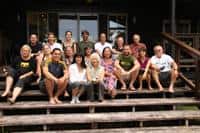
Group photo of diverse community members on wooden steps at Foundation for Intentional Community.

I can’t remember a time when I didn’t feel as though the trees, rocks, rivers, hills, lakes, and mountains were my trusted friends and confidants. I have heard of studies that show a long walk in nature to be as effective as antidepressant medication, and other studies measuring how the number of close friends one has increases one’s mental resiliency and lifespan. To me these two assets, green places and friends, are at least somewhat interchangeable. I’ve had many a good long cry by a sympathetic river or a favorite tree that leaves me feeling lighter and clearer about what I must do than any visit to a therapist ever has. I also tend my green places like one might care for a friend, heading out into the woods with my ax and saw to trim back the trails, chop a path through fallen trunks, and open up new views. When I return to my family’s home, a walk down the trail to the rocky Maine shore is just as important as paying a visit to Grandma.

I have been a wanderer most of my adult life, a nomadic wilderness guide who moves with the seasons and goes where the next job leads her. Most of my jobs involve a strong sense of community, and on the occasions when I’ve needed a place to live that is not a tent, I usually rent a room in a large house share to enjoy another layer of camaraderie. Human community has been abundant in my life and it is important to me, and yet wherever I go, I find that my deepest sense of connection is with the land itself, not the human beings.

I know a few other people who are this passionate about the land itself as a friend, but not a huge number. People often chuckle at me when I get excited about introducing them to a tree I know. There is a spectrum of relationship to the land: some exploit it only as an industrial or agricultural resource, some value it vaguely for “ecological services” like carbon sequestration, others are appreciative or even passionate about the beauty of a landscape, as if it were a fine painting. What I’m talking about is having an actual relationship with the land, a friendship, a flirtation, and a sense of community. This happens when you come to know a specific place so deeply that it ceases to be interchangeable. When you visit a place often enough and pay close attention, you no longer think that this pine tree is the same as all the others. You come to know its exact shape and its relationship to everything around it. It becomes your pine tree, not in the sense of you owning it, but in the sense that someone is your friend: you are in particular and specific relationship with it.

Once trees and trails and hills become specific and non-interchangeable to you, it becomes possible to care enough to put some effort into the relationship. You might take the time to prune the tree when a limb becomes diseased, or build a little shrine of stones and flowers at its base, or show up at a planning commission meeting when someone proposes a new building where your tree-friend now stands. Intimate relationship with your surroundings gives the land a face and a story for you. Once this happens, you understand how the land in a far away place also has a face and a story for someone else. You can’t help but care.

While your friendship with the land may inspire you to give, you will also receive much from it. The land gives us beauty, health, and a renewal of spirit. The land is also a very steady friend. While some of its moods are more inviting than others, it is always present for you and has much wisdom to teach. I often get my best ideas when walking down a trail. The gifts of the land are freely given to anyone, but you have to take the time to build a connection to receive the full bounty. The land reserves its best gifts for the people it trusts.

Here are some suggestions for nurturing your sense of friendship with the land. You can do these alone or as group activities with your community. Some of these ideas are easier to implement in a rural area, but many can be done even in small green spaces in the city.

  1. Learn to identify the species of the trees and plants you can see out of the windows of your home or office. Learn the names of any hills or bodies of water you can see. Tree identification guides and local topographical maps are usually available at your public library.
  2. If you have a meditation practice, find a place you can practice it outside.
  3. Pick a specific “sit spot” to return to once a day or once a week. Visit it throughout the seasons and at different times of day. Just observe.
  4. Walk or run on trails near where you live. Learn them so well that you don’t need a map.
  5. Sing to a tree or a rock. Try different songs and see if you can sense which ones it likes the most.
  6. Read books which describe a mystical connection with the land and its intelligence. Try The Wood Wife by Terry Windling, The Magic of Findhorn by Paul Hawkin, or The Enchanted by Elizabeth Coatsworth.
  7. Make offerings to the land. In old European cultures in places like Ireland and Sweden, it was considered reckless not to leave a few offerings for the land spirits on a regular basis, in order to stay in their good graces. Try a little milk poured on the ground, a few shiny pennies, or some birdseed.
  8. Create a shrine somewhere on the land you are befriending. This can be anything from a few stones or twigs arranged subtly at the base of a tree to raising some standing stones using local rocks. Be thoughtful about introducing manmade materials into your shrine, and don’t use anything that could harm an animal or pollute the soil.
  9. Climb trees.
  10. Return your hair trimmings and nail clippings to the earth in a thoughtful way, conscious of the ways the earth feeds you and you can feed it.
  11. Learn to identify the birdsongs of common species where you live.
  12. Learn to identify wildlife tracks in the snow, mud, or sand.
  13. Walk your land with a hunter and ask her to describe how she sees the landscape from the perspective of her quarry. You’ll likely be shown details you never noticed before.
  14. Hold meetings outside.
  15. Go skinny dipping.
  16. Take your problems and questions to the land. Hold a question in your heart while you wander through a natural area and notice what you encounter. Can you read a message in it?
  17. Take a young child to the land you are building a relationship with. Notice what they notice.
  18. If you pray, try praying outside.
  19. Learn about edible plants in your area and try eating something that you wildcraft from your land.
  20. Sleep outside on a clear night with no tent.
  21. Learn to make an herbal remedy from something growing on your land.
  22. Paint or draw a beautiful spot on your land.
  23. If you have a private spot where you will be safe and not disturb anyone, have sex outside. You can involve another human if you like, but doing this solo might allow you to focus more on the energy of the land around you.
  24. Bring beautiful pieces of nature into your home where you will see them often: a sprig of pine, an autumn leaf, a few wildflowers, a beautiful shell.
  25. Where it is safe to do so, walk barefoot on the earth.
  26. Go outside to acknowledge the solstices and equinoxes in whatever way feels right to you. Notice how your land changes with the seasons.
  27. Write a poem to or about the land.

These ideas are just a start. Anything that will help you come to know this piece of land in a specific and distinct way is a promising practice. Engage your creativity and try new ways of breaking down the barriers we place between ourselves and the out-of-doors. These ideas apply whether you have lived on the same piece of land for 60 years or you are spending three weeks on a farm for a sustainability course: befriend the land where you are and you’ll never be lonely.

Mary Murphy is a wilderness guide and hunting instructor. When her wandering years came to an end she founded Mountainsong Expeditions in the wild forests of Vermont, where she helps people learn to be in deeper relationship with the land and each other. Your can learn about her work or send her a message at www.mountainsongexpeditions.com.

Comments

Featured Blogs

Keep the conversation going with these pieces

Codicts Team
Wed Sep 2011
  • New to community
A fifth-grader takes initial steps toward right livelihood by creating a neighborhood newspaper that embodies and helps bring together her local community.
Codicts Team
Tue Jun 2011
  • Living in community
  • Relationships
A starter marriage, a spouse’s health crisis, and the small details that define each person shed light on the meaning of intimacy.
Codicts Team
Mon Jan 2019
  • Searching for community
  • Economics & Law
Bringing Communities to the People! Every single day about 1,400 people visit the online Communities Directory. That is about 2 unique individuals every single minute! About 40,000 people per month — About 1/2 million every year! People are searching for communities to learn about and to…
Codicts Team
Wed Sep 2016
  • Living in community
  • Relationships
Growing up in a community with a strong commitment to changing the world can be both enlivening and challenging.
Codicts Team
Mon Feb 2016
  • Living in community
  • Relationships
Intentional communities—people gathering to share life together, to discover meaning, and to have an impact beyond themselves—have been part of the human landscape for centuries. Many predate Christianity. Hinduism, Buddhism, and Judaism have all had communal aspects which many have chosen. Sufism (…
Codicts Team
Fri Dec 2012
  • New to community
  • Sustainability
A forming cohousing group experiences its share of bumps, but comes together to move forward.
Codicts Team
Sun Mar 2009
  • New to community
  • Sustainability
Author: Hilary Giovale Published in Communities Magazine Issue #142 We used to be a typical neighborhood. People were friendly enough and we waved to each other on our way into and out of our houses. We had the occasional chat on the sidewalk while shoveling snow or doing yard work. But that wa…
Codicts Team
Thu Jul 2018
  • Governance
Why not Join a Community? “I would live in a Community, but…” fill in the blank here. There are a lot of assumptions, fears, and misunderstandings about intentional communities that lead people to have false stereotypes of them. This list of the Top 17 Myths about Intentional Communities should h…
Christopher Roth
Wed Sep 2011
  • New to community
  • Economics & Law
Finding meaningful, socially and ecologically responsible work cannot be done in a vacuum. Right livelihood depends on networks of relationship.

Insights & Stories from the Communities Movement

Subscribe to our newsletter for fresh stories and community updates delivered to your inbox.

Join the Communiversity Community

Get unlimited access to courses, exclusive member events, and a supportive network of community builders

Unlimited Learning

Access all courses, books, and premium content

Community Network

Member-only workshops and community builders

Exclusive Events

Member-only workshops and gatherings

Update to a Public Profile

  • Go to your profile page
  • Toggle on the "Add my profile to the directory"
  • Save your profile

Information

Communities

A residential project: people live here as their primary home.

Organizations

An institution, business, network, or project that isn’t a residence (e.g. a learning center, farm, or network with no one living there full-time).

Plus Community Membership

  • Find people with Profile Match
  • Access to your community listing statistics
  • Create Discussion Groups
  • Access to our affiliate program
  • Member badge on your community profile
I am an official member of this community
Disclaimer
I affirm that my information is accurate and I am authorized to manage this listing
Foundation for Intentional Community FIC Member badge logo.

Free Plan

Free Membership
Free

Intentional Advertising

  • Subtotal

    {{ currencyFormat( pricing_summary.total_amount ) }}

Icon representing community connections and collaboration for intentional communities.

Plus Membership

We’re introducing new Plus features — including community reviews, Profile Match, and unlimited Needs & Offers posts — while keeping most of FIC free for everyone. Membership costs less than two coffees a month. 

  • Find communities with Profile Match
  • View detailed reviews about communities
  • Create free listings in Needs & Offers
  • Plus Member resources in CommUniversity
  • View communities detailed reviews
  • Plus Member badge on your profile
