

Excerpted from the Fall 2019 edition of Communities, “The Shadow Side of Cooperation”—full issue available for download (by voluntary donation) here.
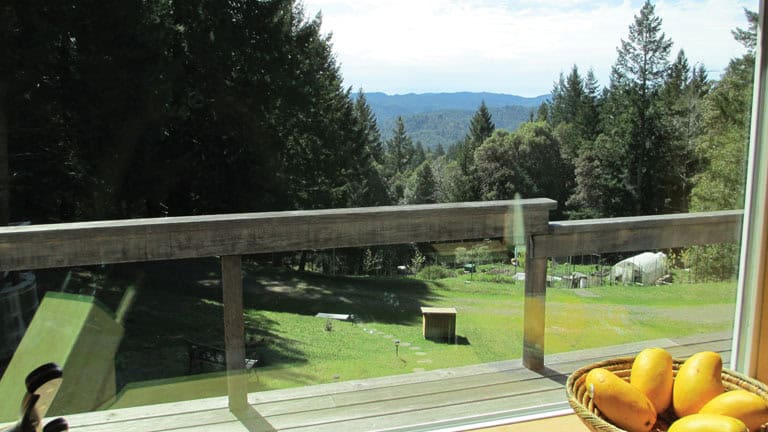
Our community started with a purpose and a raw piece of land. Many of us went from barely being able to pick up and swing a hammer to building homes and a community off the grid in the middle of nowhere. We designed and planted our own farm and orchard, making our own soil using humus from the forest and compost from our food scraps, eventually growing seedlings from seeds saved the year before. This is the kind of empowerment that can come from intentional community.
Ours was a spiritual community, our teacher at its head. He called it a benevolent dictatorship. Gathering around the principles of yoga as shared by my teacher, we grew not only in our outer challenges, but the inward ones as well, Hatha Yoga opening our bodies, Janna Yoga, the yoga of wisdom, opening our mind and spirit, and meditation cleansing our thoughts. We ate an organic vegan diet from food we grew ourselves. We worked on our communication, our integrity, and our presence.
It was inspiring and terrifying. Our teacher could be a loving paternal figure and also a cruel master. His intent was to teach us how to live in the midst of chaos and find our center. He referred to himself as “the biggest asshole” in our county, and told us if we could work with him and learn from him, we could deal with anyone in any situation.
That was true in my experience. I eventually learned how to work with, stand up to, and grow around difficult people. My first true step in that lesson was walking away from him. And he was right, my life is easier, in a way, for those lessons. I also paid a very heavy price for them.
Like many stories resembling this one, there is a shadow, a dark side that comes with power. In the five years since I left my community, I struggled with this shadow. It is easy to forget the gifts when we feel like a victim, when we wake up to the fact we have given our power away to someone else and we are paying the price.
When I met my teacher I was in my early 20s, fresh out of college. Part of the reason I chose the college I had attended was because of the cooperative living association there. I worked cooperatively with other students, cleaning, cooking, arguing, partying, and eating our way through that experience together. When I graduated, I moved to the rural mountains of northern California to live with my girlfriend, hoping to find a community and a place to call home. This was the wild west. People grew their own food, built and repaired their homes, raised livestock, and of course, grew pot.
After living in this rural town for some time, I met my future teacher by taking his yoga class. He taught in a Buddhist center above a printing shop in the middle of a town whose population was around 1,000 people. I had never done yoga, and found it intriguing. In his mid 50s, he had long hair and beard and spoke with an east coast accent. He seemed to have answers to the questions I was asking.
My girlfriend at the time and I attended his Janna classes, where he shared about the wisdom path of yoga and how to relate to ordinary, everyday life. He helped me through a difficult experience with my girlfriend’s father, and after that I was hooked.
I went to visit him in his little trailer on an organic farm in the middle of one of the largest wild blackberry patches in the world. We walked, and I shared with him that my father had died a year prior to my graduating and I was suffering. I had mental health issues before my father’s death, and his dying had pushed me to try medication. He told me that he could teach me how to heal my pain and get off the medication.
I was scared, confused, vulnerable, and grieving the loss of my father. I had tried therapists and group support, but this was so different, and I gave myself to him and the path with abandon. I moved into a small apartment with no heat, got a job as a cook at the local hospital, and worked on myself. I got off the medications and started cleansing. I didn’t have a car or friends. My girlfriend went back to school and we broke up. But I kept going, a long story for another time…
There were signs all along the way that my teacher was abusive and manipulative. He used to describe himself as Machiavellian, using tactics of the Italian political philosopher to manipulate us into being a better, more evolved version of ourselves. Because of my mental state at the time, I just assumed that he was harsh because I had work to do on myself, and if I worked harder, we would have a different relationship. This never happened.
As our lives became more entwined, he combined this harshness with something that was even more painful―withdrawing his attention from anyone he felt needed that level of shaming in order to bend you to his will. He treated us like children to scold when we did not meet his expectations and like heroes when we succeeded. He would say that he wanted us to be independent and think for ourselves, but used the power we gave him to keep us moving in the direction he wanted.
I remember one experience where I had done something that he thought was arrogant. He ordered me to get up on the stage of our yoga center at that time, naked, and proceeded to have me walk back and forth while he pointed out the arrogance in my body and gait. Now, we were a nudist group, so the nudity was not unusual. However, it made this form of shaming particularly potent. He had me stand there, bare in front of everyone, while he continued to lecture about my arrogance. At that point I had to do what he said, or I would lose everything I had built for myself, my home and community. I couldn’t just walk out. He held all the power, and I had, ignorantly, given it to him. I truly felt ashamed for what he was pointing out, feeling like I had failed.
Ultimately, he held the power over my investment in the property that at one point he promised to leave me when he passed. He used this promise like a carrot to keep me in line: a power whose spell could only be broken by me eventually leaving, walking away from everything I had built, my community and friends, and my retirement, casting out into a world I had been sheltered from for almost two decades.
To be clear, this is how I remember it, and may not reflect the entirety of the experience. That is the trick of the shadow. Lines are blurred, residing in our oldest patterns that often reflect the trauma of our childhood. We are attracted to a particular flavor of shadow, often because we are vulnerable to our own shadow’s needs, needs that often lie deep below the surface of our conscious life. What I came to realize was that if I hadn’t done this dance of the shadows with my teacher I probably would have done it with someone else.
I had some very painful lessons, and while I take responsibility for them, it doesn’t let him off the hook. There are people out there who feed off those who don’t feel valuable themselves. I was one of those people. It was very difficult to accept that I allowed this man to have so much power over my life for so long.
And yet, the dance of the shadows often ends where the journey of forgiveness begins. Forgiveness of all those who hurt us, but even more importantly, forgiveness of ourselves. It is always easy to have clear insight when we look back at our lives, but to do so without judgment is what allows us to set down the burdens that we allowed our shadows to pick up for us.
One of the lessons I am also learning is that forgiveness does not necessarily mean we forget. Once I left, I never spoke to my teacher again.
My shadow is still, and I expect will always be, present in my life. In my limited discovery, we are not meant to be rid of our shadows, but as a later mentor shared with me, to instead use them as a fulcrum around which we heal and grow.
Ultimately, it isn’t my intention to warn people away from spiritual communities. It isn’t even my intention to suggest you go into them eyes wide open. Truth is, I don’t know what someone else needs. This dance of the guru and their shadow has been around forever. At the time I entered into a relationship of student with my teacher, no one could convince me otherwise, and people tried. I expect that some form of this relationship will continue on for as long as people interact with each other.
If I could say one thing to my younger self, or anyone in the position I was in, it is to get clear written agreements around financial matters, and have an independent third party review them before signing. If the person you are entering into an agreement with will not accept that, then there is something wrong with the deal. That said, I probably wouldn’t have listened to that advice even if it had been given.
For many years, I thought and dreamt about him every day. I would be telling him in my dreams he wasn’t allowed to be there, drawing boundaries. Boundaries are what many spiritual teachers try to break down, saying they are obstacles to your healing, labeling them as defenses and patterns that need to be dismantled and changed, ultimately with the goal of diminishing the ego’s influence.
In the last few years there have been fewer dreams, and I am starting to remember things for which I am grateful. What I have found is that I recognize and acknowledge what I learned and how I grew from that experience. I am grateful to myself. I spent the last five years learning to draw healthy boundaries. At first it was so messy, but as I have grown, so too has my skillfulness.
Following leaving the ashram, I had some difficult challenges. I eventually moved to another intentional community with my wife. We lived there for a year before that community and the surrounding area were burned down in a huge wildfire. That wildfire pushed me out into the world, and I was forced to find my way. While I don’t see that wildfire as a gift in and of itself, I received the lessons from it as a gift. The development that came from stepping out into the world and making my place in it became my journey, one in which I derive much growth and satisfaction.
My teacher died of a heart attack almost three years ago. After a couple of years, one of the women with whom I had lived on the ashram called and I went to visit her. She is living in a senior home park, and she had our cats with her. It meant a lot to see her and visit with my furry friends.
She mentioned to me that the woman who took over the ashram after my teacher’s passing had given me permission to come visit. I struggled with it for a day and decided against it. I wasn’t ready. Or maybe I was just complete. I don’t know, and I don’t have to know. What I do know is that my life has moved on.
Currently, I live with a my loving wife and partner of over 15 years. I work with people who suffer from mental health conditions, using my experience to empathize and share compassion, but also to learn from them as well. I have friends and hobbies. My life feels full of blessings. And a day doesn’t go by that I don’t remember my experience and how it shaped me. It keeps things real, makes me more patient and understanding with myself and others.
I don’t feel the need to enter into another agreement with an intentional community at this time, but I also have not ruled it out either. I don’t think living with others is the problem. We have to do that. Intentional communities are a way to work being human, with all the confusion that comes with that.
For those who recognize my experience for themselves, you are not alone. I think people who end up in situations like the one I was in often feel ashamed. I sure did. For me, that shame was my doorway into accepting the pain of my life, my childhood, allowing myself to grieve and beginning the long journey of forgiveness. And that process is messy. Sometimes it’s very messy, and I looked for and received help.
Asking for help from others when doing so has hurt you in the past is very challenging. For the most part, all I could do was trust my bullshit meter. If something someone said didn’t feel right, I questioned it. If it still didn’t feel right and we couldn’t find a common ground, I moved on. Sometimes I did that abruptly. That was hard, but it also allowed me to improve at setting boundaries and standing up for myself. I went through many people until I started to find people that supported me in working things out for myself instead of having the answers for me.
Sharing this publicly isn’t easy. While I still feel shame from time to time, more and more now I acknowledge and feel my growth as a human being. It allows me to experience more of others too, making for a richer life. I suppose the success in living in community is not just in whether the community is long-lived or its members are happy, but in whether they have learned and become more compassionate, understanding people―people who make the world a better place for everyone around them because they work on themselves. That, it seems, is the task we all bring to living in this world together.
Geoffrey Huckabay is a writer and artist from northern California. He and his wife Sama Morningstar have lived and been a part of intentional communities for most of their adult lives. Their most recent community was Harbin Hot Springs, where Sama is still a massage therapist and where Geoffrey unwinds from his day job as a recreational therapist in the mental health units of a local hospital.
Excerpted from the Fall 2019 edition of Communities, “The Shadow Side of Cooperation”—full issue available for download (by voluntary donation) here.
Keep the conversation going with these pieces
There are no available blogs
Subscribe to our newsletter for fresh stories and community updates delivered to your inbox.
Get unlimited access to courses, exclusive member events, and a supportive network of community builders
Access all courses, books, and premium content
Member-only workshops and community builders
Member-only workshops and gatherings
We use cookies to improve your experience on our site. By using our site, you consent to cookies.
Manage your cookie preferences below:
Essential cookies enable basic functions and are necessary for the proper function of the website.
These cookies are needed for adding comments on this website.
Statistics cookies collect information anonymously. This information helps us understand how visitors use our website.
Service URL: policies.google.com (opens in a new window)
A residential project: people live here as their primary home.
An institution, business, network, or project that isn’t a residence (e.g. a learning center, farm, or network with no one living there full-time).

{{ item.label }}
{{ item.value ? item.value : currencyFormat( item.amount ) }}
Subtotal
{{ currencyFormat( pricing_summary.total_amount ) }}
There are no results matching your search


