

Use New Power to Build a Movement

Placeholder image for Foundation for Intentional Community website.
Codicts Team
  • August 1, 2018
  • Economics & Law
  • Governance
  • Social Justice
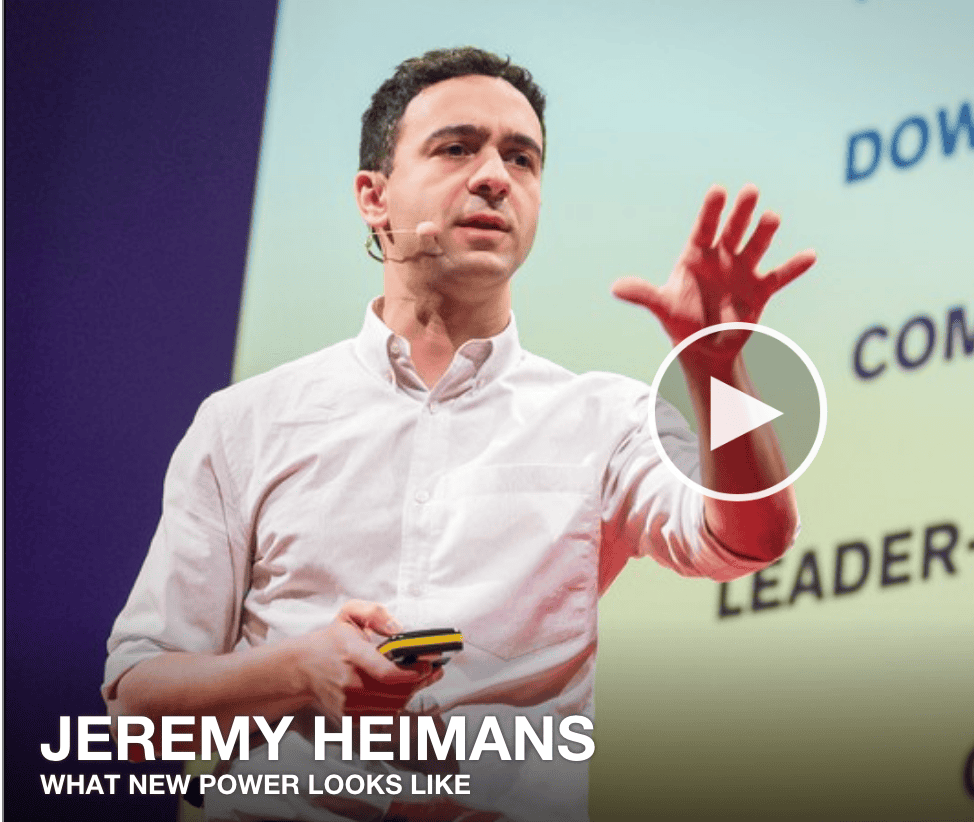
Jeremy Heimans speaking at a conference about new power dynamics.

What is New Power?

It is not just a change in technologies that is reshaping our world, our culture, and our participation in it. Our beliefs and expectations for what is possible, and what ought to be possible, is also changing.

This is eclipsing the old lessons on the right way to create and sustain movements. There are a new set of cultural and tactical rules for how to reach people, how to get them involved, and how to create real change together.

Want to start or build a community? To change some local policies? To build a movement online? Try New Power.

Old Power vs. New Power

  1. Old Power is held tightly, like Currency, whereas New Power is fluid, like Current
  2. Old Power is Held by Few, New Power is Made by Many
  3. Old Power is Hoarded, whereas New Power is Channeled
  4. Old Power tracks Downloads, New Power encourages Uploads
  5. Old Power Commands authority, New Power Shares Authority
  6. Old Power is Leader Driven, New Power is Peer Driven
  7. Old Power is Closed off, whereas New Power is Open

What New Power Looks Like

How to Build a Movement

A recent article by Jeremy Heimans from the video above, and a colleague Henry Timms, both activists for people-powered movements, is called ‘How to build a successful movement in 4 steps‘ — available on TED Ideas.

The conclusion of their research, and based on their experience, is that in order to get people’s attention, and to motivate them to act, you can follow these steps:

Step 1: Find Your Connected Connectors

Find the most influential people within your space, and connect with them strongly. Understand what they need and how to help them. They can be your absolute best allies and advocates, motivating their audiences for you.

Step 2: Build a New Power Brand

Define, talk about, and live your ethos: what do you believe, what do you stand for, and what are you doing to prove it. Shape your offering or message around empowering people to be a part of the movement you are dedicated to.

Step 3: Lower the Barrier, Flatten the Path

Make it easier to participate. Frictionless signups, notifications, surveys, petitions, donations, etc., are key. People want to be a part of something greater than themselves, and are willing to sacrifice for it. Make that easy to do!

Step 4: Move People Up the Participation Scale.

Give people small low-barrier asks for them to start helping. For those who get involved, give them the opportunity to take the next small step to help. Continue this to give people clear steps to get involved and offer more support.

The Old Power model about how to get people motivated is to make them Comply or Consume.

New Power Participation Scale

  1. Sharing – sharing other people’s content or ideas
  2. Affiliating – endorsing or joining a new power group
  3. Adapting – remixing other people’s ideas
  4. Funding – contributing money to an idea
  5. Producing – producing new power ideas
  6. Shaping – shaping new power culture

New Power is not always used by the forces of good, and New Power is not destined to be inevitably victorious. However we are only at the beginning of seeing how New Power can dramatically reshape the world of participation in a short period of time.

This all means that you and your community are more powerful than you have ever been on this planet. Use that fact to inspire you to plug in, and to start or participate in a worthwhile movement!

You can read more about this model, and how to use it, in their book: New Power: How Movements Build, Businesses Thrive, and Ideas Catch Fire in Our Hyperconnected World by Jeremy Heimans and Henry Timms.

Comments

Featured Blogs

Keep the conversation going with these pieces

Codicts Team
Thu Jul 2016
  • Economics & Law
Many U.S. cities are in the middle of a housing crisis. Some, like San Francisco, have been struggling with it for years, while others, like Portland and Seattle, hope to avoid following the same trajectory. There are many factors at play, including high rates of migration to urban areas, and the…
Codicts Team
Sat Sep 2013
  • Living in community
  • Relationships
The “public vs. home” debate brings lessons of moral relativism, humility, and tolerance for differing tastes.
Codicts Team
Thu Jun 2014
  • New to community
  • Economics & Law
Improving our relationships to work, money, and entrepreneurship can dramatically enhance our sense of community and quality of life.
Codicts Team
Fri Jun 2010
  • New to community
In this video, the BBC’s David Sillito checks out the co-housing movement, talking to members of a community in Dorset, England. Watch the video here.
Codicts Team
Fri Mar 2015
  • Searching for community
  • Sustainability
Free land on a tropical island!? Pitcairn, a small remote paradise-like island in the South Pacific is running out of people. They are giving land for free to people who want to settle there. Could it make a good Ecovillage location? “With an aging population of around 50 people, this British …
Codicts Team
Tue Dec 2010
  • Living in community
  • Relationships
A disenchanted community founder leaves her group, and finds that her rural hometown farming community and international travel and service better match her vision of honorable elderhood.
Codicts Team
Thu Jul 2018
  • Governance
Why not Join a Community? “I would live in a Community, but…” fill in the blank here. There are a lot of assumptions, fears, and misunderstandings about intentional communities that lead people to have false stereotypes of them. This list of the Top 17 Myths about Intentional Communities should h…
Codicts Team
Thu Jun 2015
  • Living in community
  • Relationships
A vibrant, reliable, and nourishing home-base can provide activists with a much-needed feeling of sustainability.
Codicts Team
Sat Oct 2014
  • Living in community
  • Relationships
A small communal family discusses how they got good at cooperating, and other essentials of collective life.
Christopher Roth
Sun Mar 2010
  • Living in community
  • Relationships
Reviews of two great books on community living, one on life in a convent with surprising insights even for the most secular, and one on the history of utopian experiments in Oregon.

Insights & Stories from the Communities Movement

Subscribe to our newsletter for fresh stories and community updates delivered to your inbox.

Join the Communiversity Community

Get unlimited access to courses, exclusive member events, and a supportive network of community builders

Unlimited Learning

Access all courses, books, and premium content

Community Network

Member-only workshops and community builders

Exclusive Events

Member-only workshops and gatherings

Information

Communities

A residential project: people live here as their primary home.

Organizations

An institution, business, network, or project that isn’t a residence (e.g. a learning center, farm, or network with no one living there full-time).

Plus Community Memberhsip

  • Find people with Profile Match
  • Access to your community listing statistics
  • Create Discussion Groups
  • 50% commission when your members purchase a Plus Membership
  • Access to our affiliate program
  • Member badge on your community profile
I am an official member of this community
Disclaimer
I affirm that my information is accurate and I am authorized to manage this listing
Foundation for Intentional Community FIC Member badge logo.

Free Plan

Free Membership
Free

Intentional Advertising

  • Subtotal

    {{ currencyFormat( pricing_summary.total_amount ) }}

Icon representing community connections and collaboration for intentional communities.

Plus Membership

  • Find communities with Profile Match
  • View detailed reviews about communities
  • Direct message and view contact information
  • Create free listings in Needs & Offers
  • Plus Member resources in CommUniversity
  • Plus Member badge on your profile
