

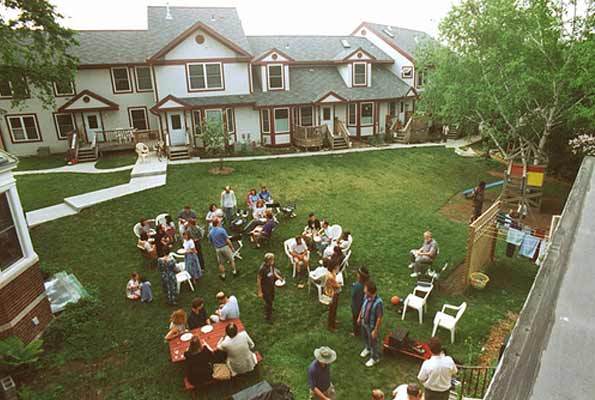
The early relationship between the FIC and the Cohousing Association of the US was rocky, with people in both groups being dismissive and judgemental of the different models each organization was focused on. Fortunately, we’ve moved past that and the two organizations enjoy a close, collaborative relationship. These two pieces touch on how we’ve bridged the gap. The first is by Karin Hoskin, Executive Director of Coho/US. The second is by, Sky Blue, Executive Director of the FIC.
For more 30th blog posts click here.
“The Foundation for Intentional Community (FIC) is a nonprofit organization dedicated to supporting and promoting the development of intentional communities, and the evolution of cooperative culture.”
“The Cohousing Association of the US (Coho/US) is a national non-profit raising awareness of the benefits of cohousing and supporting the development of cohousing communities nationwide.”
FIC and Coho/US – similar yet different. People of the two organizations share similar aspirations: the desire to live together or share common spaces, to share responsibilities and resources, to create some level of social cohesion. As we acknowledge the varieties in intentional communities, we should also acknowledge the likenesses. As FIC and Coho/US continue to communicate, we find that we are often drawn to talk about how amazing living in an intentional community is (though not without its challenges) but also how can we create more of them. To create more of them, we need more people to know about them. It sounds so simple, yet is a huge undertaking. So how can we do it?
The most basic way we can educate people about how we live is to use every little opportunity to tell them. When someone asks me where I’m from, I don’t simply say Colorado.Instead, I tell them that I live in a cohousing community in Boulder, Colorado. If I get a response like “oh, what’s that?” I tell them my short elevator speech, which goes something like this:
“It’s like the old-fashioned neighborhood that I grew up in. We all have private homes, but we have shared spaces as well. We have monthly celebrations or gatherings of some sort, and we eat a meal together a couple of times a week, so I know all 80+ of my neighbors really well. It’s a great place to raise kids as we really support each other, and we can collectively live a little more consciously on the earth by sharing resources. We can easily reuse or upcycle household items and clothing, and and we can car share among the 34 households.”
I don’t think that living in some sort of intentional community is for everyone, but I do think that many people would be happy to. I just want everybody to know it can be an option. Aging in community is a topic that is a quickly growing trend. Fifty or one hundred years ago, family members lived close to each other and were able to support each other through life. This is not as true these days with people moving away from family to seek further education or to pursue a career. Because of that, as we age, we often don’t have that circle of family close by. Living in an intentional community can offer assistance. This is not to say that community members will necessarily take care of you as you age, but because you have developed relationships with community members, you have a better chance of being well resourced when help is needed.
As we continue to develop relationships as individuals, we should encourage networking between the many types of intentional communities so that we may flourish as community members. We are a small part of the larger world, and we are connected. Think globally, act locally, know your neighbor.
—
Cohousing was one of my first introductions to collective living and the world of Intentional Communities. My father helped found Valley Oaks Village, in Chico, CA, in the mid-90’s. He and I moved into his unit in 1996, when I was 16, and I lived there for a year before I moved out on my own. I even become a member of the community (i.e. part of the consensus decision-making group) for 6 months (a token amount, but formative for a 16 year old). My path then took me to a student housing cooperative and then to Twin Oaks, and I’m grateful for the perspective each of these communities gave me. My predominant associations have been with communities that identify as Intentional Communities, but I’ve had contact with many that don’t.
Terminology is a tricky business. A certain group adopts a label that’s meaningful to them. Another group comes along that’s very similar but wants to differentiate itself, maybe even disassociate. Maybe they didn’t even know about each other when they got started. But if they’re both reaching out to larger society, trying to grow as a movement, tapping into the same resource base, this can create tension and confusion. If they would be better off as allies, how do you reconcile the differences in terminology and any underlying, real differences the terminology might point to?
Is Cohousing a form of intentional community? The term Intentional Community was in use before Cohousing, and describes a broader range of models than most people realize. But Cohousing describes a particular, innovative model developed fairly recently. By contrast, the term Housing Co-operative has been in use in the US since at least the early 1900’s, pre-dating the term Intentional Community. Does it make sense to try and identify housing co-operatives as a form of Intentional Community? Then there are Ecovillages (again, a relatively new term). Some groups adopt this as their primary identity, orienting them towards sustainability and is very inclusive of different ownership models (e.g. Ecovillage of Ithaca identifies as an ecovillage but is most akin to cohousing when it comes to how it’s ownership and finances are organized). And if Intentional Community is the blanket term, then do we need other terms for the various other kinds of communities out there? Communes, land trusts, homesteads… It’s a long list.
Why does this even matter? Well, in the ecosystem of shared ownership models of residences and residential developments there are a number of different organizations doing networking and support: Cohousing US, the FIC, NASCO, ENA, the National Association of Housing Cooperatives, the Federation of Egalitarian Communities, to name some of the most active players. Are each of these groups movements in themselves? Do they collectively qualify as a movement? There’s a clear affinity and potential benefit to collaboration, but it seems to me that they are falling into the same pattern of “siloing” common in the non-profit world.
This movement, which I would call the Communities Movement (and which I would put into a larger movement I would call the Cooperative Movement, which, in my mind, includes worker co-ops and transition towns, for example), is in a very fortunate position at this point in time. There are a plethora of viable models and valuable resources available. Even within the distinction of Cohousing there are numerous variations that will appeal to different people or work for the slightly (if not massively) different circumstances each aspiring community faces. A great resource out there is the Cohousing Legal Toolkit, by Janelle Orisi and Cynthia Hawley. Whether or not a group were to identify as a Cohousing Community, and whether or not some of the material in the Toolkit is workable for a given group, it’s an amazing outline of the kinds of questions any group needs to be asking when embarking on the adventure of collective living.
The relationship between Cohousing and Intentional Communities, particularly as represented by Coho US and the FIC, has evolved over time and at this point is a success story in inter-organizational cooperation. Cohousing has always sought to be a more accessible model of shared living than other forms of intentional community, and, early in it’s life in the US, was reticent to associate too closely with “hippie communes.” This was understandable because of mainstream perceptions but didn’t necessarily reflect the reality of the diversity of intentional communities. But over time the movers and shakers in both worlds started interacting and even overlapping, and there was a recognition of how closer association could be beneficial for everyone. For example, Coho US pulls its directory from the FIC’s Communities Directory, which has been one of it’s primary programs for a couple decades, and the FIC has found an important market for its products and services in the Cohousing world, which tends to be more affluent.
At their core, all types of communities, collectives, cooperatives, and other community-oriented organizations tend to struggle with the same things: Decision-making, interpersonal dynamics, organizational structures, finances, whether or not people are doing their fair share, what color to paint the living room, why can’t people clean up after themselves, what to do about the barking dog… the list goes on.
Every group has something to teach and something to learn from every other group. Whatever you call yourself, we’re all part of this movement.
Keep the conversation going with these pieces
There are no available blogs
Subscribe to our newsletter for fresh stories and community updates delivered to your inbox.
Get unlimited access to courses, exclusive member events, and a supportive network of community builders
Access all courses, books, and premium content
Member-only workshops and community builders
Member-only workshops and gatherings
We use cookies to improve your experience on our site. By using our site, you consent to cookies.
Manage your cookie preferences below:
Essential cookies enable basic functions and are necessary for the proper function of the website.
These cookies are needed for adding comments on this website.
Statistics cookies collect information anonymously. This information helps us understand how visitors use our website.
Service URL: policies.google.com (opens in a new window)
A residential project: people live here as their primary home.
An institution, business, network, or project that isn’t a residence (e.g. a learning center, farm, or network with no one living there full-time).

{{ item.label }}
{{ item.value ? item.value : currencyFormat( item.amount ) }}
Subtotal
{{ currencyFormat( pricing_summary.total_amount ) }}
There are no results matching your search


