

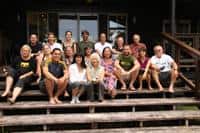
We are two retirees whose horizons have expanded through new opportunities offered in the intentional communities world. We hope other groups and individuals may be inspired to pursue similar options, which can benefit all parties while facilitating the transition to community living. This is our story…
A Turning Point
We are at another turning point in our lives together. After several decades of relative stability in our living situation, it is time once again to make changes. There are many reasons for this.
First, our only child, Carey, is now a grown man, graduated from college, and in the Coast Guard. He is stationed in Gloucester, Massachusetts, due to be discharged in June of 2015 and preparing to enter graduate school when he is no longer on active duty. He has also has passed the Massachusetts Firefighters’ tests. With a great boxer mix dog, and a lovely girlfriend, he has made his choices known for the next few years, at least. He will be in Boston.
I grew up in the milder climate of Long Island, New York, and Ray in Seattle, Washington. We met when I went West to graduate school. After I graduated, Ray found employment in California, which took us away from his brothers and best friend in Seattle. Soon we found jobs in Connecticut and ultimately our present location in Massachusetts. While living on the East Coast allowed us to be physically close for a rewarding reconnection with my parents Allene and Dick, and my brothers and their families, the passage of time brought with it my parents’ struggles with mortality and finally their deaths. Our “temporary” stint back East has lasted 24 years and counting!
Now we are both “retired.” However, because of our 11-year age difference, planning for the future has been more difficult than anticipated. Ray left his career in the public power industry 10 years ago. I left my architecture job to join him at 60, three years ago. The first year of my employment freedom (my Panamanian friend calls it jubilation) was a whirlwind of travel and obvious overcommitment to regional volunteer work. Now I find I need a more focused effort. However, Ray is happy reading, puttering, cooking, and serving on a few city boards.
Although we live in a highly functional town, we find ourselves becoming more isolated from much of it. When we bought our house, we knew it was within walking distance to a grocery, the library, and town hall, and Carey walked to elementary, middle, and high school. There was also great energy in our neighborhood, with children learning to bike on our dead-end street, potlucks, and so forth. Our village has many social support networks. When a house burns or someone has an illness, there are instant fundraisers and other efforts to help. There are many activities in which we can participate and have done so, from the library book club to serving on a city committee. What isolates us is the harsh winter weather, the need to drive to attend most events, and the fact that because our son is grown, and we have left the work force, we have removed ourselves from the daily social and business life around us. We feel this separation deeply.
We are also living “lighter” on the planet. We have fully insulated our 1920s bungalow, put in energy efficient windows, and built a deck constructed with recycled plastic and certified sustainable lumber. We converted to a highly efficient gas furnace, refrigerator, and even a 2001 Prius. We garden, purchase winter and summer consumer supported agriculture shares, and such. We recycle and share our skills and resources.
The Move toward Cohousing
As a permaculture and Transition Town advocate, I find that shared housing is also a cultural fit for me. However, I wasn’t sure that Ray would be interested in this approach.
To downsize and move seemed a good idea, while we both have healthy lives and are young enough to have the energy to make new connections and friends. When we agreed that we wanted to move “back” to the West Coast, the next decision was what did we want to move to? Would it be a yurt on a small farm, or a modest house in a neighborhood, or some other traditional retirement solution? Were these the only options?
I knew about cohousing, having learned about it in architecture school. I mentioned the idea to my husband. His reaction was less than enthusiastic! Ray was worried that living with consensus decision-making would be tedious and intrusive, and that his privacy would be circumscribed. I too worried about endless meetings. We had attended meetings for a start-up cohousing in our area. If cohousers ran their meetings like this group of well-meaning folks, then maybe this option was not for us.
I decided to spend more time learning about cohousing, because I recognized that living in this manner would provide us with functional community from the start. We would also be able to share resources and meals. My 80-year-old parents had missed the opportunity to move to a supportive community, and I saw the result in the way that they became separated and alone.
First I did more online research. Exploring the Cohousing Association’s website, I learned that many groups took a long time in forming, and that some never got built. In addition, I learned a bit about active listening, and continued to take the opportunity to visit cohousing communities. In the summer of 2011 I stayed overnight at Loch Lyme Lodge in Lyme, New Hampshire, not far from Hanover and Dartmouth College, where Pinnacle Cohousing is being built. There we had a visit from the Ecovillage at Ithaca designers, and I listened closely. I was energized by the possibility but unsure of how to proceed.
On February 15, 2012, Liz Ryan Cole, my contact at Pinnacle, sent out an email. “Unique opportunity to experience cohousing life in beautiful Sonoma County, California, during one of the best times of the year… AVAILABILITY: March 26-April 28, 2012. $1300 for the nearly five weeks includes wi-fi, water, gas, electricity, garbage, laundry, community facilities, hot tub, etc. Owners pay HOA dues. No smoking…contact Kate.”
Fate had dropped in and given us a chance to try out cohousing for a month, in one of the most beautiful parts of the country. How could we lose? I remember yelling upstairs to my husband, here’s a great opportunity and his reaction was “Why not? If we don’t like it we can always visit the city, and if we do, that’s fine too.” With no apparent effort while on vacation, we could live in cohousing for a month, sampling community meals, meetings, and events. I immediately contacted Kate, who with Marcin owned the unit. Once assured we would be selected, we worked out the arrangements online. I credit our landlords with being completely open to this approach; their generosity and kindness speaks legions about what cohousing can offer.
Testing the Waters at FrogSong
We arrived at FrogSong sight unseen, and were introduced to the community. First, Kate and Marcin picked us up at the Park and Ride. Once we were checked into the guest room they gave us an orientation. Kate had made a map of all the owners with their names and animals. Marcin took me to his yoga class in Sebastopol. They gave us access to the listserv, so we could sign up for community meals and join committees if we wanted to. They gave us a tour of the facilities (the laundry room was a highlight because of the system for letting others know what to do with clothes in the machines), connected us to community “mentors,” and introduced us at the community meal. We signed a contract, gave them a damage deposit, and then off they went on THEIR vacation!
Living in the cohousing was different. Some rules were overt and some were not. Learning how to live there meant taking social relationships baby steps at the beginning. For example, loving gardening, I was happy to see the community garden needed help, and there was an Earth Day plant and mulch. So I joined the landscape committee to assist them, went plant and mulch shopping with members, and Ray and I pitched in to help that day.
But initially we weren’t so sure we wanted to participate in every community meal, and we wanted to investigate the town, so we ate out and cooked at home often. The FrogSong community email listserv was very helpful, for arranging rides, finding out about group events like trips to concerts and speakers, and team decision-making. But some of the activities were informal, not listed, like the three-time-a-week walks, some celebrations, once-a-week group yoga instruction, and group meditation. To learn about them, we talked to our “mentors” and met the rest of the group at community meals. We participated as much as we could.
To learn more about consensus decision-making was very important to me, so I attended the monthly business meeting. Here I saw the five-card consensus system in action for the Homeowners Association voting portion, and for the cohousing discussion. I was impressed that this group had asked everyone to take facilitator training and then to use it in meetings. Along with respect for the rewards and difficulty of the process, we saw evidence of deep community in their interaction and mutual support. Apparently cohousing folks had developed a system for consensus decision-making which was both relatively expedient and inclusive. That was very encouraging and inspiring.
A Sea of Opportunities
During the time of our first of four month-long visits to FrogSong, we traveled to cohousing communities in Portland, Oregon and stayed overnight at one in Corvallis. We wanted to see if our California experience was unique to this cohousing, or shared. What we found was that although each cohousing community is made up of different people, with somewhat different visions, most had very similar values, facilities, and activities.
Because of this rental opportunity, we have learned about the value of conscious community for us, as well. In Creating Community Anywhere: Finding Support and Connection in a Fragmented World, authors Carolyn R. Shaffer and Kristin Anundsen describe the difference between a functional community and a conscious one. “In a conscious community, members not only help each other take care of business together—the external task—but they also reflect together on their common purpose, internal processes, and group dynamics… (It) honors the individual as well as the group, knowing that the well-being of one cannot be bought at the expense of the other… Such a community renews itself regularly, celebrating individual and group passages and revising and recommitting to its vision and mission. In doing so it challenges its members and itself to move beyond roles to wholeness…like a living body…” [Shaffer, Carolyn R. and Kristin Anundsen, Creating Community Anywhere, CCC Press, CA, 1993/2005, page 11.]
Since our first visit in 2012, we have been back three times. We visited other built cohousing communities and settled on becoming full members at Oakleigh Meadow Cohousing in Eugene, Oregon, with the same architect, and similar shared values. We have learned how the character of cohousing intersects with our own character, because we have had the rare opportunity to rent for a short term. Indeed, we recommend this approach to others who want to explore what cohousing means to them, both as a way of housing and as a way of living. Short-term vacation cohousing: what a great way to learn!
Deborah Carey discovered cohousing while getting her architecture degree at the University of Washington. She didn’t get serious about living there until she retired from the Commonwealth of Massachusetts in 2011. Her husband Ray Shockey didn’t consider living in cohousing until they rented a unit for a month. Now she and her husband are involved in Oakleigh Meadow Cohousing in Eugene, and in explaining the value of short-term “vacation” cohousing rentals to others. Email her at boiester [at] gmail.com if this appeals to you as a way to “try on” cohousing.
Keep the conversation going with these pieces
There are no available blogs
Subscribe to our newsletter for fresh stories and community updates delivered to your inbox.
Get unlimited access to courses, exclusive member events, and a supportive network of community builders
Access all courses, books, and premium content
Member-only workshops and community builders
Member-only workshops and gatherings
We use cookies to improve your experience on our site. By using our site, you consent to cookies.
Manage your cookie preferences below:
Essential cookies enable basic functions and are necessary for the proper function of the website.
These cookies are needed for adding comments on this website.
Statistics cookies collect information anonymously. This information helps us understand how visitors use our website.
Service URL: policies.google.com (opens in a new window)
A residential project: people live here as their primary home.
An institution, business, network, or project that isn’t a residence (e.g. a learning center, farm, or network with no one living there full-time).

{{ item.label }}
{{ item.value ? item.value : currencyFormat( item.amount ) }}
Subtotal
{{ currencyFormat( pricing_summary.total_amount ) }}
There are no results matching your search

We’re introducing new Plus features — including community reviews, Profile Match, and unlimited Needs & Offers posts — while keeping most of FIC free for everyone. Membership costs less than two coffees a month.

