
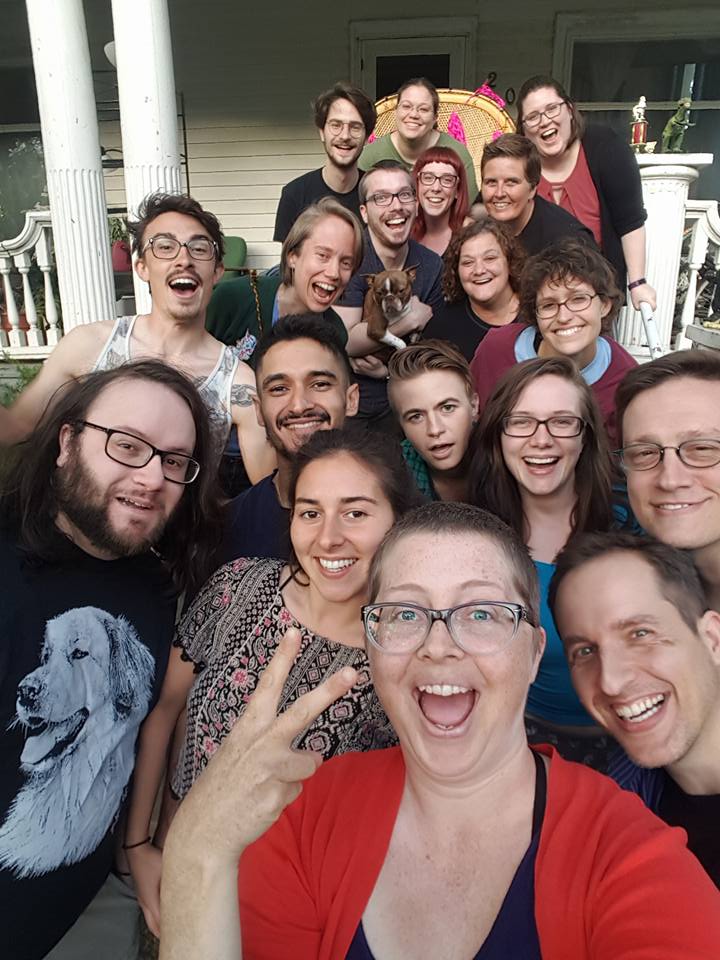
Group of diverse people smiling on a porch at Foundation for Intentional Community event.

River City Housing Collective

  • Communities

About the Communities

  • Established
  • Home-sharing
  • Urban

Founding year

  • 1977

What we do

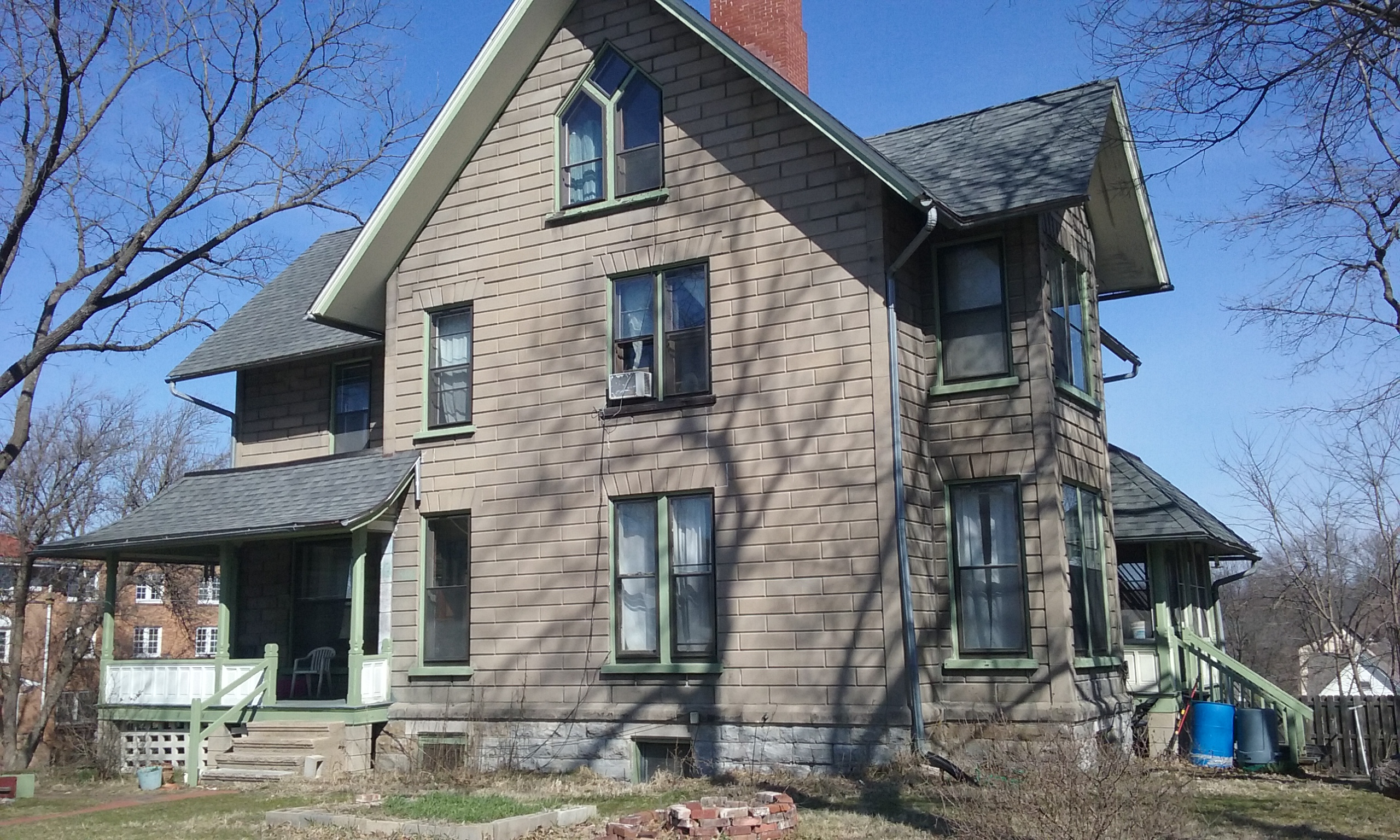
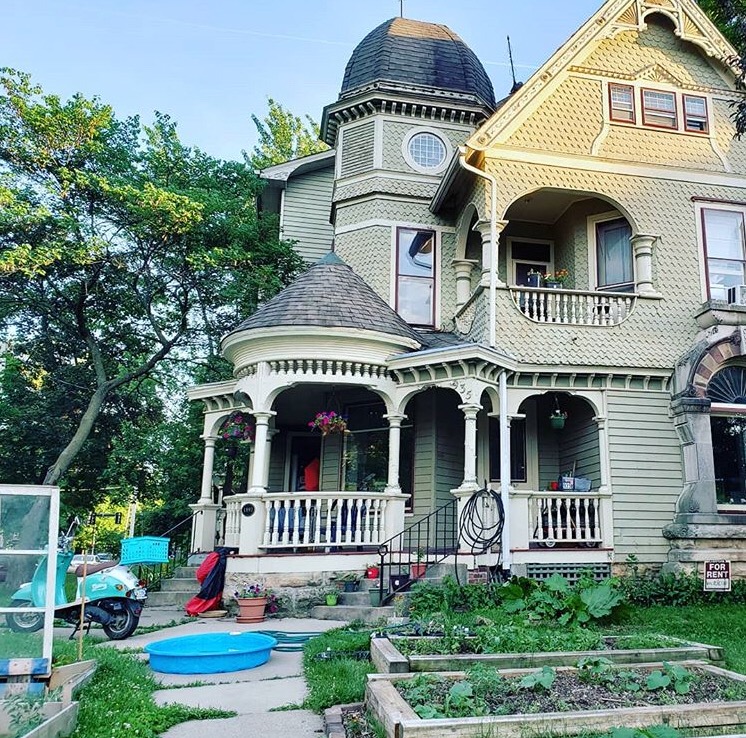
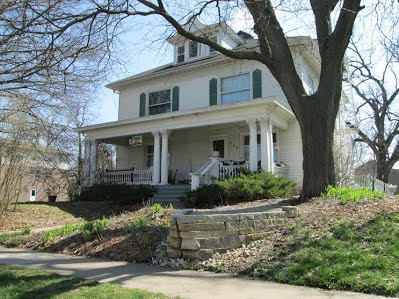
River City Housing Cooperative has 35 rooms across three large historic homes within walking distance of downtown Iowa City and the University of Iowa campus.
Our members rent at affordable area rates that vary by room size and features. Your private room is your personal sanctuary, but community is built and sustained through everyday interactions, so you’ll share a kitchen, dining room, living room and other facilities with your housemates.
We are our own landlords, so our houses are managed and operated through the collective efforts of our members. In addition to keeping our rents affordable, shared responsibility for cooking, cleaning, maintenance, and administrative tasks allows RCHC to continue to grow in its mission of sustaining a healthy physical and social environment for all of its members. Members complete a minimum of 16 hours of work credit a month; 8 for their House and 8 for the Collective. They also complete a yearly maintenance requirement.
All members participate in decision-making at RCHC through biweekly House and Board meetings.
All members participate in a food plan, where they purchase food collectively and cook dinner for their House twice a month. Basic household staples are also purchased collectively, so you can always count on toilet paper, laundry detergent, and cleaning supplies.
We strive to maintain a safe and inclusive space for all members through a commitment to mutual values and a comprehensive safe space policy.
To apply to live at RCHC, please visit our website and fill out the Prospective Member Request Form. A membership committee representative will contact you as soon as possible to begin the process.

Our Mission

Vision Statement:
There are three things we as RCHC value and hope to continuously develop: our physical environment, our social environment, and our relationship with the outside community.
We hope to develop our physical space by maintaining our facilities and by instilling a sense of ownership among our residents.
We would like RCHC to be “home-like” with a social environment that encourages involvement; where members interact with mutual respect, goodwill, acceptance, trust, and support.
We hope to be an asset to the community through concern for the environment, education, and the support of community endeavors.
RCHC Goals:
Within our physical sphere, we commit ourselves to:
Save rent through owning and managing our own homes
Keeping our houses clean and functional
Taking responsibility for the financial well-being of the collective
Continue to make improvements on all our houses
Within our social atmosphere we commit ourselves to:
Questioning our definitions of “diversity” and seeking to be diverse and non-discriminatory with regards to race, sex, age, sexual orientation, physical ability, perspective, religion, politics, and creed
Incorporating individual voices within the whole
Offering a community in which to share individual talents and gain practical skills
Taking initiative in solving interpersonal conflicts with mutual respect
Provide social and educational events
Cooking from scratch while meeting the dietary needs of all members
Sharing household chores with an equal division of labor
Within the greater community, we commit ourselves to:
Participating in the intentional community network
Low impact living through recycling, composting, conservation, and the reduction of waste
Participating in community outreach and service
Facilitate community-wide social and educational events
Expanding the collective to include more people and homes
Purchase local and organic food

  • Purpose
  • Home-sharing
  • Community type
  • Coliving
  • Sustainability practices
  • Waste reduction / composting

Commemorative dates

  • January 1, 1977
  • Started planning
  • January 1, 1977
  • Started living together

Video

Gallery

  • 14 Total members
  • Open to new members
  • Open to visitors
Total
15

How to join

RCHC is an intentional community, and our prospecting process is the best way that we’ve found to meet and select new members. Prospective members apply through the online form on our website. The prospecting process begins with an information session; at this time, a membership representative explains the fundamentals of collective process and living at RCHC as well as the requirements and expectations that we have for our members.
If you’re still interested after this initial meeting, then you’ll schedule a prospect dinner at the house of your choice. The dinner is conducted in a casual question-and-answer format, in which all of your potential housemates will get a chance to ask you questions that speak directly to coop life and values, and what you could contribute to the community as an active member–they in turn will answer any question that they ask. Then, it’s just a matter of voting; the house will vote on your prospect at the house meeting following your final dinner [based on all contact, answers to dinner questions, and your references], and you will be contacted with a decision shortly thereafter. All parts of the process can be conducted remotely.

Basic expectations or agreements for members

Reach out at our e-mail address, and someone will get back to you as soon as possible.

Primary decision-making authority

  • Small Leadership Group

A few people (not elected by the broader community) make the major decisions.

Decision-making process

  • Modified Consensus

Generally seek agreement, but have backup methods when consensus isn’t reached.

Governance structure

  • Collaborative/Horizontal

Power and responsibility are shared relatively equally among members.

Conflict resolution approach

RCHC’s Board is comprised exclusively of all active members. Members elect officers at the annual General Membership Membership.

Economic model

  • Independent Finances

Members maintain separate personal finances with minimal sharing.

Economic scenarios for this community

  • Members need to pay fees, dues, or similar to live there on a per month or per year basis
  • There is a labor obligation
  • Members typically need to have their own job or other personal source of income to cover their expenses while living in the community?

Additional economic information

Regular fees: Yes
Labor: Yes (0 hrs/week)
Members with pre-existing debt: allowed
Members contribute $100/mo. to shared House accounts that pay for collective food purchasing as well as standard household goods.
Members are required to complete 16 work credit hours /month (8 for their House and 8 for the Collective). There is also a yearly requirement of 18 maintenance hours.

Shared resources and amenities that are accessible to everyone in the community

Common House, Garden(s), Workshop, Fire pit, Internet

Frequency of communal meals

  • Approximately 1 meal per day

Significant food acquisition practices

  • Locally sourced

Dietary restriction

  • People can cook and eat what they want in their own residence

Substance use culture

  • Substance use appears in public spaces but no pressure

Gender composition

  • Majority non-binary/gender diverse (over 30%)

Age demographics

  • Multi-generational (all ages well represented)

Guest Book

Written reviews are available for plus members. Click here to upgrade.

Location

  • Iowa, United States

River City Housing Collective

Needs and Offers

Connecting people and communities through an intentional online marketplace

  • Promoted
  • Events
2 weeks ago

Coastal Regeneration Immersion: Permaculture Design Certification in Jalisco, Mexico

Tropical Dry Forest Permaculture Design & Regenerative Stewardship Certification (PDC)12-Day Intensive | 120 Hours | Costalegre, Jalisco, Mexico APPLY AT XOCHIRAIZ.COM Join us for an immersive Permaculture Design Certificate course set in the tropical dry forest bioregion of coastal Jalisco. This 120-hour intensive blends internationally recognized PDC curriculum with hands-on regenerative practice — combining ecological design, agroforestry, natural building, and community stewardship into one integrated learning experience. Lead Faculty Jorge Luis Gtz. Olarte (Arborescencia RedGenerativa) – Regenerative Design, Soil Biology & Agroforestry Ozzy Lusth (Survior & Xochiraíz) – Wilderness Resilience & Survival Skills Dave Collins (Capacha Coastal Conservation Center) – Bioarchitecture & Ecological Development What You’ll LearnThe course moves through six progressive phases: Permaculture & Ecological Literacy – ethics, principles, and reading the tropical dry forest landscape Water & Soil Systems – keyline design, water harvesting, living soils, and compost systems Horticulture – food garden design, propagation, and biological pest control Regenerative Food Systems – tropical agroforestry, food forest design, and guild planting Ecological Infrastructure – bamboo bioarchitecture, bioclimatic farm design, compost toilets, greywater, and rocket stoves Integrated Design Studio – team-based final design projects covering watershed strategy, agroforestry, food forest layout, infrastructure, and phased implementation Daily RhythmMornings begin with optional surf/yoga and journaling, followed by field practicums and hands-on workshops. Afternoons include design studio and construction lab work, with reflection circles, communal dinners, and evening talks, films, or campfire discussions rounding out the day. Final ProjectParticipants work in teams to produce a full regenerative design package — landscape analysis, water plan, agroforestry design, food forest plan, ecological infrastructure, and bioclimatic farm plan — presented to a faculty review panel on the final day, followed by a closing ceremony, certificate delivery, and community feast. CertificationGraduates receive the Tropical Dry Forest Permaculture Design & Regenerative Stewardship Certification (120 contact hours), hosted by Capacha Coastal Conservation Center and Tierralegre, A.C. Curriculum integrates international PDC standards with tropical ecology, agroforestry, ecological restoration, bamboo bioarchitecture, bioclimatic design, GIS/photogrammetry, and regenerative leadership. Highlights Hands-on bamboo construction (temazcal, bathhouses, sculpture) Tropical dry forest silviculture practicum Community mapping and design project for Ekoa Green Community Talent show and sea turtle release
January 10 – January 24
  • Promoted
Offer
  • Promoted
Offer
  • Professional Services
4 months ago

Community Matchmaking: Get Help Finding Your Community

Would you like to join an intentional community but don’t know how? Feel overwhelmed by the number of communities out there? Not sure if there is one that’s a fit for you? CommunityFinders is here to support you on your path to community living. You can find your community by: Taking the free Community Types Quiz to learn which of the most common types of community is a fit for you. Booking a 1:1 consultation with a Community Matchmaker to receive recommendations for communities that are a fit for you. Joining the Money and Community Mini-Course to find out which communities are within your budget. Reading the book Intentional Community to help you understand your options and decide whether community living is right for you. Our goal is to help community seekers become community finders — people with confidence that their community match is out there and they will find it. Looking forward to working with you to find your community! Please be in touch, Cynthia Tina Founder communityfinders.com What communitarians are saying: “Cynthia helped me clarify the intentional communities that fit me, better get to know them, and finally choose one that I’m now a member of. I have no doubt anyone on a community journey will find great value in her guidance.” – Alan Stillman “Out of potentially thousands of communities, Cynthia matched me with very similar values revealed on their websites. I am in the process of applying to visit the number one recommendation. I’m excited and thankful for Cynthia‘s skills. Beyond well worth.” – Tommy Teeple “Due to her extensive community experience, she could offer many insights, provide useful tips and present selected communities to me that she had visited herself.” – Antonia Von Hassell
Need
  • Forming Communities
1 week ago

Searching for cash partners in development

TITLE:Seeking 6 Founding Cash Partners — 20 Deeded Acres in WV (Well & Septic) + 1/8th Debt-Free Farm & Shop ($200k) BODY:We are assembling 8 households (6 cash shareholders + 2 experienced builders) to buy and develop 180 acres in rural West Virginia—closing together so the property is 100% debt-free from Day 1. Our goal is a multi-generational homesteading environment with total freedom on your own land, paired with a well-equipped common hub shared with like-minded neighbors. WHAT YOUR $200,000 BUY-IN INCLUDES:* 20 Private Deeded Acres: Fee-simple 20-acre lot with a private drilled well and 1,250-gallon septic installed during buildout.* 1/8th Ownership of a 20-Acre Shared Commons (Zero Land Mortgage):- Shop & Fleet: 4-car auto shop (2-post lift & 240V welder), equipment barn, band sawmill, log splitter, tracked skid steer, mini excavator, tractor & dump trailer.- Homestead & Kids: Natural creek/stream access, water house with dual cisterns, greenhouse, homeschool/reading room, playground, pavilion & fire pit.- Commons Guest Cabin (Post-Build): Existing cabin converts into a $45-$65/night guest cabin for members’ visiting family, with open dates rented on Airbnb by the association to fund community reserves.* Zero Dues for 5 Years: A $65,000 reserve funded at closing covers all commons taxes, insurance, road gravel, and equipment upkeep for 5 years ($100-$150/mo starting Year 6). SEVEN CORE PRINCIPLES:Earth-friendly stewardship, no discrimination, no religion, no politics, no hunting/wildlife protection, no private commercial businesses, and total freedom on your private 20 acres. WHY THIS BEATS RAW LAND & ECOVILLAGES:Raw 20-acre WV land costs $135k-$250k+ with zero utilities or machinery. Unlike traditional ecovillages, you get a real deed to 20 acres, no 2-year trial gauntlet, and fast builder execution backed by third-party milestone escrow draws. We are locking in our 6 partners via non-binding LOIs before putting our target 180-acre tract under contract so everyone walks the land together. Reply or DM me with a brief intro for our 1-Page Prospectus and Partner Questionnaire

Update to a Public Profile

  • Log in
  • Go to your profile page
  • Toggle on the "Add my profile to the directory"
  • Save your profile

Information

Communities

A residential project: people live here as their primary home.

Organizations

An institution, business, network, or project that isn’t a residence (e.g. a learning center, farm, or network with no one living there full-time).

Plus Community Membership

  • Find people with Profile Match
  • Access to your community listing statistics
  • Create Discussion Groups
  • Access to our affiliate program
  • Member badge on your community profile
I am an official member of this community
Disclaimer
I affirm that my information is accurate and I am authorized to manage this listing
Foundation for Intentional Community FIC Member badge logo.

Free Plan

Free Membership
Free

Intentional Advertising

  • Subtotal

    {{ currencyFormat( pricing_summary.total_amount ) }}

Icon representing community connections and collaboration for intentional communities.

Plus Membership

  • Find communities with Profile Match
  • View detailed reviews about communities
  • Create free listings in Needs & Offers
  • Plus Member resources in CommUniversity
  • View communities detailed reviews
  • Plus Member badge on your profile