
by Kim Kanney, Community Bookstore manager
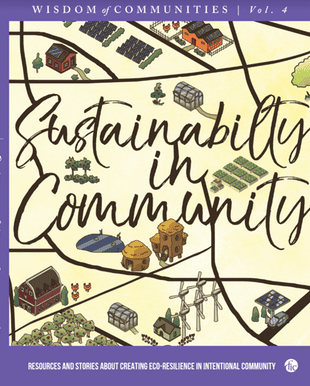
Finally! Our fourth and final volume of the Wisdom of Communities series has been released! Now you can get your own copy of Volume 4: Sustainability in Community or order the entire set in both printed books and digital ebooks.
Wisdom of Communities compiles hundreds of our favorite articles from Communities magazine and distills them into 4 hefty books, serving you a platter of the greatest wisdom our authors can offer on starting, finding, communicating and sustaining in community. This series is an essential set for community founders, seekers, current communitarians, students, and researchers alike.
In Volume 4: Sustainability in Community we focus on food, water, shelter, energy, land, permaculture, ecovillage design, eco-education, and resilience in cooperative culture. These areas will prove more and more essential in allowing communities to navigate changing circumstances on our planet, while growing into new, regenerative ways of living and thriving together.
For example, Gwendolyn Hallsmith lists in her article titled “Ecovillage Infrastructure: The Skeleton of Community,” the questions anyone must ask first who desires to build an Ecovillage.
“All too often,” she says, “people try to form ecovillages without a solid understanding of the legal and technical issues associated with large numbers of people living on the same piece of land together. They find a large lot for sale out in the middle of the countryside, buy it, and start to make plans for communal living without first making sure that what they have in mind is even possible.”
Here are the top 5 questions, according to Hallsmith:
1. What is your water supply and how will it be appropriately treated?
2. How will you address human waste and what are your area’s requirements?
3. What is your area’s zoning laws for housing capacities?
4. What type of legal entity will your community adopt (i.e. corporation, nonprofit, cooperative, etc)?
5. How will you establish home ownership? Through a land trust, cooperatively owned housing, subdivision or condominium?
Read further details about each of these questions in the full article found in Wisdom of Communities: Volume 4 – Sustainability in Community. You can also view the introduction and entire table of contents here.
What else is new in the FIC Bookstore? Visit our Recently Added page for all the books, documentaries and games you may have missed.
Keep the conversation going with these pieces
There are no available blogs
Subscribe to our newsletter for fresh stories and community updates delivered to your inbox.
Get unlimited access to courses, exclusive member events, and a supportive network of community builders
Access all courses, books, and premium content
Member-only workshops and community builders
Member-only workshops and gatherings
We use cookies to improve your experience on our site. By using our site, you consent to cookies.
Manage your cookie preferences below:
Essential cookies enable basic functions and are necessary for the proper function of the website.
These cookies are needed for adding comments on this website.
Statistics cookies collect information anonymously. This information helps us understand how visitors use our website.
Service URL: policies.google.com (opens in a new window)
A residential project: people live here as their primary home.
An institution, business, network, or project that isn’t a residence (e.g. a learning center, farm, or network with no one living there full-time).

{{ item.label }}
{{ item.value ? item.value : currencyFormat( item.amount ) }}
Subtotal
{{ currencyFormat( pricing_summary.total_amount ) }}
There are no results matching your search

We’re introducing new Plus features — including community reviews, Profile Match, and unlimited Needs & Offers posts — while keeping most of FIC free for everyone. Membership costs less than two coffees a month.

