

Author: Jesse Harasta
Published in Communities Magazine Issue #152
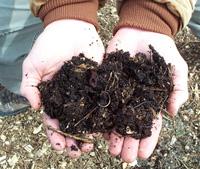
During the past three years while I have lived at the Bread and Roses Collective House in Syracuse, New York, my most frequent House Chore has been that of the “Compostmeister.” Beyond dealing with the one to one-and-a-half buckets of compost generated weekly by myself and my nine housemates, I have also picked up buckets from a nearby coffeeshop and roaster as well as a Vegan cafe, totaling perhaps 30-35 15-liter buckets of compost a week. I also was involved in the searching out of pallets to construct our six composting bins, and the purchase and maintenance of our finicky woodchipper, which provides layers of “brown” compost for the pile. This yearly total of around 26 cubic meters of compost is being used by the House to create what we hope to be the largest organic garden in all of Syracuse, including 12 two-meter by 10-meter raised beds, three terraces, and a small orchard.
As I gather, spread, and layer compost (not to mention wash buckets) I tend not to think about the future uses of the material, but instead of the various people and organizations that these food remnants represent: the potlucks, midnight snacks, lunches out, coffee breaks, and pancake breakfasts. The food scraps are organic material which break down into nutrients which we then use to grow more food, but they cannot be summed up only by their physical nature, because they also both represent and make real human relationships.
I am an anthropologist and as I teach Anthropology 101, I am always faced with the challenge of teaching my students to understand “economics” as not simply the measurable transfer of currency, but as the ways in which human beings use their physical surroundings to continue their social, cultural, familial and, yes, physical lives. One of the classic works I always refer to is The Gift (1923) by Marcel Mauss. Mauss—and those who have worked with his ideas later—tell us that a gift is never “free” but is instead always couched within social relationships, and one gift is always meant to lead to another (though perhaps not directly back to the original giver). Everything about the giving of gifts, not just their worth, but the nature of the object (a dozen roses and a child’s book may cost the same but mean different things), and the circumstances of the giving all shape the nature of the gift. Gifts can “make real” relationships between people, such as an underling giving tribute to a lord or a gift of an engagement ring. They are more than symbolic, as they often allow people to have the resources to do important tasks, such as the gifts given at baby showers and graduation parties.
The buckets of decomposing coffee grounds, potato peels, and lemon skins that I pour into a heap and cover with ground-up tree branches make real relationships: between our House and the people at the two local restaurants that we frequent, between housemates cooking for each other, between me—Compostmeister—and my housemates, and eventually between the gardeners and those who eat the food. Food is remarkably rich symbolically and it is perhaps the most common type of gift given by humans. The ability for us to grow and give it is a far more powerful ability than the mere weight of the nutrients collected.
My compost musings point to a new economics, one that focuses upon human needs and human relationships, but one that does not try to have us subsist off of good feelings and hugs, but instead off of a firm ground of well-fertilized soil.
Keep the conversation going with these pieces
There are no available blogs
Subscribe to our newsletter for fresh stories and community updates delivered to your inbox.
Get unlimited access to courses, exclusive member events, and a supportive network of community builders
Access all courses, books, and premium content
Member-only workshops and community builders
Member-only workshops and gatherings
We use cookies to improve your experience on our site. By using our site, you consent to cookies.
Manage your cookie preferences below:
Essential cookies enable basic functions and are necessary for the proper function of the website.
These cookies are needed for adding comments on this website.
Statistics cookies collect information anonymously. This information helps us understand how visitors use our website.
Service URL: policies.google.com (opens in a new window)
A residential project: people live here as their primary home.
An institution, business, network, or project that isn’t a residence (e.g. a learning center, farm, or network with no one living there full-time).

{{ item.label }}
{{ item.value ? item.value : currencyFormat( item.amount ) }}
Subtotal
{{ currencyFormat( pricing_summary.total_amount ) }}
There are no results matching your search


