Author: Shepherd Bliss
Published in Communities Magazine Issue #159
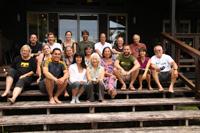
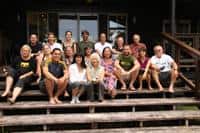
I have been a member of the Veterans Writing Group (VWG) for the last 20 years. The intentions of our community include the following: being together in a non-military environment, telling our stories to each other in a healing context, and writing them down. We also like to laugh together, and sometimes some of us surrender to expressing our grief through crying. When we started we met each month in various San Francisco Bay Area locations, and we now meet seasonally in Sonoma County, northern California. People come from all over the state.
At first we were all military veterans, except our writing teacher Maxine Hong Kingston, an award-winning author and former University of California professor. Then widows, nurses, children of vets, peace veterans, former gang members, and others impacted directly by the violence of war asked to join us. How could we say “no” and follow the Buddhist principles that guide us? Our members span the American wars from World War II to Desert Storm. We have had Chinese, Israeli, Korean, and Vietnamese participants.
Around 40 of us attend each meeting, drawing from a base of around 100 members. New people come to most meetings. We have published the award-winning book Veterans of War, Veterans of Peace, edited by Maxine (www.vowvop.org). We have read from it at various book festivals and Maxine and group members sometimes offer workshops.
Our get-togethers start with informal socializing and then we sit in a circle in a large room in the Redwood Empire. We meditate, check-in, meditate some more, and then someone describes the writing prompt which was distributed earlier by email. Then we meditate more and disperse to write in silence, returning for a potluck lunch, which starts in silence.
In the afternoon we each read—either something we’ve written that day, or something we’ve been working on. We listen without judgment, supportively, rather than critically. Both the check-ins and readings can include highly emotional moments of grief and joy, often involving crying and belly laughing together. Then we do a walking meditation into the nearby tall trees, which provide an open container that holds us.
These last 20 years with this vets group differs sharply from the first two decades of my life. I was born into a different kind of intentional community—a military family. Though there are similarities between the two communities, their differences are important. The intention of this essay is to describe some of the lessons that I have learned from participating in these two distinct kinds of families.
● ● ●I was born during World War II into the military family that gave its name to Ft. Bliss, Texas. My family moved every three years, which is common for military families. In addition to being away from my birth, my father was away for a few years while stationed in Saudia Arabia, where our family could not accompany him. As a young child I attended mainly military schools. I started playing chess at a young age, to learn military strategy. I liked marching around with the boys and rough-housing.
The military is an intentional community whose intention is to protect the nation. We form a tribe quite distinct from civilians. It is usually possible for most of us to recognize what are called “military brats.” As the old saying goes, “You can take the boy out of the military, but not the military out of the boy.”
The military family in the film and book The Great Santini by Pat Conroy was a lot like my own, including having five children. It was not until I went to college that I learned how different the military community is from the civilian community. We of the military are Other than the majority. We follow a different set of rules, including firm obedience to the chain of command.
In the military I learned many values, such as discipline, team work, duty, honor, country love, a sense of mission and something larger than the self. When I became of age, I joined the US Army during the American War on Vietnam. Though I had been militarized for a couple of decades, I was not always comfortable being in the Army. I did like boot camp, being with other teenage boys, playing in the woods.
I was organized out of the Army in the late ’60s by my first real love for someone outside the family. She invited me to potlucks, where the food was better than military food. And there were girls there. Instead of calling us “paid killers” and “death merchants” as some war opponents did, these peace activists treated us as humans.
My girlfriend back then, Marilyn Yeo, showed me pictures of napalmed babies. This may seem stupid on my part, but I had not connected our playing with guns in the woods to killing people. When I got it, I resigned my commission as an officer, disappointing my family of origin. I went on my way to other kinds of communities, like the academic community, the religious community, and political activist communities, often waging peace. I finally found the Veterans Writing Group.
For many years I despised the military for what I saw it do in Vietnam, Chile when I lived there, and elsewhere. I eventually came to a more balanced approach to the military and the positive things that I learned from being raised in a military family, separate from the war-making part.
Since joining the VWG, I have felt at home there. Our group has a clear, wonderful leader, Maxine Hong Kingston, a peace activist. Can you imagine what it would take to hold together vets from each of the different services and a wide array of other kinds of people? Her form of leadership is different from that of the military. For one thing, our group is totally voluntary. You can come to meetings or not, as you need to. Each meeting has a different facilitator. Each all-day meeting has a clear structure.
● ● ●Some of my best writing has been stimulated by the VWG community. Even when I am not able to attend, I am aware that it is happening and feel nurtured by it. The prompt for the fall 2012 meeting was to write about trees. I wrote a piece that has been widely published under various titles, including “Trees Transform.” I used it as a study guide for a walk into the woods with my Dominican University of California students.
Our winter 2012 meeting began the morning after Pearl Harbor Day. One of the things that some of us discussed was the term “moral injury,” which some are using to replace the clinical term Post-Traumatic Stress Disorder (PTSD).
“Moral injury” is a relatively new term to refer to what veterans and others experience, especially those who saw combat or violence. “Moral injury” places the blame on war itself. “Disorder” implies that something is permanently wrong, whereas “injury” suggests that healing is possible.
“Every generation gives war trauma a different name,” explained Korean vet Jiwon Chung at our last vets’ meeting. “Moral injury de-pathologizes the condition. If you go to war and come back troubled or suffering, it is not because you are psychically weak, but because you are morally strong. What you witnessed or did went against your deepest moral convictions.”
Chung later added, “That we vets suffer moral injury, despite the tremendous suffering and anguish it brings, is actually a validation of our humanity. War is the reason for moral injury. Peace, justice, and reparation are the cures for moral injury.”
Keep the conversation going with these pieces
There are no available blogs
Subscribe to our newsletter for fresh stories and community updates delivered to your inbox.
Get unlimited access to courses, exclusive member events, and a supportive network of community builders
Access all courses, books, and premium content
Member-only workshops and community builders
Member-only workshops and gatherings
We use cookies to improve your experience on our site. By using our site, you consent to cookies.
Manage your cookie preferences below:
Essential cookies enable basic functions and are necessary for the proper function of the website.
These cookies are needed for adding comments on this website.
Statistics cookies collect information anonymously. This information helps us understand how visitors use our website.
Service URL: policies.google.com (opens in a new window)
A residential project: people live here as their primary home.
An institution, business, network, or project that isn’t a residence (e.g. a learning center, farm, or network with no one living there full-time).

{{ item.label }}
{{ item.value ? item.value : currencyFormat( item.amount ) }}
Subtotal
{{ currencyFormat( pricing_summary.total_amount ) }}
There are no results matching your search