

Excerpted from the Fall 2019 edition of Communities, “The Shadow Side of Cooperation”—full issue available for download (by voluntary donation) here.
Happiness is based on trust. In fact, in most nations “trust” is the number one ingredient to happiness. I’d learned this from reading the scientific literature of the Psychology of Happiness. Trust in the government, the police, your employers, family, and neighbors is the most important element for long-term happiness.
It’s perhaps even more important for intentional ecovillages, as we must fully rely upon each other in close quarters. Equity, shared labor, and shared meals are most important for success, as I concluded in my last article for Communities (issue #181, The Culture of Intentional Community).
My most recent experience in community development demonstrates exactly how important all of this is. Without these basic building blocks, a community can’t get off the ground. And an emerging community can literally fall apart.
Here’s the story:
Last year I answered an ad in Caretaker Gazette to manage a lodge, campground, and potential permaculture village as part of a 100-acre ranch at a remote beach in a hamlet in Mexico. Our phone conversation was very involved and the owners begged us to join them and take it to the next step. They were very impressed by our experiences creating an ecovillage in a remote place (Fiji). Their ranch had solar power, local water treatment, was built mostly with Earth, and on permaculture principles. There was even a food forest plus Moringa trees. It sat above a truly gorgeous, quiet beach.
My partner Leslie and I enjoyed five days on the Mexican coast with the owners of the ranch. Over the subsequent days they offered us a 50 percent profit-sharing partnership in the business if we would run the Airbnb for the five lodge rooms and campground, as well as manage volunteers. They also asked us to look after their goats, dogs, donkeys, ducks, cats, and chickens, especially while they were gone.
Ted envisioned a community with about a dozen people since the facilities existed. Sally, his partner, wasn’t so sure. They seemed worn out from the back and forth to New England. Her attitude was of defeat, resignation, and quitting. She wanted to live in the city. They offered us up a blank canvas to create a working community based on permaculture principles and nature enjoyment. They relied on volunteers for the day-to-day management―they needed us. Ted and Sally both admitted that they couldn’t do the management themselves as they merely employed people in their fields of advertising and financial consulting. They had no experience in tourism or running an Airbnb.
Ted loved the idea of music around the campfires; however, they were not personable people. He wanted to see the existing facilities enjoyed.
I saw the vision. His wife was ready to sell the place. Leslie loved the opportunity.
We agreed to begin in December 2018. On arrival, I saw how the grounds and lodge had fallen into disrepair, looking abandoned, hardly maintained before my mid-December arrival. The first lodge guests were going to arrive and the place was far from ready. The house we were offered was barely functional: lights, toilet, and shower did not work properly, and the refrigerator had hundreds of dead maggots and flies in it. They made few preparations for our arrival. We were faced with a true challenge. We worked very hard before Christmas getting everything ready for the tourist season to commence.
The first two volunteers were sweet women from Germany and Alabama. The four of us hit it off with shared meals, solid work, and lots of laughter. We let them do their job as they saw it, offering gentle respect. In contrast, the owners were constantly rushing and had no time for us except for hurried meetings. We never relaxed together. Stressed-out, they often went up to Puerto Vallarta.
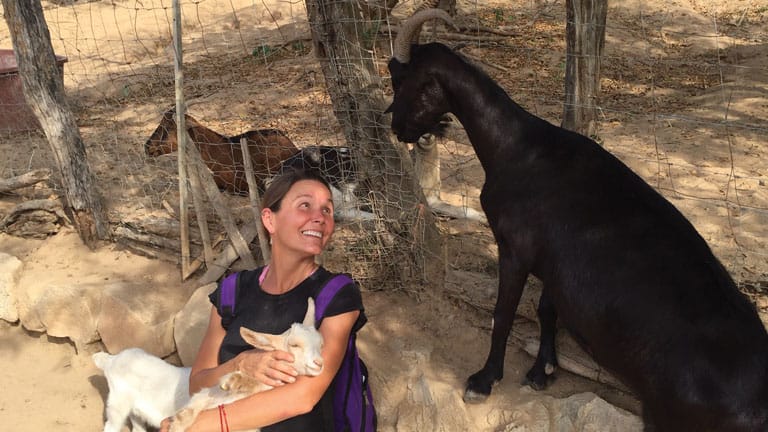
While the owners were gone over the New Year’s holiday, nine baby goats were born. After being goat midwives, we lovingly raising the newborns. Strangely, the owners didn’t thank us for that or for looking after their four dogs and three cats. In emails they demanded we do additional work, not agreed upon before.
Over the next six weeks, six more volunteers joined us from Korea, Oregon, Connecticut, Australia, and Canada. They were all lovely people. We worked like a well-oiled machine, at an even pace, with everyone respectfully trusting the other to do their volunteer jobs without our supervision or any disharmony. It was wonderful. We had fun. As managers we trusted each person to figure out how best to complete their own work, in contrast to Ted and Sally who called or texted often to micromanage.
We fed, milked, and raised goats, plus the whole menagerie. We dealt with scorpions nightly and built gorgeous curving adobe stairs, ran the water pumps, watched stunning sunsets. After our duties we savored many nights of bonfires, fishing, sitting in the dipping pool; we played volleyball on the beach and swam in big waves. Together we served our lodge guests and included them in our feasts at the big outdoor kitchen. We did much, much more. In fact, Leslie and I were busy over 40 hours a week, not the 25 as was promised.
During rare appearances from their home up on the hill, the owners seemed increasingly mistrustful, unfriendly, fearful, and downright disrespectful. They had problems with an elder parent, alcohol, and former dealings in New England. Sadly, neither had anything nice to say about each other. This contrast strengthened my relationship with Leslie.
They rarely agreed on anything in our presence without first bickering. A few times, they openly fought in front of us, but not in front of the volunteers, as I learned later. Alone with me, Ted demeaned women, including his own wife and daughter. This bothered me greatly. Over the following weeks, they broke many promises, and asked us to do work on false pretenses. They seemed to have no respect, for each other or us. My loyalty faded.
The volunteers agreed that things were much better when the owners weren’t around. We had a fun, welcoming little ecovillage despite Ted and Sally’s visits. Our volunteers stayed happy and enjoyed the beauty of the beach and the nearly abandoned place we restored.
While the owners took a two-week trip to Mexico City, we hosted a magical dance and song retreat we offered with the dance leaders. Those five days with our 18 guests, two retreat leaders, the chef, and our six community members were truly idyllic: we laughed, sang, and ate together in paradise. As managers, Leslie and I were hosting from breakfast at 7 AM until the dances ended at 9:30 PM. We saw the community as imagined come alive. The peace and quiet there was ideal for the Dances of Universal Peace. Everyone there loved our community.
We stayed well within budget, making a decent profit; unfortunately we wouldn’t see our half. The funds Ted and Sally promised did not materialize. After they returned, Sally came up to our house. Rather than showing any gratitude for the extra 15 hours a week above our commitment, she complained about the earth-moving crew, and others, talking to us as if we were flunkies to them, not managers. They hadn’t cared at all that I had sprained my ankle building stairs for them or carried on working over the retreat. Things changed for me after that. Leslie and I were very surprised at their demeanor, considering how fantastic the dance retreat went. We also had retained our hard-working, reliable team who loved the place even more.
I realized that there was no future for us there. The trust was gone. This was confirmed when we had time to mingle with people in the village. We discovered that the locals, both Mexican and Gringo, did not trust them, like them, or want them around. Some of the locals were former volunteers who had suffered similar treatment. Clearly, it was explained to us, they had a regular pattern of being friendly to their volunteers and then disposing of them.
We heard they sometimes told volunteers and paid guests to leave the ranch, often without one day’s notice. Villagers confirmed they even threw out an eight-month pregnant woman on false pretenses. That pissed off the kind folks in the village and turned things sour for them. Even the bartender at the only local cantina there asked us to remind them their business wasn’t welcome.
I could have done due diligence by contacting past volunteers before we began, yet the comments on their Airbnb page were great. Comments reflected the efforts of volunteers, the last volunteer manager, and the beautiful place itself.
What many people fail to understand, especially some Americans, is that sustainability is also about social and economic sustainability. Trust, egalitarianism, and fairness are key to most healthy endeavors, especially community building in remote locales. Ted and Sally were truthful when they said they had no idea what they were doing, either running the business or establishing a community. They didn’t. We left the day after they presented doctored accounting and wouldn’t pay us the real amount they owed us. That was the final straw. Our volunteers left soon after. The thrill was gone.
How sad that our little community completely disintegrated, abandoned again, after a good run. We couldn’t have asked for harder-working or more cooperative teammates than the six who shared the potential ecovillage with us. We are so thankful for their efforts.
What a truly missed opportunity. It could have worked. Our beloved volunteers wrote to me afterwards on what a wonderful atmosphere we created, lighthearted and fun. The Airbnb guests and retreatants gave us glowing appreciation for our efforts in the Guestbook. We did our part as managers. We loved the position.
Later we found out more details: the owners had been preparing to kick us out, as the house we were in had a deposit on it to be rented; they gave us no notice of that. Ted once spread a rumor that a neighbor was a drug dealer to try to ruin his reputation over a dispute about power tools. To me that’s unconscionable. The owners sold off the adorable goats knowing they would become birria (goat stew), after promising vegetarian Leslie that they would never do that. We also found out that they would subdivide the ranch to be sold off so they could leave the country with a profit.
These were the ugliest Americans I had ever met in Mexico; they didn’t fit in such a warm, friendly village. The ranch seemed tainted. It was on its way to being subdivided, just another investment property, not to be a community after all. Emotionally we let go and moved on to a much better caretaking gig.
The ranch was gorgeous and they did a decent job of developing it, but they abandoned it often while the place needed serious love and continual maintenance.
There was joy and trust while we ran the ranch. We learned valuable lessons and loved our time there. We also realized that the hard work, spirit, and friendships created were not enough. Gratitude is necessary.
● ● ●
Postscript
After I wrote this article I sent it to five of the volunteers who shared this time with us. It seems they had little idea what we were experiencing, as managers, with the owners. They were not exposed to the daily demands, via email and WhatsApp, nor the arguments. They experienced the beauty of the place as did we, but without the sour notes of rudeness and fear. I had to rewrite some of it due to their valuable input.
One of the volunteers who helped build the adobe stairs wrote a response to my article above. An excerpt:
“So it is clear that a paradise can’t guarantee any peace of mind, let alone a heart which may have already gone sour. This leaves me with mixed emotions. It is sad since one bad apple could potentially ruin the community and create havoc with distrust. Then I also remember because of people like you and Leslie communities continue to thrive and are sustained. Thank you.”
Our volunteers and lodge guests let us know in writing how greatly they appreciated all our efforts. After all, it’s about the relationships made. One wrote: “It just wouldn’t have been the same or as enjoyable without you friendly people.” Our little community made this remote permaculture place come alive.
Together we created so much happiness. Too bad the owners missed out on all that, still living hurried, American-style lives. What a wonderful experience living there, learning so many lessons. It strengthened our commitments to honesty and trust, and to building socially sustainable communities. Onwards.
Philip Mirkin is the founder and executive director of the Fiji Institute of Sustainable Habitats (www.SustainableFiji.org). He designs hurricane-resistant structures for the Ministries of Women, Children, and Poverty Alleviation; Education; and Native Affairs. He is coordinating Fijian Cabinet Secretaries, NGOs, and local leaders to empower women to build the first domed, Women’s Resource Centre out of natural materials in Fiji. Author of The Hybrid Adobe Handbook, he also cofounded Fiji Organic Village. Philip has designed ecovillages in New Zealand, Fiji, and Puerto Rico, spoken at conferences, taught sustainable building in a wide range of settings and universities, and offered a free workshop series on natural Tiny House building for homeless mothers and veterans. Since 1981, Philip has led annual humanitarian aid/disaster relief programs and is currently supplying a clinic in Haiti and hospitals in Fiji. His new book Hurricane Lunch is available in 2020. Contact: philipmirkin [AT] hotmail.com. WhatsApp: +52 415 185 8837.
Excerpted from the Fall 2019 edition of Communities, “The Shadow Side of Cooperation”—full issue available for download (by voluntary donation) here.
Keep the conversation going with these pieces
There are no available blogs
Subscribe to our newsletter for fresh stories and community updates delivered to your inbox.
Get unlimited access to courses, exclusive member events, and a supportive network of community builders
Access all courses, books, and premium content
Member-only workshops and community builders
Member-only workshops and gatherings
We use cookies to improve your experience on our site. By using our site, you consent to cookies.
Manage your cookie preferences below:
Essential cookies enable basic functions and are necessary for the proper function of the website.
These cookies are needed for adding comments on this website.
Statistics cookies collect information anonymously. This information helps us understand how visitors use our website.
Service URL: policies.google.com (opens in a new window)
A residential project: people live here as their primary home.
An institution, business, network, or project that isn’t a residence (e.g. a learning center, farm, or network with no one living there full-time).

{{ item.label }}
{{ item.value ? item.value : currencyFormat( item.amount ) }}
Subtotal
{{ currencyFormat( pricing_summary.total_amount ) }}
There are no results matching your search


