

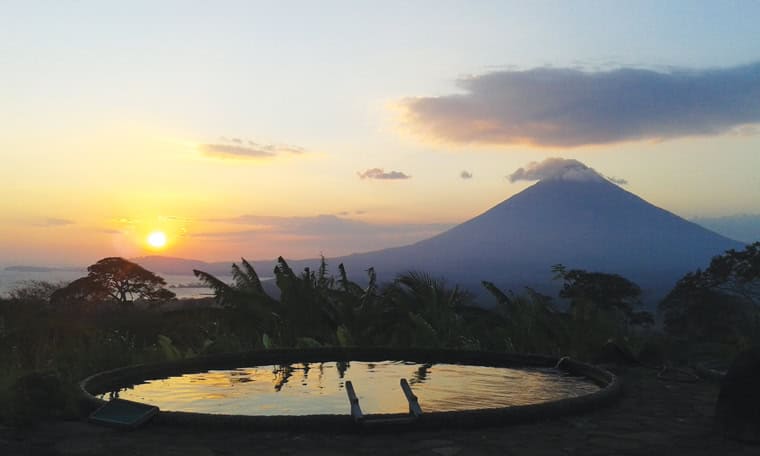
I have always been two things at once…literally marked on my body through a pair of confused eyes—one blue, one brown, and reiterated through my visit with a Shaman in the highlands of India, as he stared into these tangled eyes and uttered the words “you are this, and you are that, and you forever will be both.” It took many years to understand what he meant, but as I entered an intentional community in the Nicaraguan jungle, I began to understand.
I was studying international law at the time, and with this came a bureaucratic world full of elitist language and moot court competitions and a long, complex thesis. I loved this part of myself; I loved dressing up and drinking expensive wine and talking political jargon at exclusive events. For many years, however, this came at the expensive of the mystical goddess inside of me—the woman who longed to be jumping barefoot through the jungle with knotted hair and a hammock for a bed. I struggled with this duality inside, not quite understanding how I could be both of these things at once and consequently ignoring, arguably, the more important part of me. Others would struggle with it too—and such black-and-white judgments took a toll on the way I viewed myself. I spent a lot of time pushing this goddess away, trying to hide and ignore her for fear of criticism. But, just as placing a band-aide on a wound only hides but does not heal, this goddess eventually bled out.
In the company of my academic friends, I was often able to receive a type of intellectual stimulation that I will forever thrive on. I would spend my evenings partaking in heated political debates and sharing legal insights, always learning and growing from each other’s knowledge. But when it came to my desire to feel more spiritually connected to the earth, to spend time in nature, and to investigate alternate states of consciousness, many of my academic friends thought I was a little out of my mind. By the same token, when I would spend time with many of my friends who embarked on a less conventional and more spiritual path, I also faced judgment for being “too far into the matrix.” For years, I felt torn between one group of friends who judged me for dancing around fires, and another who judged me for throwing on mascara and kickin’ it at the office. But as the Indian Shaman had cautioned me so many years before, I am this, and I am that, and I forever will be both. I owe my Nicaraguan experience to embracing this beautiful symmetry in my life.
My stay at an intentional community in Nicaragua taught me that not only is it okay to move in between these two worlds, but that anybody else’s judgment about this has never actually been about me. Furthermore, it taught me how to harness the moral foundation of intentional community and use it as a tool which I am free to pick up and put down throughout my life, as I see fit.
Here are three lifelong lessons that my stay at an intentional community taught me:
Unplug
First, and perhaps quite obviously, the benefits of unplugging from technology are indescribable. It is evident that as a society, we are over-attached to technology. In community, we had access to Wi-Fi only during certain hours and in a common space far from the rooms where we would eat, meditate, and sleep. We were encouraged to lock our technology away and to call upon it only when deemed necessary.
Ironic as it may seem, living in a community setting can largely be about finding solitude and creating a safe space for self-reflection. Of course, solitude is hard to find when you are constantly plugged into the outside world, so it is important to turn off and remove these harmful distractions. It is hard to do at first out of your own sheer will power, but after easing into this transition with the help of my community, it is a practice I will forever draw up in order to re-balance.
Unplugging from technology creates the shift into the next lesson learned:
Experience genuine connection without expectation
Staying in an intentional community allowed me to practice honest love and connection with my fellow human beings, without judgment or expectations. As a group, we often created and participated in workshops that, to someone outside looking in, probably seemed a little strange. We mimicked animals, we danced topless, we expressed ourselves however we felt fit—all without a wince of judgment. Through participating in a space free of judgment, I was able to let go of judgments about others and myself.
When we release these expectations about how people should behave, or how they should treat us—when we let go of that energy we’ve been taught that sees a black-and-white world in which people are either wrong or right—we leave room for something magical to happen: authentic connection. We create freedom.
The people I spent time with in the community were from all over the world, coming and going, with different kinds of goals and ambitions. But none of that mattered, because we were there to sit with each other in the moment, to see each other as we truly are, and then to let go. I will forever strive to bring genuine connection without expectation into all of my relationships.
Strive to create a lifestyle in line with your morals
The intentional community helped to remind me of the very basics: put your money where your mouth is. If you don’t support animal cruelty, don’t eat factory meat. If you are worried about the state of the environment, be conscious about the amount of water you are using, about leaving your lights on, etc. Respect your body—think of food as fuel; you wouldn’t pour tar into your car engine and expect it to run properly, so don’t put it into your body and expect different results.
In our kitchen, we did not allow meat or dairy. We ran on a diet of organic fruits, vegetables, and grains. Apart from the kitchen, other sources of water were located far down a hill. This meant that every time I wanted water, I actively had to work for it. Moreover, my cabin had no electricity, which reminded me that a bedroom is an intentional space used to rest and recharge, not to sit up and text late at night.
Although many of the things listed above may seem obvious, they can be very tough to actually implement into everyday life. These are the simple lessons that support me in my symmetry—that I continue to draw upon whenever I am, at times, feeling a little overwhelmed by a bureaucratic world. I will forever come back to community-based living whenever I feel a disconnect between this symmetry.
Regardless of your lot in life, I truly believe spending some time in a community-based setting has something magical to offer everyone.
Through spending time within this community, and living freely without judgment, I began to understand that the duality within me is something to be honored, not judged.
I am this, and I am that, and I forever will be both.
Elizabeth Arnott is from London, Ontario, Canada. She has spent the past three years traveling for work, academia, and her own personal growth. A cultural alchemist, she has traveled through Haitian highlands to Indian jungles, experiencing the meaning of community in many different ways. Elizabeth works in human rights law and has most recently been living in a small Mayan community on Lake Atitlan, Guatemala. Contact Elizabeth at earnott [AT] @gmail.com.
Keep the conversation going with these pieces
There are no available blogs
Subscribe to our newsletter for fresh stories and community updates delivered to your inbox.
Get unlimited access to courses, exclusive member events, and a supportive network of community builders
Access all courses, books, and premium content
Member-only workshops and community builders
Member-only workshops and gatherings
We use cookies to improve your experience on our site. By using our site, you consent to cookies.
Manage your cookie preferences below:
Essential cookies enable basic functions and are necessary for the proper function of the website.
These cookies are needed for adding comments on this website.
Statistics cookies collect information anonymously. This information helps us understand how visitors use our website.
Service URL: policies.google.com (opens in a new window)
A residential project: people live here as their primary home.
An institution, business, network, or project that isn’t a residence (e.g. a learning center, farm, or network with no one living there full-time).

{{ item.label }}
{{ item.value ? item.value : currencyFormat( item.amount ) }}
Subtotal
{{ currencyFormat( pricing_summary.total_amount ) }}
There are no results matching your search

We’re introducing new Plus features — including community reviews, Profile Match, and unlimited Needs & Offers posts — while keeping most of FIC free for everyone. Membership costs less than two coffees a month.

