

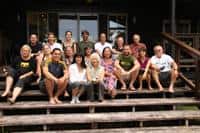
There’s an abundance to the city, an almost overwhelming abundance. Today this abundance showed up as 20 rolls of sushi. A couple weeks ago it showed up as about 30 lbs. of filet mignon. Before that it was a gross of eggs (a dozen dozen) and a crate of organic grass-fed heavy cream and a case of fair trade black Himalayan chia seeds. All free. All pulled out of a dumpster in the middle of the night and brought back to the main house of Compersia, the commune I call home in Washington, DC.
As anyone who has moved to the country to pursue the simple life will tell you: the simple life is not so simple. The dream of rural abundance, of growing all your own food and fashioning all your own tools, is more often a reality of long hard work and making do with less. Unless you’re independently wealthy, there are not many places you can live where everything you might want comes easily and abundantly.
Fundamentally there is one difference that separates rural areas from urban ones: population density. Many communes and intentional communities settle in the country. Insofar as they desire to build a new world divorced from mainstream society this makes sense. With fewer people occupying the land there’s more room to build and more room between you and your opinionated neighbors. Over the decade that I lived at rural Acorn Community, in central Virginia, this is certainly the reality that I experienced. The abundance of space, both physical and cultural, provided a lot of room to grow a little utopia and keep it insulated from the corrosive effects the mainstream would have on it. However, there are abundances in many places if you can appreciate and cultivate them.
When I first moved to Acorn in 2005 I came looking for proof that a better world was possible. My political blossoming in college, during the peak of the anti-corporate globalization movement and the run-up to the Iraq War, saw me immersing myself in the history and theory of anarchism. But in conversation after conversation my passionate insistence that we could, as a society, thrive without constantly brutalizing and dominating each other was met with skeptical requests to cough up the proof that my nice ideas could stand up to harsh reality. When I discovered Twin Oaks and then Acorn, all quite by accident, I knew immediately what I had stumbled upon and that the egalitarian communes movement was my life’s work.
And the communes did not disappoint. Acorn Community, an egalitarian income-sharing commune, member of the Federation of Egalitarian Communities, and daughter of older larger commune Twin Oaks Community, was founded in 1993 and at the time of my joining listed “anarchist” as one of its self-applied labels. Acorn operates by consensus, runs a fairly complex and highly seasonal mail order garden seed business, and does it all with a minimum of formal structure. While there we saw the business quadruple in size (rising to over $1 million in revenue by the time I left), helped two other nearby communes to form, built a giant eco-groovy new headquarters for the business, and weathered an arson and a whole string of health, mental health, and interpersonal crises by various members. My time at Acorn and getting to know the other rural social laboratories of the FEC taught me or confirmed several important things:
● Prosperity and organization are possible without heirarchical domination of each other. People are, as it turns out, really good at managing complexity.
● Complex organizations can be run democratically with relatively small overhead. This is related to the above point but the distinction I’m making is that a business or organization can be both directed and managed in a non-heirarchical, democratic, and cooperative way.
● Motivation is available without individual or private reward, like wages. Human motivation is more complex. I found that people could be motivated to apply themselves to valuable labor by the prospect of collective enrichment as well as less tangible things like their values, personal curiosity, or simply love of a good challenge.
● Intense cooperation/communalization/socialization significantly boosts quality of life relative to cost of living. In short, a middle-class quality of life is achievable at sub-poverty levels of income. And it comes with a lighter and less rigid labor burden than is required by almost all full-time jobs! A corollary of this is that intense communalization brings ecological impact down to ballpark global sustainable levels with relative ease.
● The socialized economy of the communes provides a supportive healing space for people dealing with various forms of mental illness (from simple things like anxiety to more complex things like psychotic breaks) as well as being flexible enough to make mental differences that were a problem in the mainstream not a problem in the commune.
What I noticed about all these is that none of them seemed to be a result of the communes’ rural locations. In fact, for all the advantages of living in the country there were several glaring problems. The work that could be done in the country was generally pretty low wage. Low population density means commune life could feel isolating, particularly for minorities of any sort. Undeveloped land means that population growth is limited by the speed at which new residences can be built. Their remoteness made visiting them difficult for interested people. Perhaps most striking of all, though, is simply that there are a lot of people who want to live communally but do not want to live in the country.
Our society is run by the few at the expense of the many. It is consuming and degrading the environment we depend on. Inequalities of wealth and power are accelerating. The world is on fire. I thought I had found some ways to help put it out but now those tools needed to spread.
In the summer of 2014 I had the good fortune to be able to take a trip to Europe both for pleasure and discovery1. In Madrid, I visited the comrades of the Red de Colectivos Autogestionados2 (RCA). Most of the members of the RCA were also members of the CNT, Spain’s famous anarcho-syndicalist trade union which is remembered as the most successful anarchist organization in history, having fought off Franco’s fascist coup for several years and controlled large areas of Spain at their peak. After Franco died and his fascist regime was dismantled, membership in the formerly illegal CNT exploded. However, despite sky-high membership the CNT did not display the strength or resiliency that it had historically and had been fading ever since. The RCA arose out of a very material analysis of this situation. Spain has a long deep history of cooperatives, long predating the Rochdale Society in England and with a stunningly high and widespread membership. It was this community of cooperatives that provided the material base and support for the combative and often embattled CNT during the decades leading up to the fascist coup. By the time Franco died (peacefully in his bed) he had largely succeeded in co-opting the cooperative movement and cleansing it of its leftist politics. Looking at this history the comrades who started the RCA concluded that for the CNT to regain its power they needed to rebuild the network of radical cooperatives that had fed and supported it.
There’s an example of this closer to home and closer to now in the Movement for a New Society (MNS). A Quaker peace movement-derived organization that started in 1971 and lasted until 1988, MNS saw the world as being on the verge of a revolution and made it their mission to research, educate, train, and prepare the new society that could arise after the old one tumbled. To support their work and their activists they established a nationwide network of cooperatives and urban communal houses, often sharing income. In interviews I conducted with several veterans of MNS the value of the communes and cooperatives in supporting the work was reiterated again and again. This support came not only in the form of material support (to avoid bankruptcy) but also in social and emotional support (to avoid burnout) and as laboratories and testbeds for the ideas that MNS’ activists were developing.
So here we were. The world clearly needed changing. We had some proven strategies for building effective movements. The rural egalitarian communes had done good work but had also clearly shown their limitations. The need to develop a network of urban egalitarian communes to support radical social change work was clear. In the Fall of 2013 several fellow communards and co-conspirators and I decided to try to do just that by launching a project called Point A.
Of course, we are not the first ones to try such a thing or things like it. Specifically on the urban egalitarian communes question, since I first joined Acorn there’s been one or two urban communes in the FEC. When I first joined there was Emma Goldman Finishing School in Seattle, Washington, and a few years later they were joined by The Midden in Columbus, Ohio. Both shared the same general model and in the last two years both have devolved into simple group houses or co-ops and left the FEC. This is a sobering recent history but there are counterexamples if we widen our gaze a bit. Ganas, an intentional community with a smaller income- and asset-sharing commune at its core, has been thriving in New York City for 35 years. Over in Germany there are a bevy of income- and income- and asset-sharing communes located in major cities, some of which have been going for over 30 years3. In Spain (mostly) there’s Las Indias, a nomadic but very stable income-sharing commune that’s been going for 14 years. In Israel, a new generation of urban kibbutzim has arisen. In light of this, it’s easier to consider the dissolution of Emma Goldman Finishing School and The Midden as something peculiar to that model or an accident of circumstance.
Point A took on the mission of working to cultivate ambitious and engaged egalitarian income-sharing communes in the urban centers of the American East Coast. Ambitious and engaged—to connect them to the wider work for social justice and liberation. American East Coast—because that’s where the FEC has the most resources, and the FEC is a natural ally for this work. When we started working we went in every direction we could find at once: Researching examples of successful urban communes. Finding and forging contacts with collectives, cooperatives, and organizations that might make good allies. Conducting research into legal and tax options for urban communes. Conducting research into financing options for urban communes. Organizing public talks, workshops, and events. Building out a website and blog to point people to.
We started the work in one city: Washington, DC. This is the city in whose suburbs I grew up and where I had the densest network. It’s where I wanted to get a commune started. And it’s where I have stayed and worked, but the project didn’t stay there. Soon after starting in DC we were enticed to NYC by some exciting prospects, and other Point A organizers started working there. Then we got involved with some collectives in Baltimore that we thought might be interested in converting. Then we were contacted by a new, and sadly short-lived, commune in Richmond, Virginia. Then a collective house in Binghamton, New York. Various Point A organizers have tried various tactics in each of these cities.
In DC, meanwhile, the project, as I was organizing it, maintained a laser-like focus on getting a single commune started. The general strategy was to start by recruiting potentially interested people from our existing network. These people would start the conversation that is the first phase of any cooperative project. One caution we had heard again and again was that the people to start the conversation would likely not be the people to start the commune. Keeping this in mind, we thought of each phase as a sinking island, a platform we could find temporary purchase on but that, if we wanted to continue, we would need to be planning to move on from. That first meeting had about 20 people. Of those, 12 ended up coming to our monthly meetings. After a little less than a year, a group of eight likely founders had identified themselves. Together those founders, of whom I was one, finished hammering out what we hoped was the bare minimum of policy and structure that we needed to start and put each other through our newly designed membership process. Of those potential founders, five made the jump and actually started the commune: Compersia, the first egalitarian income-sharing commune in DC (in a while, at least).
After that I stepped back from Point A work. My fellow Compersians and I had a lot of work cut out for us continuing to build out the agreements and policies we didn’t have, figuring out how to live together, and figuring out how to run this urban commune we had created. Now, a year and a half in, we’re still around. We’re even growing! With any luck we’ll need a second house before long to fit all our members.
To learn more about Compersia visit compersia.community or better yet email contact [AT] compersia.community. To hook up with the Point A crew check out frompointa.org or send an email to info [AT] frompointa.org.
GPaul Blundell is a member of Compersia Community in DC and an enthusiast about egalitarian community. He enjoys long easy bike rides, nerdy board games, and building the new world in the shell of the old.
1 I visited a number of urban and suburban egalitarian communes in Europe and the results of my interviews, observations, and analyses eventually made it into a one-off podcast called “Income Sharing Across the Pond” available free on Soundcloud.
2 English translation: The Network of Self-Managed Collectives.
3I personally visited Kommune Niederkaufungen in Kaufungen outside of Kassel and Villa Locomuna located in Kassel.
Keep the conversation going with these pieces
There are no available blogs
Subscribe to our newsletter for fresh stories and community updates delivered to your inbox.
Get unlimited access to courses, exclusive member events, and a supportive network of community builders
Access all courses, books, and premium content
Member-only workshops and community builders
Member-only workshops and gatherings
We use cookies to improve your experience on our site. By using our site, you consent to cookies.
Manage your cookie preferences below:
Essential cookies enable basic functions and are necessary for the proper function of the website.
These cookies are needed for adding comments on this website.
Statistics cookies collect information anonymously. This information helps us understand how visitors use our website.
Service URL: policies.google.com (opens in a new window)
A residential project: people live here as their primary home.
An institution, business, network, or project that isn’t a residence (e.g. a learning center, farm, or network with no one living there full-time).

{{ item.label }}
{{ item.value ? item.value : currencyFormat( item.amount ) }}
Subtotal
{{ currencyFormat( pricing_summary.total_amount ) }}
There are no results matching your search


