
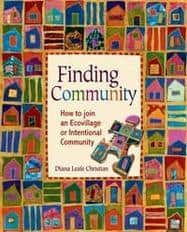
Diana Leafe Christian is the author of Creating a Life Together and Finding Community, two of the most important books available to community builders and seekers. She also served as the editor of Communities magazine for 14 years. She started her journey with the FIC at the 1993 Celebration of Community. Attended by over 800 people, it was a seminole event in FIC’s early history. She is the 2018 recipient of the Kozeny Communitarian Award.
For more 30th blog posts click here.
I think of the FIC as my community “mom and dad” when it comes to some of my earliest training in intentional communities and the US communities movement.
I first met FIC Board Members at the August 1993 Celebration of Communities, a gigantic communities conference at Evergreen State College in Olympia, Washington. Over 800 people came to hear Patch Adams give the keynote address and longtime communitarians share advice on consensus, conflict resolution, children in community, and dozens more topics. I took workshops with Carolyn Estes of Alpha Farm on consensus (Wow, what an idea!), and Laird Schaub of Sandhill Farm about resolving conflict (Communities have conflict?) Backstage in what one might call the “engine room” of the conference, I also met Dan Questonberry and Jenny Upton of Shannon Farm; Harvey Baker of Dunmire Hollow; Betty Didcoct, veteran of communities in British Colombia and an ace consensus facilitator; Elph Morgan and Jillian Downey, recent graduates from Ann Arbor; and the community-traveling Geoph Kozeny, from, well, everywhere.
While I loved all the community-learning offered by the Celebration, I was really there to seek the job of Managing Editor of the FIC’s recently acquired Communities magazine. I was interviewed for this by Dan Questonberry, Geoph Kozeny, and Laird Schaub. While they seemed warm and friendly, they also appeared to be somewhat skeptical about my ability to do the job because I’d never lived in an intentional community before, and had only been studying communities for the last year as publisher and editor of Growing Community, my small newsletter. I was relieved when Dan Questonberry, thumbing through its pages, finally said, “Maybe she could do it; the articles seem on topic and well-written.”
“Hire me!” I mentally shouted to Dan, Laird, and Geoph, hoping to counter their apparent view that a non-communitarian like me, even with editing skills, could not and maybe should not edit a magazine on what I guessed they considered a sacred and arcane topic. (“Editing is a transferrable skill!” I added to my loud mental shout.) At their board meeting at Songaia Community near Seattle just after the conference, the FIC decided to take a chance on a layperson and hired me anyway. I was so happy!
I’d thought the Celebration was powerful immersion-schooling, but my education really began by reading, choosing, editing, and sometimes wholly re-writing articles for Communities. Every issue had a theme, so each quarter, topic by topic, I got a sizeable download of community lore from diverse community founders, seekers, and afficianados. (Laird and Geoph had agreed I could also be the magazine’s editor, as it needed editing as well as managing.)
The job required my attendance at the FIC’s twice-yearly board meetings, which were held at different communities around North America. I absorbed everything I could from each group, asking founders and longtime members to tell me about the group’s history, favorite stories, sorrows and joys.
I met more FIC Board Members and Associate Board Members at these meetings, each of whom influenced and inspired me in various ways. In the early days I met Earl and Peggy Loftfield, then of Sirius Community; Lois Arkin, who would later became one of my dearest community friends; Caroline Estes, Grandmamá of consensus training in the communities movement and trainer of community trainers; Paul DeLapa, recently of Esalen Institute and soon to become a consensus trainer himself; Loren Schein, longtime community advocate in Eugene, Oregon; Ben Lipman, a friend from Colorado, where I lived at the time, who’d persuaded me to apply for the Communities job in the first place; Tony Sirna, co-founder of Dancing Rabbit in Missouri; and Tree Bressen, veteran of three different intentional communities, and a regular contributor to Communities and its longtime copyeditor. I later met Jeff Grossberg, an experienced fundraiser for nonprofits; Hank Obermayer, who would soon found Mariposa Grove community in Oakland; and Bill Becker, my neighbor down the road at Sunrise Ranch Community. In the early 2000’s I met newer board members Raines Cohen, co-founder of Swan’s Market Cohousing in Oakland, resident of Berkeley Cohousing, and co-founder with Betsy Morris (later an FIC Board member too), of Cohousing California; and Ma’ikwe Ludwig, with whom I once visited Hummingbird Ranch Community in New Mexico. (And just recently met Sky Blue of Twin Oaks, the FIC’s new Executive Director.)
Three of these meetings were especially memorable. In 1994 we convened at Miccosukkee Land Co-op (MLC), founded in 1974 by professors and former students at Florida State University on a large property of woods, meadows and swamps near Tallahassee. On the tour I was impressed by the community’s relatively inexpensive homebuilt wooden houses (no insulation whatsoever and screens for windows) and their winding wooden boardwalks over the swamps. (“Um, do you have alligators here?” OH yeah — see that three-legged dog?”) I found out how a community conflict over building a swimming pool had been resolved by the pool-advocate members creating their own swimming pool co-op (non-co-op members could swim for a small fee), how others then created a pizza oven co-op to forestall a similar conflict, and how the community helped friends create a smaller community, Sunrise, down the road. I loved dancing to the group’s homegrown rock band, especially their “Ballad of MLC,” about the significant events of Miccosukkee’s community history so far, including babies born at home, the death of a beloved older member, and a devastating fire.
Meeting at Twin Oaks in Virginia and the Farm in Tennessee was especially significant, as I’d read, heard, and dreamt about these well-known communities since the ‘60s and ‘70s. At Twin Oaks I visited what for me were legendary sites: the hammock shop; the dairy farm; Zhankoye, their large community building; Degania, their former children’s residence; and the original farmhouse where it all began. At The Farm I stayed up late several nights in a row as founders and early members described their experiences in the community’s early years. (They all seemed to wear tie-dyed tee-shirts and have long hair, however by the late 1990s it was long gray hair). Visiting The Farm was like going on a pilgrimage to a sacred site, a kind of Hippie High Holy Ground.
In addition to absorbing hundreds of articles by communitarians and visiting memorable, if not famous communities, I gained invaluable knowledge and skills directly from individual FIC members.
I was schooled in consensus decision-making and meeting facilitation in conversations with and taking the workshops of Betty Didcoct, Caroline Estes, Tree Bressen, and Laird Schaub. And instruction and insights from Laird on a myriad of topics, including, to name only two how to write more effectively and tighten up articles when possible, and reducing potential conflict in meetings using his subtle and skilled approach to agenda planning. From Paul DeLapa I got an effective, good-will circle process to give one another feedback — I liked it so much I taught it (as the “Gifting Circle” process) in workshops all over the world, and people loved it. I understood community life more deeply and broadly from conversations and visits with Geoph Kozeny and Harvey Baker, and from reading Geoph’s “Peripatetic Communitarian” columns over the years, as well as my all-time favorite article of Harvey’s: “Community Member as Lightning Rod.”
And . . . my life was literally transformed by FIC folks who helped me launch a whole new world in writing articles and books and offering workshops on starting successful new communities. In order to help me start teaching workshops for example, in 1997 Bill Becker, director of venue rental at Sunrise Ranch, generously offered me the use of their space at no charge for my first workshop ever on starting new communities.
I’ll never forget how, at a board meeting in Cedar Rapids, Iowa, Elph Morgan and Jillian Downey took me aside and seriously advised me not to use a local self-publishing house for the book I wanted to write, but to propose it to a real publisher instead, like for example New Society Publishers in Canada (and New Society did become my publisher).
In a series of phone interviews, Tony Sirna and Hank Obermayer each shared founding stories of Dancing Rabbit and Mariposa Grove respectively; their stories became important parts of Creating a Life Together.
In 2003, after the book was published, Lois Arkin graciously invited me to co-teach a workshop with her on starting new communities at Lost Valley Educational Center in Oregon — and doing helped me attract many more jobs teaching workshops in the US. And in 2006, as one of the keynote speakers at the Japanese Ecovillage Conference, Lois recommended me to the conference organizers for their next event the following year. Thus I became a keynote speaker at the 2007 Japanese Ecovillage Conference in Tokyo — an amazing experience I’ll never forget.
Tree Bressen gave me invaluable ideas and suggestions about teaching workshops, and just gave me several of her specific exercises from trainings in consensus and facilitation.
Over the years Lois Arkin at Los Angeles Eco-Village and Raines Cohen and Betsy Morris in the Bay Area organized and promoted my workshops in each location, which of course generated me with more jobs, more community sharing and learning, and more income.
I’d become rich in knowledge, ideas, experience and friends in community life, thanks to the generosity of all these knowledgeable and generous community activists.
This initial “community immersion” education from my years with the FIC — editing the magazine, visiting communities, and being mentored by individual FIC folks — led to my writing Creating a Life Together and Finding Community. (Also with help from community founders not involved in the FIC: Dave Henson of OAEC in, Liz Walker of EcoVillage at Ithaca, Dianne Brause of Lost Valley Educational Center, and of course the many founders and early members of Earthaven, the North Carolina community I joined in 2001.) The books in turn led to my doing workshops, consultations, and conference presentations all over North America. In 2005 Creating a Life Together was published in French, and in the next few years in five other languages too, including Russian and Korean. This led to my doing workshops and consultations and conference keynotes internationally, which of course led to more knowledge of community life. I became an EDE (Ecovillage Design Education) trainer for GEN-affiliated Gaia Education, and taught a month-long EDE courses in the Philippines in 2010 and in Israel in 2011. This led to my contributing chapters to Gaia Education books on the social design of ecovillages, and on the economic design of ecovillages, as well as a chapter on Earthaven’s early development for GEN’s 20th anniversary book, Ecovillage: 1001 Ways to Heal the Planet. I joined the board of the Global Ecovillage Network’s (GEN) regional organization, Ecovillage Network of the Americas (ENA) in 2012, and later joined the boards of GEN-US and GENNA (GEN-North America).
I’m blessed to be doing the work I love about the topics I love using the writing and teaching skills I love, while making friends with wonderful communitarians everywhere, from the US and Canada to Colombia, Brazil Mexico, Quebec, Israel, Japan, Russia, and most countries in western Europe. So when people comment on the wonderful traveling life I now have, or thank me for the ideas I’ve been able to share with them about what works well in community, I remember I couldn’t have even begun this journey without the help of “my community mom and dad.”
Keep the conversation going with these pieces
There are no available blogs
Subscribe to our newsletter for fresh stories and community updates delivered to your inbox.
Get unlimited access to courses, exclusive member events, and a supportive network of community builders
Access all courses, books, and premium content
Member-only workshops and community builders
Member-only workshops and gatherings
We use cookies to improve your experience on our site. By using our site, you consent to cookies.
Manage your cookie preferences below:
Essential cookies enable basic functions and are necessary for the proper function of the website.
These cookies are needed for adding comments on this website.
Statistics cookies collect information anonymously. This information helps us understand how visitors use our website.
Service URL: policies.google.com (opens in a new window)
A residential project: people live here as their primary home.
An institution, business, network, or project that isn’t a residence (e.g. a learning center, farm, or network with no one living there full-time).
{{ item.label }}
{{ item.value ? item.value : currencyFormat( item.amount ) }}
Subtotal
{{ currencyFormat( pricing_summary.total_amount ) }}
There are no results matching your search