

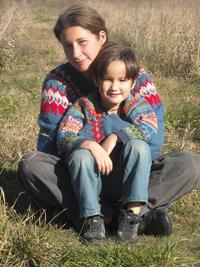
I have lived and worked at Innisfree Village for most of the last 24 years. I raised my son here. I have enjoyed a lifestyle of sharing, learning, caring, and laughing with people from around the world as well as with people with Intellectual Disabilities. We all have things we need and gifts we can give.
I can cook a meal for 20 with little effort and give some decent haircuts. I am not very good at measuring carefully and cutting things in a straight line. That’s where my friend Willy comes in. He can be very exact and very literal. He challenges me to think in other ways or at least to consider the world from various people’s viewpoints. I can practice a foreign language here, get help with my computer, or car, or bicycle. Hugs are free here and given quite freely.
This is a full, rich life that is not for everyone, but could be for many of you. We have quite a few similarities to egalitarian communities: we share resources, grow many of our own vegetables, have a pool of vehicles for our use whether “work”-related or for personal time. We are free to go in and out of each other’s homes. We get fresh bread and granola delivered to our house twice a week. We have movie night, birthday parties, dances, and potlucks. There is always someone to be with. Finding alone time is possible but requires a bit more effort.
Some of the ways we are different from egalitarian communities: we have a Board of Directors, an Executive Director, and are bound by the License granted to us by the Department of Social Services for the State of Virginia. The population with Intellectual Disabilities, whom we call Coworkers, pays tuition to live here. Or more precisely their families do. In a more perfect world (and perhaps in more socialist-type democracies) this would be free to all who need it and a birthright of being a citizen. Unfortunately, we don’t live in that world here in the US (yet?).
Innisfree Village is a Lifesharing community with adults with Intellectual Disabilities. We are a Service community in that we serve adults with disabilities. We were established in 1971 by some parents of young people with disabilities wanting a place for their children to grow and thrive in a community of respect and beauty.
Our mission includes:
1. Being a model therapeutic environment with people with intellectual disabilities, emphasizing empowerment, interdependence, and mutual respect of all community members.
2. Evolving with the changing needs of the individuals with intellectual disabilities within the Village community and beyond.
3. Valuing work and fostering creativity through artistic crafts, stewardship of the land, and daily community life.
4. Promoting efforts in the stewardship of our land to acknowledge the reciprocal relationship between our human health and our natural environment.
5. Encouraging the integration of community members into the larger society through participation in cultural, educational, recreational, religious, and volunteer programs.
6. Relying for its financial resources upon family support, the spirit of volunteerism, and private funding.
7. Supporting and encouraging the talents and individuality of community members from diverse educational, national, ethnic, and social backgrounds
We are a community of about 75 people, 60 of whom live here. It is a dynamic community, as people do come in and out on a regular basis. The 40 Coworkers make up the foundation of our community. Philip, Bee, and Marny all arrived here in the 1970s. Kevin, Sian, Corinne, and the two Brookes arrived in the past five years. We all arrive from various places and bring differing problems, needs, and gifts. The more dynamic part of our community is the Residential Caregiver Volunteers who come from around the world to serve for at least one year within our community. At the moment, we have Volunteers from 20 to 68 years of age who have come from Germany, Maine, England, California, Alabama, Zambia, Michigan, Spain, New York City, and Japan.
We have 10 houses spread out on our 550 acres. Each house has one to six Coworkers living there, with one to three Volunteers who live together. This is what Lifesharing means. Our day starts with breakfast in our homes and we need to “get to work” by 9. One of my favorite times of the day is between 8:45 and 9 a.m. when everyone is heading out and walking to work. I lovingly refer to this as our morning rush hour.
We have seven main workstations where we might work. The Farm is where we collect and wash eggs from our 300 or so chickens. We consume this within the village and usually have enough to sell to some local restaurants and health food stores. We also have about a dozen mamma sheep. We are just learning how to shear the sheep, then clean, card, and spin the wool into a workable product.
We have two gardens; one is the Vegetable Garden, which grows veggies on about five acres of land. We have a CSA about six months a year, that is mostly for our use, with a few select customers outside of the community. We also have an Herb Garden which grows herbs and flowers. We sell flower bouquets in a local grocery store and once or twice a year will provide flowers for weddings. Our herbs also yield fresh (in season) or dried (out of season) basil, oregano, sage, dill, parsley. We make a variety of teas that get put into tea bags and also we make an assortment of soaps.
Our weavery and woodshop have both been up and running since the early ’70s. We are especially known for our beautiful cutting boards, placemats, and scarves. We sell to some local craft stores as well as various artisan fairs.
Our bakery produces about 50 loaves of bread twice a week, for our own consumption. In addition, we make granola that is enjoyed by the Village and sold in some local stores, including Whole Foods. The making of our communal lunches is one of our workstations. All 70 of us join together for a delicious vegetarian lunch four days a week. We have some excellent—and possessive—garlic peelers and cheese graters, so we probably eat more than our share of garlic and cheese at our lunches, thanks to Heyward and Katie.
Is it paradise, you ask? Some days yes and some days no. As in most communities, we have to deal with difficult personalities. There are people in community that we may not like but need to find a way to live with. Because we are looking for the best in our Coworkers and try to work with people’s strengths, that can also help in dealing with the Volunteers and Staff who live or work here. Our Coworkers can have challenging behaviors above and beyond what the general population has to deal with. Fortunately, having a large property means that people are free to move about and take long walks when frustration or anger is our motivator.
Folks with seizure disorders need a vigilance that most of us do not require. At Innisfree Village, we work long hours and may have little time for ourselves. It is necessary to be flexible, have patience, and enjoy a healthy sense of humor.
New Volunteers are joining and leaving our community every few months. This keeps a dynamism but is exhausting, as we are continually offering thorough training for the life and the guidelines here, as well as constantly saying goodbye.
Coworkers might come to the end of their lives here and that can be difficult, powerful, and sad. Can we keep someone here or do we need to find another end-of-life situation for them? The most we can do is to consider each situation on its own and join with their families for the best option.
On a lighter note, a colleague just piped in with these “hardest aspects of our community”: working 24/7, allergies, Virginia summers, cohabiting with spiders and snakes. I can say that this challenges me regularly. I just walked home to put away some of our eggs and meat in my fridge, to find a black snake wiggling on my kitchen floor. Not fun for me. For many people, especially for those not used to our climate and life in the country, these are the biggest challenges.
One needs to want to live with people differently-abled in a rural environment and to be willing and able to share of themselves in a community that is big and sometimes messy, but where smiles and hugs are plentiful too.
There are many opportunities to experience life in a Service Community, whether one commits for one year or 24 years. The benefits of Lifesharing are limitless. We welcome visitors and more importantly, Community Members.
Located in Crozet, Virginia, in the foothills of the Blue Ridge Mountains, Innisfree Village welcomes visitors and new Community Members (see www.innisfreevillage.org). Nancy Chappell is Innisfree Village’s Associate Director.
Keep the conversation going with these pieces
There are no available blogs
Subscribe to our newsletter for fresh stories and community updates delivered to your inbox.
Get unlimited access to courses, exclusive member events, and a supportive network of community builders
Access all courses, books, and premium content
Member-only workshops and community builders
Member-only workshops and gatherings
We use cookies to improve your experience on our site. By using our site, you consent to cookies.
Manage your cookie preferences below:
Essential cookies enable basic functions and are necessary for the proper function of the website.
These cookies are needed for adding comments on this website.
Statistics cookies collect information anonymously. This information helps us understand how visitors use our website.
Service URL: policies.google.com (opens in a new window)
A residential project: people live here as their primary home.
An institution, business, network, or project that isn’t a residence (e.g. a learning center, farm, or network with no one living there full-time).

{{ item.label }}
{{ item.value ? item.value : currencyFormat( item.amount ) }}
Subtotal
{{ currencyFormat( pricing_summary.total_amount ) }}
There are no results matching your search

We’re introducing new Plus features — including community reviews, Profile Match, and unlimited Needs & Offers posts — while keeping most of FIC free for everyone. Membership costs less than two coffees a month.

