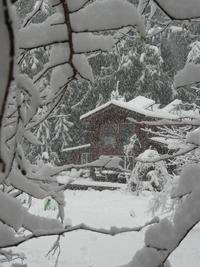
Five years ago, the community and I had just started our courtship. My family and I—husband and two young children—still lived among the bright lights of the city.
A few months into “dating”—which meant living on the 20-acre community land trust part-time each week during the membership process—the annual May Day Celebration rolled around. We had all just come off the typical long gray Washington winter. Our 10 adult members, gaggle of children, friends, neighbors gathered together in the sunshine. We danced barefoot in the cool grass, ate from the table spread with food and spring flowers. The band played under the cedar tree laced with tiny white lights—each powered by the solar panels just beyond the meadow. I turned my face up to the sun and let the lively beat wash over me. Sunshine converted to sound. It was like magic. I was in love.
Fast-forward to October—it’s the start of our first full winter at Walker Creek living off-the-grid. The kids aren’t asleep yet—our power keeps cutting out and they want their bedside Turtle Light to sleep. They are freaking out. I’m on a deadline. My laptop is sucking too much power from our back-up battery bank, but I need to finish the newsletter I am on contract to produce for a nonprofit in Florida, and it’s too late to drive 25 minutes into town to the nearest coffee shop. Everything’s closed. I am freaking out. My husband Ken is outside starting the backup generator—again. The lights turn on. The generator should be charging our eight deep-cycle batteries stored in the barn but it’s not. The lights go out. The baby starts crying. Should I nurse Katey or stoke the fire? If I don’t tend the fire right now I’ll have to re-start it, the idea of which adds to my stress level, not to mention that Ken’s out of earshot troubleshooting the generator and the kids won’t be left alone in a dark house. I throw the little one on my hip and pull my rain jacket over her body and grimace as I hear my five-year-old wail to keep up through the slick mud. I grab two pieces of wood by the barn with my one free hand. I’m panting with anxiety.
So much for the simple life.
I’d visited friends in Colorado who power their house with the sun. They live against the backdrop of the Sangré de Cristo Mountains with a sun that beats down year-round. Other than that visit, I didn’t have prior experience living with solar power. Even then, I noticed how often they stopped to look at the power meter panels. I didn’t understand. Wasn’t energy from the sun free? Unlimited? Abundant?
Isn’t being able to generate your own energy, to be self-sufficient in terms of your power needs—as Walker Creek has been for more than 30 years—the ideal?
After a grand three-decade experiment in energy independence, Walker Creek Community has first-hand experience with two major misconceptions of off-grid living: that it’s a romantic simpler choice involving homemade beeswax candles, self-sufficiency, life in the slow lane; and that it’s a better environmental choice. We’ve learned as we’ve lived off-the-grid that in our case—it’s not.
“I never encourage people to choose off-the-grid if they have utility power available,” explains Alana Nelson, co-owner of Fire Mountain Solar, and part of the husband-wife team who led the joint effort to bring utility power up Periwinkle Lane—to the four households of our community, to the solar well-pump that provides water to our entire community, and to the two neighboring households who share an easement on our mile-plus dirt lane.
Tim and Alana Nelson have lived as neighbors to Walker Creek Community going on 15 years, ever since building their strawbale home up the hill from the community. The Nelsons’ solar energy business grew out of living here on this land, off-the-grid. Alana explains that there are definitely appropriate situations for being off-the-grid. Among them: when it’s so remote, like a cabin in the wilderness, that utility power is not an option; and when the cost to bring utilities to your home is so prohibitive—one of their clients was quoted $250,000 to run utilities a mile up their road—that an alternative-energy system is a smarter investment.
The houses that line the paved road to our lane have electricity, we live not 10 minutes from a vast hillside housing development, and beyond our fence we can see the 120-foot tall power lines rising above the cedar grove. The lines buzz like 1000 angry bees in deep winter when more humidity wets the air. Some days, we mock them with the smooth silver solar panels that sit on our roof. Other days, they mock us as we run outside to start our generator, bracing against the cold air.
In the late ’70s and early ’80s, just after the folks living at Walker Creek collectively donated the 20-acre property to the Evergreen Land Trust, a clear vision was already at hand. Walker Creek trust agreements articulate the commitment to be “an experimental ground for alternative technologies.” Wind, water, and solar energy have all been a part of that experiment.
Today’s members of Walker Creek are similarly committed. As established public school teachers, business owners, and tech freelancers who grow their own food and steward land cooperatively, members straddle the wide ground between back-to-the-landers and career professionals. Within this dichotomy Walker Creek also serves as an experimental ground for how the common US lifestyle—complete with computers, cars, and busy calendars—can co-exist with alternative energy choices.
Community member Aviathar Pemberton has made his home at Walker Creek Community for 28 years. He raised his three children here, off-the-grid, from babyhood to teenager-hood to young adulthood. Aviathar’s evolution with alternative power ranges from candles to kerosene lanterns that smoked up the inside of his house to propane lights to electric automotive lights (like your tail lights) which he’d keep charged by running his car every few hours. Eventually he bought two solar panels to charge the set of deep-cycle batteries which charged the small 12 volt electric lights.
Around 1995, Aviathar, who also goes by V, began the process of adding more and more panels to his solar array, slowly converting his household to LED lights (which had just come out), building up a bank of back-up batteries, and investing in propane-run generators for our Northwest winters when there simply aren’t enough daylight hours—or sunshine—to produce a reliable amount of power.
The Good, The Bad, and The Ugly
With simple doable new habits around energy use—not leaving appliances plugged in, using power strips, mastering the art of making toast on the stovetop—our adjustment to living off-the-grid was surprising. Many days, our family hardly noticed the difference. Most days, I appreciate the forced consciousness around electricity, the small shifts in awareness, the ingenuity born from constraints. Who needs a document shredder when you have a fireplace for central heating? Who needs those kitchen appliances cluttering your counters when you can do it by hand? Can we figure out as a community how to build a root cellar in that hillside? There’s something deeply satisfying about figuring out ways of doing things that you know have been done for hundreds of years before whirring, buzzing appliances with flashing digital displays came along.
And really, who wouldn’t love the power of self-reliance—of learning how to meet your own energy needs? Winter storm power outages leave you utterly unaffected. Making your own electricity: it is magic.
The rewards of an off-grid system don’t always come easy. We had warnings. As prospective members, we were told, “Some weeks, keeping the lights on and the water running and the house warm is a full-time job.” But like when you’re on the cusp of marriage and people tell you, “Marriage is hard work,” sure, you hear them. But how hard can hard be? Only later, once you are in the daily, yearly unrelenting throes of your lights going out in the middle of cooking dinner, or as you walk at 6 a.m., again, through a pitch black winter morning shivering in pajamas and a coat across the creek to start the well pump generator for your shower before work—only then do you know.
I’ve tried to come up with a way to explain—more than “it’s hard.” And the best metaphor I can think of is this: visualize that energy-conscious person, like maybe you are, like the one I’ve always been, who turns off the lights when she leaves a room, even at the office; who turns off the tap when she brushes her teeth. Now picture a woman in Uganda, hauling a bucket of water. How does your relationship to that water change if you are her? How do your choices change when you only have one bucket? That finite amount is a far cry from water in the tap that you can treat with care—and that you can turn on at any time. That “bucket of water” is your electricity for the day when you live off-the-grid. It’s an entirely different relationship.
Off-grid solar panels generate electricity, to use and to store to your bank of batteries. When there’s no sunshine, you pull from the finite electricity stored in your batteries. So when it’s cloudy or nearing nighttime, you have to consider what’s left in your batteries, and how it fits with your plans—you might want to get some late night work done on your computer while your kids watch a movie. You can either make different energy choices, or turn on your generator to recharge your batteries enough to get through the night. Or you can choose to wait for enough sun to recharge your batteries, which may be tomorrow around 9 a.m., or…not. It could be cloudy.
“The batteries are the weakest part of an off-grid system,” explains my husband Ken. Think of how your laptop or cell phone battery eventually holds less and less of a charge. Solar bank batteries do the same thing. And they have to be babied—bathed regularly in distilled not regular water. They can’t get too cold. Even then, at $250 a pop, they need regular replacing. One bad battery can take your entire system down.
No doubt about it, living off-the-grid limits choices. Some you’d expect, others you might not. When your neighbor who raises grass-fed cattle offers up the chance to purchase a cow or half a cow from her, none of you have a freezer (electric) to store it. When you buy your Excalibur food dehydrator for the autumn abundance of apples and Asian pears and plums, you realize your house doesn’t have the power to run it for the 24 hours it takes. So you store the dehydrator at your mother’s house who lives an hour south in Seattle. It’s an added bonus to work together on a big food project—and it also takes scheduling a drive down, kid logistics, hauling all the fruit to and fro, and getting to all this before the fruit rots. Each decision that affects off-grid power use adds up to a bigger picture layered with dubious environmental decisions and lots of logistics. So much for the simpler life!
What’s the big deal anyhow, to just run the generator whenever you need power? Walk with me for a moment, through this glorious forest of ours filled with native hemlocks and salmonberries, cougar and coyote, filled with shiny clean air that you breathe in as the forest breathes out. Walk through the cold winter air, clear as glass, under a sky held up by mossy trees. Now add in your polluting generator rumbling and roaring through the stillness. It really sucks.
Or maybe you sipped power today but your neighbor who makes and sells organic soap as a livelihood needs the extra power to finish up a batch. You get to hear her generator roar from across the creek. Polluting propane is a serious contradiction to living in nature.
Air pollution, noise pollution, and lifestyle constraints aside, the tipping point in our decision to join the grid was this: the opportunity to be a green-energy producer. “We spend all this money on a good off-grid power system and when the sun comes along and the system is at full capacity, there’s this little switch that turns the panels off,” explains V. “On summer days, our batteries are completely full by 11 a.m. After 11 a.m., that clean power goes to waste.”
“Now we can capture all the excess energy that we weren’t able to store in our battery banks in the summer time when the sun is shining in abundance and we can let someone else down the line use it,” says Alana.
What Do We Stand For Now?
A few weeks ago, on one of our several “electricity work weekends,” Ken and V along with another community member were discussing next steps. It was all sounding so serious. I wanted to add a little levity so, using my most syrupy New Age voice, I requested that we all hold hands in a circle and shout out the appliance we were most ready to invite into our lives.
“Toaster!”
“Hot tub!”
“Freezer!”
It’s a brand new world in the woods of Walker Creek. How will we change, in terms of our energy consumption, now, with unlimited access to electricity?
Even with all the truths we’ve learned about the environmental costs, being able to declare that I live off-the-grid is a badge of honor hard to let go. What do we stand for, now that we can no longer declare as a community, “We are an example of off-the-grid living”—as we have for the last 30 years? “We are an example of a group of people with solar panels on our roofs” seems to lack the same punch.
What we can be is a net zero community. “With our solar panels we’ll be able to bank enough credits in the spring and summer to get us through the winter,” explains Alana.
But we won’t be monitoring each other’s household electricity bills, just like we’ve never monitored each other’s propane bills when we were off-the-grid. At times, I was curious how we compared: households ranged from $40 to a whopping $250 a month in propane use.
Let’s be clear that other folks might be able to pull it off better than we did—living off the grid, burning less propane—with fewer trees in the way, a larger solar array, a larger battery bank, and a larger budget. And here in the great Northwest, the bulk of our grid power is alternative energy: hydropower. For us, burning propane rather than using hydropower as a backup energy system for our solar array makes less sense. Take that same argument to the Midwest where the majority of grid power comes from burning fossil fuels—close to half of the US’s electricity production comes from coal burning—and propane plus solar would be the better environmental choice.
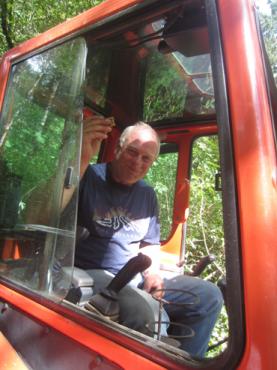
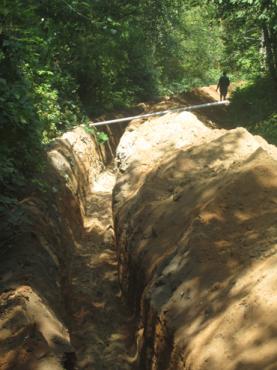
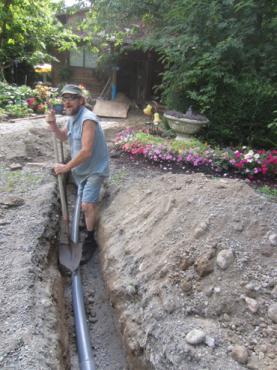
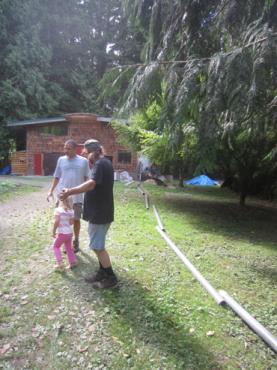
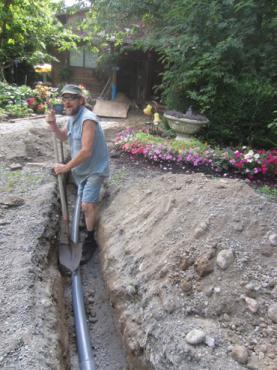
Since our initial electricity meeting six months ago, we’ve not yet made time for collective discussions on how a grid-tie will alter our lifestyle and legacy. It’s taken all we have to manage the pipe trenching work ourselves to lower costs. And to keep up with the vast and fast-changing information, deadlines, and decisions—loan payments, community dues increases, and a few crux moments requiring consensus from the four community households when members were spread all over the country on summer vacations. Many members admit they’ve been holding their breath, wondering if logistics would get in the way of seeing the project to the end.
They nearly did get in the way. Along the course of these fast-moving several months, balls were dropped, papers weren’t read closely enough to catch important details, and neighbor relations nearly blew sky high—enough that several parties were ready to pull the plug on the project, no pun intended as it really wasn’t all that funny how one oversight threatened to break a 15-year relationship between households.
And—we persevered. Walker Creek is committed not just to being an experimental ground for alternative technologies, but also to “principles of human cooperation and…the growth of a new culture and society.” Community relationships remain intact. The email just arrived today: “PSE is coming Thursday to do the final hookups and then we’ll have electricity!” writes Tim Nelson.
As for exactly how Walker Creek will evolve with electricity and with re-defining ourselves as a model for sustainable energy…stay tuned. A new courtship with power has just begun. Soon, we write our vows.
This article was written using sunshine juice, with the occasional backup of a propane generator, a cursing husband, and the generous support of a Mount Vernon Library power outlet.
Keep the conversation going with these pieces
There are no available blogs
Subscribe to our newsletter for fresh stories and community updates delivered to your inbox.
Get unlimited access to courses, exclusive member events, and a supportive network of community builders
Access all courses, books, and premium content
Member-only workshops and community builders
Member-only workshops and gatherings
We use cookies to improve your experience on our site. By using our site, you consent to cookies.
Manage your cookie preferences below:
Essential cookies enable basic functions and are necessary for the proper function of the website.
These cookies are needed for adding comments on this website.
Statistics cookies collect information anonymously. This information helps us understand how visitors use our website.
Service URL: policies.google.com (opens in a new window)
A residential project: people live here as their primary home.
An institution, business, network, or project that isn’t a residence (e.g. a learning center, farm, or network with no one living there full-time).

{{ item.label }}
{{ item.value ? item.value : currencyFormat( item.amount ) }}
Subtotal
{{ currencyFormat( pricing_summary.total_amount ) }}
There are no results matching your search