

Author: Chris Roth
Published in Communities Magazine Issue #157
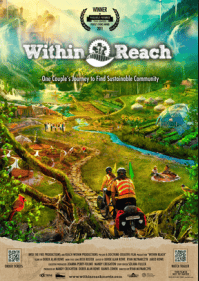
Within Reach
By Mandy Creighton, Ryan Mlynarczyk, and friends
Into the Fire/Reach Within/Doctrine Productions, 2012, 1:38 run time
DVD available from withinreachmovie.com
Nearly five years in the making, Within Reach is a major new documentary about the promise of intentional community and cooperative living. Its creators suggest that the dream of “sustainable community” is within reach of all of us, and, through their personal story, offer many possible paths to that hopeful future.
Mandy and Ryan left their mainstream jobs and lifestyles to cycle 6,500 miles across the United States over a period of two years, visiting 100 communities of many different flavors and talking to people everywhere they went about ways of living more sustainably. Accompanied at times by fellow videographers and additional cyclists, they documented their journey, assisted by a crowdfunding campaign. The monumental task of wading through, excerpting, and editing together portions of their countless hours of footage into a coherent film took another couple years.
Happily, the result is a broadly-appealing mixture of “road trip” movie, community documentary, and exploration into practical approaches to social and ecological sustainability. Entertaining and understandable enough for a mainstream audience, it also delves deep into the “sustainable community” movement to offer fresh material to even the most experienced communitarians and eco-living activists.
Its central conclusion is perhaps best summed up by cohousing pioneer Jim Leach: “Community is the secret ingredient in sustainability.” In scene after scene, we see vibrant pockets of community, and witness firsthand all the ways in which cooperation allows and encourages people to live more lightly on the earth while creating resilient webs of mutual support.
Eight years after doing service work together in Central America, where they first experienced “small communities living simply, in harmony with nature,” Mandy and Ryan (who fell into much more conventional, increasingly unsatisfying lives in the interim) find each other again and decide they want to recapture the magic they felt there. They embark on an epic “quest for utopia,” hoping eventually to find a new home aligned with their ideals.
The film documenting their journey ingeniously overlaps several thematic progressions. Its structure is not entirely linear, but rather a set of overlaid patterns. While most of the visits are presented in chronological order, this is not a rigid guideline; when it serves the purpose of the movie to jump ahead or back to a setting or interviewee with something important to say about a theme, it does.
One progression (indicated by three-dimensional letters embedded in the landscape at the start of each new section) attempts to answer the initial question, what is sustainable community? The answers, in order, are that community is sharing; community is family; community is a legacy; community is food; community is education; community is service; and community is economical. The film then poses and attempts to answer another question—what does it take to live in sustainable community?—and concludes with suggestions about creating community wherever you are.
Another progression concerns type of community. We start with cooperative houses, then visit cohousing groups, transition towns, ecovillages, spiritual communities, extended communities growing “beyond the community border,” working farm communities, groups focused on education and self-education, service-oriented communities, and a green town.
While we see relatively short clips of dozens of different communities, certain groups get significant segments of at least several minutes each; these include Earthaven, The Farm, Cobb Hill, Ecovillage at Ithaca, The Possibility Alliance, Dancing Rabbit, Joyful Path, Hummingbird, and the “green town” of Greensburg, Kansas.
The film also catalogs a broad range of sustainable-community-related practices and technologies (often highlighted with on-screen text), including consensus process, solar cookers, suburban farm animals, community kitchens, skillshare workshops, gardening and permaculture, natural building, community potlucks, eating local diets, “unschooling,” homemade entertainment, neighborly collaboration, and eco-retrofitting.
Our view alternates between the small picture—one couple’s trip around the country—and the big picture—national and global social and environmental trends that make a change of direction toward “sustainable community” paramount for our survival. Richard Heinberg, Bill McKibben, Rob Hopkins, Aron Heinz, and others offer valuable insights, interlaced throughout the film, on everything from the end of cheap fossil fuel, the urgency of addressing climate change, and the increasing dissatisfaction and social isolation in America over the last 50 years, to the importance of localization, of deep listening, and of self-examination. Just as valuable are the reflections of community members on what life in community is like for them. While they tout its many benefits, they also discuss some of the challenges: decision-making can be an ordeal, and compromising can be difficult. As one Cobb Hill resident observes, our culture doesn’t teach most of us how to live in community, so we have a steep learning curve when we decide to.
Fortunately, community can also be an ideal place to safely engage in the emotional and inner work that helps us become better community members. That work is necessary to create the “social sustainability” that, many in this film observe, is the backbone of ecological sustainability. “The way we treat the planet is really connected to how we treat [each other and] ourselves,” says one student visiting Ecovillage at Ithaca.
Yet the magic of community is felt most directly not through words, but through the many scenes in which community members are fully engaged in creating “sustainable culture” themselves—through sharing music, food, play, practical projects, helping one another live not only more ecologically but more joyfully. The spirit of community is palpable, leaving viewers with the (correct) impression that there is a whole world of cultural and ecological-living innovation awaiting them, if they move beyond the constraints of mainstream America.
An engaging soundtrack—comprised of homespun music reinforcing the grassroots perspective of the film, alternating with interviews, the bikers’ reflections, and community scenes—helps the movie stay stimulating and dynamic. The videography, surprisingly professional given the sometimes challenging traveling and shooting conditions, conveys the experience of the journey well. Titles and captions are also used to excellent effect.
My favorite single segment depicts the Superhero Alliance in La Plata, Missouri—probably the most radical experiment included here, a service-oriented group operating on the gift economy and dedicated to simple living not dependent on modern technology. In this section, the power of engaging in “emotional inner work” is perhaps most clearly described: speaking in candlelight in this electricity-free community, with flashes of lightning visible through the windows behind her, Keren Ram describes how healing it is for people to “see my dark areas and still love me” in an environment that is so supportive and embracing of each person’s humanness. She also conveys clearly the power of shared dedication to being present and spiritually centered, of which the “bell of mindfulness” is a common reminder at the Superhero Alliance Sanctuary.
(I must admit that my personal acquaintance and several longstanding friendships with those we meet in this segment help make it my favorite. In fact, the movie is full of people I know and/or have at least met, part of the extended community network of friends and colleagues that helps this feel like a “movement” rather than just a set of of isolated cultural aberrations.)
Every in-depth segment has its memorable moments and revelations, from the interviews with the children participating in Ecovillage at Ithaca’s Primitive Pursuits program (best line, from an extremely imaginative child: “It’s not imagination!”) to the reflections from ex-suburbanites learning rural skills at Cobb Hill and from ecovillagers learning how to create homes for themselves at Dancing Rabbit.
For someone already familiar with much of the intentional community landscape—and perhaps for any viewer—the most inspiring, hopeful segment may be the depiction of Greensburg, Kansas. Following a 2007 tornado that destroyed 95 percent of the town, townspeople banded together to rebuild using green principles, doing community planning as a group. They decided not to re-erect their backyard fences, but instead to encourage neighborly interaction wherever they could, while adhering to an ecological approach that, rather than being dogmatic, meets each person “where they are” and helps them move organically toward more sustainable practices.
Greensburg’s mayor, Bob Dixon, is one of the most eloquent voices for community in this film. Describing the social isolation that has overtaken our society in recent decades, he says it’s time to change from being “back porch, back patio people,” walled off from one another, into once again being “front porch people,” who get to know our neighbors and thus are able to deal much better with the issues we’ll inevitably face together. Perhaps because they’ve learned the lessons of the tornado, the town’s residents all seem up to the challenge of working together. The fact that such a radical movement toward sustainability and community can happen in a “regular” middle American town inspires real hope that it can happen anywhere.
Each town, city, or rural area may need to confront its own form of “disaster” in order to make such a transition. Since current trends suggest that we will have no shortage of those in coming years and decades, the best we can hope for is that we start making these changes before the full force of disaster strikes. In an age of resource depletion and climate change, such an approach can mitigate both local and global suffering.
At one hour and 38 minutes, this film cannot be exhaustive in addressing the issues it raises, or in depicting all dimensions of the intentional community world. One fundamental question that it does not answer is: are any of these “sustainable communities” truly sustainable? They are all clearly moving in the direction of, or working towards, a way of being that is regenerative rather than self-destructive—but in the modern world, true “sustainability” is hard to ascertain and may be impossible to achieve without larger-scale, more fundamental changes. Even Mandy and Ryan’s human-powered trip around the country was fueled by many “unsustainable” elements. The idea that simply by moving to (or creating) a place calling itself a “sustainable community” we’ve achieved sustainability strikes me as an illusion. Instead, all any of us can do is take steps toward what that kind of world could be; it seems unlikely that any of us will arrive there in this lifetime.
The movie does a good job of depicting both the joys and challenges of Mandy and Ryan’s bike journey, including mechanical, breakdowns, injuries, difficult weather, dwindling finances, hostile authorities, and personal and relationship challenges (at one point, we learn, Ryan has smashed his computer and quit the project in frustration—he later apologizes, relents, and rejoins Mandy). But it doesn’t maintain the same balance in its depiction of the communities the couple visits.
True, as already mentioned, multiple interviewees talk about some of the difficulties they’ve experienced; especially in the areas of collective decision-making and compromising our personal desires, they remind us that our culture hasn’t taught us how to live in community. But we viewers don’t see these difficulties first-hand. We don’t experience any of the pain and disappointment, the frustrations and breakdowns of various sorts, that happen in community just as they happen on bike trips. In effect, with each community, we—like the short-term visitors we’re accompanying—are in a “honeymoon phase.” We get to see how appealing each place can be; we don’t get to feel how challenging it can be. And ironically, when interviewees talk about the challenges, their honesty makes their communities seem even more appealing.
The most common criticism of this film is likely to be that, while it opens viewers’ eyes (including mainstream viewers’ eyes) to many new horizons related to sustainability and community, it does so through rose-colored biking glasses.
However, one movie cannot be all things to all people. This one is a surprisingly in-depth introduction to the wide-ranging world of forward-looking community-building. It demonstrates that it is possible to leave a mainstream lifestyle and enter into a world that most people only dream about. It also shows that one can make changes in one’s own life and community to move much closer to a future that is healthy and friendly to both people and the planet. The film doesn’t hit us—at least not viscerally—with the potentially discouraging news that life in community can be just as challenging as life outside of it, fraught with potential pitfalls. However, if we are making conscious choices, these pitfalls occur in the context of a reality we feel more aligned with, and that has more staying power than the lives we’ve left behind.
The movie concludes with Mandy and Ryan’s arrival at Hummingbird, the community they have chosen as their new home—“but,” an on-screen caption tells us, “their journey toward a sustainable life never ends.” In the years since their bike trip ended, they have in fact moved on from Hummingbird. Mandy now lives at Dancing Rabbit, and Ryan, having tried Dancing Rabbit as well, now lives outside of intentional community, in Hawaii. In other words, for each of them (as for anyone who commits to an extended exploration of community), the “honeymoon phase” has passed.
Yet the lessons of their film remain just as valuable, and the journey they share is a compelling one. This documentary deserves to be seen not only by those in the “sustainable community” movement, but by a much larger mainstream audience as well. It has the capacity to change lives—and, whether creating ripples or waves, it can make a real contribution to the more regenerative, community-based future that, we hope, is still “within reach.”
Keep the conversation going with these pieces
There are no available blogs
Subscribe to our newsletter for fresh stories and community updates delivered to your inbox.
Get unlimited access to courses, exclusive member events, and a supportive network of community builders
Access all courses, books, and premium content
Member-only workshops and community builders
Member-only workshops and gatherings
We use cookies to improve your experience on our site. By using our site, you consent to cookies.
Manage your cookie preferences below:
Essential cookies enable basic functions and are necessary for the proper function of the website.
These cookies are needed for adding comments on this website.
Statistics cookies collect information anonymously. This information helps us understand how visitors use our website.
Service URL: policies.google.com (opens in a new window)
A residential project: people live here as their primary home.
An institution, business, network, or project that isn’t a residence (e.g. a learning center, farm, or network with no one living there full-time).

{{ item.label }}
{{ item.value ? item.value : currencyFormat( item.amount ) }}
Subtotal
{{ currencyFormat( pricing_summary.total_amount ) }}
There are no results matching your search


