

Author: Heather M. Barnes
Published in Communities Magazine Issue #157
“I can’t I can’t I can’t!” wails Marisa, tiny for her 12 years. She’s seated in the center of our circle, face pressed into her knees and shaking visibly. Around her, 13 of her classmates ignore her, lying on their backs in silence, waiting it out.
It’s a balmy Thursday night in October, the final evening of camp for these sixth graders from Los Angeles. They’re about to do a solo night walk, the culmination of everything we’ve been working on all week: nature exploration, teambuilding, and personal growth. When Marisa first started quivering they fell effortlessly into the role of supportive team, offering advice and encouragement. But after 15 minutes with no improvement they gave up, reverting to the children that they are and leaving her for me to handle.
It’s what I do. Since 1993, I’ve been facilitating outdoor programs for youth ranging from inner-city organizations, where the chaperones buy boots and jackets for the kids or nobody will, to exclusive private schools that request specific life experiences they want the kids to have, like a shopping list. That makes me chuckle. I can no more dictate which lessons each kid needs to learn than I can make the wildlife obey while they’re here.
For 19 years I’ve watched kids transform from selfish, impatient, sometimes violent young people into thinkers, collaborators, and doers. In this I’ve noticed three hurdles each kid fights and then overcomes. Some may conquer only one or two, others succeed all three, but they’re always in the same order: fear of nature, fear of the group, and fear of self. After a week of community-building, fresh air, and exercise, they’re calm and cheerful, ready to move into the deeper, more profound realms of interpersonal exploration. Instead, camp comes cruelly to an end. The kids are stuffed back into the boxes they worked so hard to escape and return to the environments that put them there. With luck, they’ll retain a few bright pearls of insight and follow them like beacons throughout life.
I’d like to give you a slice of life at sixth-grade camp. For this purpose I’ve created a fictional group of kids. While their names are made up, their characteristics and experiences are those of real people.
Fear of Nature
Call it West Middle School, your average public school in Los Angeles. Its student population is heavily diverse; family income levels cluster around lower-middle class. The school is situated at the end of one of LAX’s runways; every day they squeegee jet fuel off the windows, and the students are never allowed free time outdoors.
For these kids—and millions like them, regular Americans growing up indoors—the idea of nature comes from books or movies, most of it neutral or disparaging, some good. Regardless, there’s little positive interaction and no free exploration. Richard Louv, in his award-winning book Last Child in the Woods, addresses this very issue, discussing the cultural removal of children from nature to the detriment of the children, the adults they will become, and the nature they will be charged with protecting. Indeed, there is a powerful disconnect here, which becomes obvious the minute they exit the bus.
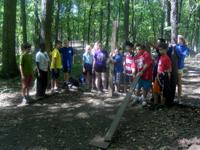
Just before 11 on Monday morning, three buses pull up in front of the camp’s dining hall, and we—the outdoor facilitators—greet them. One hundred sixth-graders, plus heaps of clean, shiny baggage, pile out. Some stop and gape silently. Others point and shriek, and the rest vent their nervousness on each other. They’re a mere hour from their school, but if the buses dropped them off on Mars instead, they would hardly have been more shocked.
After lunch I meet my group for the week. There’s Marisa, a born leader. Stan, shy and overweight, who dreams of seeing a deer. Shelby, the fast-talker who notices more than she lets on. Alejandro, the abused boy who loves lizards. The rest hang back like a Greek chorus, their personalities emerging gradually throughout the week.
Despite the fact that so many kids are experts on a single species, many are disgusted or terrified of nature as a whole. Therefore, my first request to them—please sit down on the ground—is met with horror and disbelief.
At first, nobody moves. Their eyes scour the ground for somewhere “clean” to sit, their skin practically crawling. Every zip in the air becomes a heat-seeking hornet, every smudge of dirt a stinking swamp. You’d think I’d asked them to lie down in the middle of a crime scene. I repeat the request three, four, seven times, earning some hard stares for it, but this is a necessary step. It’s impossible to focus on consensus-building when the next passing ant could launch them into the Charleston.
By Monday night, however, each one is happily dusty and they’ve given up the fight to stay pure. When we reconvene Tuesday morning they flop down without a second thought. The rest of the week, they troop through high grass, play “camouflage” at the edges, hunt for fire-building supplies in the woods, and sit beneath trees during journal time. Each day, it gets harder for me to call them back from the sacred places they’ve found. The lure of the wild is now much stronger than their fear of it.
Fearing the Group
Teambuilding is the art of solving problems—physical, mental, spatial, linear, etc.—by collaborating with others. It’s a study of process, not result. Learning to empathize and strategize with others is much harder for kids than it is for adults, and tempers flare quickly.
By Wednesday afternoon, however, our mythical group is still acting like a Monday group: lack of focus, little investment, too many distractions. When they reach an impasse on a river-crossing challenge, discussion quickly dissolves into bickering.
“Hey, put this board on that one—” suggests Marisa, offering a one-by-eight to Eric, who’s balanced in the middle of the “river.”
“No, that’s stupid!” Eric snarls suddenly. Without warning, he stomps off. “None of this is real anyway. What’s the point?”
“Eric!” the others protest. “Get that board, it’ll drift away!”
“No, it won’t,” Eric yells over his shoulder. “It’s not actually a river.”
I call a water break and we circle up. If they’d been giving it an honest go all this time I’d be sympathetic, but only a handful have been committed to the task. I inform them that they’re not going anywhere until I get a little honesty.
Picking at the grass, the kids offer feeble distractions. They’d rather be hanging out in their bunks, playing games, eating at restaurants. They’re hot, tired, and dehydrated. (“Yeah, we know, drink more water.”) When this is met with silence from me, the deeper truths begin to emerge. They’re afraid of getting lost, or hurt, or stuck someplace. Scared of looking silly or stupid in front of their peers. They don’t know what they’re doing, who they are, what they want from life. Everyone else has it easier, better, faster. Nobody feels like they belong.
Ninety astonishing minutes later (rather than the standard five-to-10), we emerge from the most intensive debrief session of my career. I feel as drained and reinvigorated as they do.
Two miracles ensue. The kids get up and cross the river in 15 minutes flat, each one pitching in and offering eager ideas.
Then, when they’re almost done, a black-tailed doe ambles past, halting the process. Everyone except Stan sits down in place and watches. Stan tiptoes toward her, rolling his feet in the Native American style they learned earlier. He stops 10 feet away and they regard one another, boy and deer, for several minutes, until she moves off casually into the woods. Stan returns to us beaming, tears streaming down his face, but he doesn’t seem to notice. The kids leap up and congratulate him on how awesome that was. It’s a moment he’ll never forget.
It’s one thing for a group to solve a problem together, where the glory is shared equally, but quite another to step back and allow one person to shine. Many groups will reach this point by Wednesday afternoon; they just don’t usually wait until Wednesday afternoon to do it.
To me, it means they’re ready for the high ropes course.
Fearing the Self
A high ropes course is a series of physical obstacles such as swings, balance beam, cargo net, and cables to cross, things which would be easy if done on the ground but can seem impossible 40 feet in the air. The obstacles are fixed between trees, and participants are hooked into safety equipment to prevent them from falling.
The high course is safe, but its true value lies in its perceived danger: how do you react when faced with a challenge that scares the skin off you? Freeze up? Flee? Push on? It’s here that many people discover what they’re made of and what they do with that.
However, doing the course yourself is only half the challenge. The other—and, arguably, more important—part is offering support from the ground (being emotionally vested in someone else’s success). Friends on the ground can call up advice and encouragement or stop you from doing something dangerous, like double-unclipping your safety lines. Remembering that this cheerleading squad is there can be a valuable resource for kids facing a Flea Jump, Giant’s Ladder, or a zip line through thin air.
Call me old-school (and in the world of adventure facilitation, I am), but I believe no one should do the high course until they can play both giver and receiver, learning to connect with something outside of themselves. What kind of friend are you? Do you stay with the person up there the whole way or zone out when things get slow? How do you treat the climber who flies through the course as if on wings versus the one who fights back tears 10 feet up the ladder? This, too, is part of the self-awareness that comes into focus at the high course.
Back to Thursday night in the woods.
Fourteen kids, a teacher, and I sit in a comfortable blob at the start of the trail. No one asks what’s going to happen next.
The solo night walk wraps everything up neatly like a present. Though safe, it pits each kid’s new-found realizations and feelings against their old ones, in the oldest place on Earth: nature.
Thirteen can’t wait to go. One is afraid I’ll make her go. I have no idea what will happen.
Breaking the silence, Eric asks, “Can I go first?”
“No, I wanted to!” Shelby hisses from behind him. “I was trying to get up here to ask!”
“Can I?” Three others chime in. Suddenly there are seven hands waving in my face.
We draw lots and Shelby wins. She strides confidently down the trail, the faint crunching of her boots on gravel fading away. The group is silent, transfixed by both the perfect evening and the triumph of Shelby’s walk, despite the fact that they haven’t seen her reach the other end yet. There is no doubt in their minds that she will.
Marisa is calm too, watching with plain wonder beside me. Maybe she’ll go after all, I muse.
Next is Jason, who marches off so jauntily that I have to remind him to slow down lest he catch up with Shelby and ruin it for both of them.
Eric.
Sammie.
Alejandro.
Eventually, only Marisa and I remain.
“Well?” I say. Her audience is gone. The moment of truth has arrived.
She’s quiet. Then: “I can’t.” Her voice is flat, gravelly. No tears, no drama. This is the truth, then.
“Why not?”
“Because something might be there. Maybe everybody’s dead and we don’t know it.”
“No one is dead.”
But no matter how much I want her to share in this triumph, I can’t force the experience on her. Maybe she’ll face this one later, but right now it’s not hers. Sometimes the lesson is for me.
We walk back together and find our group sitting in a circle, unharmed and in barely contained silence. No sooner do Marisa and I sit down than they erupt like a giddy volcano.
“Oh my gosh, that was so cool! I didn’t think—”
“I was so scared, I thought I was going to die—”
“I know, I can’t believe it, either! We can do anything!”
Marisa sits motionless, a smile frozen on her mouth. She’s bravely trying to be happy for them, but the thin smile can’t disguise her dawning regret. This, too, is an experience.
Sitting here with my group on their final night of sixth-grade camp, listening to each one in turn relive every nuance of the walk, I catch glimpses of the new people they’re becoming. Some broadcast their pride, others glow more quietly. One looks miserable.
I know what opportunities to learn I gave them this week, but as to which bright pearls they’ve actually secreted away in the pockets of their psyche, I couldn’t guess. I’d probably be wrong.
Keep the conversation going with these pieces
There are no available blogs
Subscribe to our newsletter for fresh stories and community updates delivered to your inbox.
Get unlimited access to courses, exclusive member events, and a supportive network of community builders
Access all courses, books, and premium content
Member-only workshops and community builders
Member-only workshops and gatherings
We use cookies to improve your experience on our site. By using our site, you consent to cookies.
Manage your cookie preferences below:
Essential cookies enable basic functions and are necessary for the proper function of the website.
These cookies are needed for adding comments on this website.
Statistics cookies collect information anonymously. This information helps us understand how visitors use our website.
Service URL: policies.google.com (opens in a new window)
A residential project: people live here as their primary home.
An institution, business, network, or project that isn’t a residence (e.g. a learning center, farm, or network with no one living there full-time).

{{ item.label }}
{{ item.value ? item.value : currencyFormat( item.amount ) }}
Subtotal
{{ currencyFormat( pricing_summary.total_amount ) }}
There are no results matching your search


