
The Cool Block Program Helps Neighbors Work Together to Fight Climate Change

Placeholder image for Foundation for Intentional Community website.
Saul Of-Hearts
  • February 16, 2017
  • Economics & Law
  • Governance
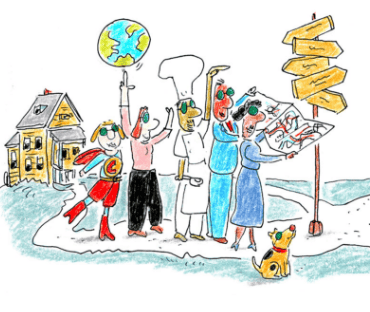
People holding signs and a globe in a community setting at Foundation for Intentional Community.

When we hear the words “intentional community,” we may think of residential communities like back-to-the-land communes and urban housing co-ops. But you don’t have to live in the same house to have a shared vision and make an impact.

A non-profit called Cool Block brings entire neighborhoods together to support each other and build community over shared environmental goals. David Gershon, the founder of Cool Block, describes it like this:

“The Cool Block program is 9 meetings over approximately 4-and-a-half months, that help people learn carbon reduction, water stewardship, disaster resiliency, livability, and empowering others. It is so simple and so profound.”

Participants follow along with the Cool Block handbook, which includes 112 action items to choose from. The programs are self-directed, with some actions intended for individual households and some for the whole block. It’s designed for up to 8 households to participate at once.

So far, the program has launched in Los Angeles, San Francisco, and Palo Alto, and is rolling out to more cities this year. It’s received praise from citizens and local leaders alike. California’s Lt. Governor Gavin Newsom calls it an “exemplary how-to guide for local communities to make a significant impact on climate change.”

A related project, the Cool City Challenge, is even more ambitious: participating cities will aim to get 25% of residents involved in the program. James Keene, the City Manager of Palo Alto, says that “Cities are the platform for change in our world today. The Cool Block links the challenges facing our planet to the intimate, personal, social scale of the city block.”

Communities can tailor the program to meet specific needs, such as caring for elderly residents or setting up a tool-sharing agreement. According to Shareable, “By partnering with cities, Cool Block organizers also raise awareness about resources that people may not know about, including rebates for solar energy, community classes, block organizing initiatives, and party packs people can share.”

Want to learn more about the Cool Block program and see if it’s right for you and your neighborhood? Check out the intro video below and visit the Cool Block website to see how you can get involved:

https://vimeo.com/198096342

Images via CoolBlock.org

Comments

Featured Blogs

Keep the conversation going with these pieces

Karin Iona Sundberg
Fri Jun 2013
  • Living in community
  • Relationships
Life in and out of community offers valuable lessons about governance, membership, vision, struggles, and deepening connections.
Saul Of-Hearts
Mon Sep 2016
  • Living in community
  • Relationships
Just over an hour north of Lima, Peru, a circle of cone-shaped buildings rises beside a sandy beach. These structures are called “trulys,” and they’re part of a spiritual eco-village built by Hare Krishnas on the Peruvian coast. The village is a popular stopping place for travelers looking for a pea…
Saul Of-Hearts
Thu Jun 2016
  • Sustainability
The Energy Action Coalition, the “Hub of the Youth Climate Movement,” has hosted four Power Shift convergences for young climate activists since 2007. This year, the event is expanding into four regional convergences taking place in Philadelphia, Detroit, Orlando, and the West Coast: “Power Shift b…
Geoph Kozeny
Fri Jun 2007
  • Living in community
  • Governance
Author: Geoph Kozeny Published in Communities Magazine Issue #135 “How many of my thoughts and feelings is it good to share, and how much can I or should I keep to myself?” This important question applies whether you’re living in a community, working with a team, or being involved with family…
Christopher Roth
Wed Sep 2014
  • Living in community
  • Relationships
In our “Community Conversations” issue, people both within and outside of intentional community discuss questions like: What does community mean to us? Where do we find it? What are its benefits and challenges? How do we deepen our experience of it? What is the purpose of community, and how do we ta…
Daniel Greenberg
Sat Mar 2017
  • New to community
  • Sustainability
Compared to carbon offsetting, carbon onsetting may be a more effective strategy to build sustainability.
Christopher Kindig
Thu Apr 2013
  • Sustainability
Follow Amanda’s incredible bicycle trip around the US to explore ways people are creating community and sustainability. Find a screening near you, or order a screening kit to inspire people where you live! http://test.withinreachmovie.com/seethefilm.php
Starhawk
Wed Mar 2012
  • Living in community
  • Relationships
Ritual can connect us more deeply to place, mark the passages of our lives, comfort us in times of grief, and link us in the pure joy of celebration. It works best when created collectively.
Derek Alton
Mon Jun 2014
  • Living in community
  • Relationships
Tamarack Institute’s Conversations campaign reveals shifting expectations of community among youth and seniors, varying perspectives on group identity and boundaries, and diverse attitudes toward technology.
John Ahern
Fri Jul 2016
  • Living in community
  • Relationships
This Australian community’s bridge is a lot more than just a bridge.

Insights & Stories from the Communities Movement

Subscribe to our newsletter for fresh stories and community updates delivered to your inbox.

Join the Communiversity Community

Get unlimited access to courses, exclusive member events, and a supportive network of community builders

Unlimited Learning

Access all courses, books, and premium content

Community Network

Member-only workshops and community builders

Exclusive Events

Member-only workshops and gatherings

Update to a Public Profile

  • Log in
  • Go to your profile page
  • Toggle on the "Add my profile to the directory"
  • Save your profile

Information

Communities

A residential project: people live here as their primary home.

Organizations

An institution, business, network, or project that isn’t a residence (e.g. a learning center, farm, or network with no one living there full-time).
Plus Community Membership

  • Find people with Profile Match
  • Access to your community listing statistics
  • Create Discussion Groups
  • Access to our affiliate program
  • Member badge on your community profile
I am an official member of this community
Disclaimer
I affirm that my information is accurate and I am authorized to manage this listing
Foundation for Intentional Community FIC Member badge logo.

Free Plan

Free Membership
Free

Intentional Advertising

  • Subtotal

    {{ currencyFormat( pricing_summary.total_amount ) }}

Icon representing community connections and collaboration for intentional communities.

Plus Membership

  • Find communities with Profile Match
  • View detailed reviews about communities
  • Create free listings in Needs & Offers
  • Plus Member resources in CommUniversity
  • View communities detailed reviews
  • Plus Member badge on your profile