

Author: Liz Walker
Published in Communities Magazine Issue #156
“To promote experiential learning about ways of meeting human needs for shelter, food, energy, livelihood, and social connectedness that are aligned with the long-term health and viability of Earth and all its inhabitants.”
—Mission statement for EcoVillage at Ithaca‒Center for Sustainability Education
Last night a group of four dozen people gathered in the Common House for a simple vegetarian dinner of curried lentil soup, hearty cornbread, and a salad made from three kinds of greens from our onsite farm. After the dishes were cleared, a third of the group stayed on for an in-depth presentation by Jesse Sherry, a PhD student from Rutgers who is studying the ecological footprint of several ecovillages and comparing their impact to that of the average US citizen. Using data generated from about half of the 60 households who live at EcoVillage at Ithaca (EVI), Jesse found that the EVI average was about 2.4 global hectares (gha) per person, compared with 8 gha per person for the national average. This means that people who live in our community use only about 30 percent of the resources (for travel, heat, food, water, and waste) of typical Americans. Lest we get too self-congratulatory, the two other ecovillages studied—Earthhaven in North Carolina and Sirius in Massachusetts, were at 1.8 and 2.1 respectively. We were doing well, and with more collective effort we could do even better.
Looking around the room, I remembered our “Envisioning Retreat,” 21 years ago. In June of 1991, 100 of us camped out in a field during the week of the summer solstice and dreamed of creating an ecovillage together. While fireflies flickered around our tents, we talked of our vision: to create a community of up to 500 people, with thriving organic farms and a vibrant education center just outside of Ithaca.
As with the presentation we had just heard, I was struck at how far we have come, and at the same time how far we have to go. At age 21, how have we matured, and how are we still struggling to live out our values? What have we learned that may be useful to the broader society?
Forming an Identity
Early in the development of EVI, we chose to appeal to middle class Americans. We wanted to create an alternative lifestyle that would demonstrate a far more ecological approach than mainstream culture, yet that would be attractive to a wide variety of people. We wanted to influence development patterns, and make a difference through our example.
This influenced many of our subsequent choices. We wanted to be accessible to visitors and students, so we decided to develop on land that was just two miles from downtown Ithaca, New York, a progressive college town that is home to Cornell University, Ithaca College, and TC3, our local community college. We have a steady stream of visitors who come to EVI on tours, to do research, to visit, or to buy produce from our farms. A common comment from visitors is, “You know, I could actually see myself living here.”
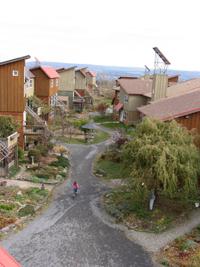
Another early decision was to use the cohousing model. In 1991, cohousing was so new to the US that none of us had ever seen this type of community. However, cohousing brings some key principles into play that have been highly successful. Our two (soon to be three) densely clustered neighborhoods are centered on winding pedestrian streets that offer a congenial place for kids to play, neighbors to chat, and conversations to unfold around picnic tables and sand boxes. There is a delightful sense of wandering through a park as one follows the path past unique front-yard gardens blossoming with a profusion of flowering plants.
The Common Houses offer a common space for several community dinners each week, kids’ indoor play space, home offices, common laundry facilities, and a place for ongoing classes, celebrations, dances, and special gatherings. There is a nice balance between people’s private lives and the ongoing life of the community.
Another key choice was to actively farm the land. We chose land with abandoned agricultural fields that we have gradually been bringing back into production. Right now we have two working farms: West Haven Farm has 10 acres under production and grows certified organic vegetables and fruit for 1000 people a week during the growing season. Kestrel’s Perch Berry Farm is five acres and has a U-Pick operation with seven kinds of berries. Both farms are operated as CSAs, with member families from all over the county. In addition, we have several thriving community gardens for the residents, and a growing agricultural education program, Groundswell Center for Local Food and Farming, which will soon reclaim 10 acres at EVI for small-scale incubator farms for low income beginning farmers.
EcoVillage at Ithaca was started by a nonprofit organization (now called EVI‒Center for Sustainability Education), and a big part of our initial work has been to grow the ecovillage itself from a vision to a real, living laboratory. At times it has been hard to separate out the identities of the living community and the educational work. Once in a while there is a clash between our nonprofit mission (which seeks to bring in visitors, support research, and “grow the vision”) and some of the residents who want to enjoy quiet lives without the disruption of more visitors or more neighborhoods.
Gaining Skills
As our ecovillage has developed over time, we have grown in our capabilities. Our initial cohousing neighborhood was the first in New York State, and we had all the challenges of convincing our local planning board, bankers, insurance agents, and the NYS Attorney General’s office that we were legitimate developers. Now we are actually the ones writing new zoning regulations; not only do we anticipate they will be adopted by our county, but also hope they will be of use around the country.
In 1997, when our first resident group, “FROG,” was built, no incentive programs were in place to help fund renewable energy. Now, in 2012, we have just installed a brand new 50 KW ground-mounted solar array which is producing 60 percent of the electricity needed by all 30 homes in FROG. Smart meters tell us how much current we are using in our homes or as a whole neighborhood. Our second cohousing neighborhood, “SONG,” built in 2002-2004, was able to take advantage of incentive and rebate programs that returned approximately 50 percent of the value of the investment. Out of 30 homes, almost half sport photovoltaic panels (solar electric) and four use solar thermal (hot water). Our third neighborhood, “TREE,” currently under construction, plans to make extensive use of photovoltaics and solar thermal. Incentive and rebate programs now return about three quarters of the original investment, making it crazy not to use them.
In addition to expanding our renewable energy capacity, our green building efforts have also become more sophisticated over time. From simple passive solar duplexes in FROG, to examples of strawbale, structurally insulated panels (SIPs), and timber-frame buildings in SONG, we are now aiming for Passive House (PH) certification in TREE. The Passive House standard is “arguably the most stringent energy-efficient building spec in the world,” says Chris Corson in the May 2012 issue of The Journal of Light Construction. “The big picture goal of the Passive House movement is to nearly eliminate housing’s share of climate change by slashing energy consumption to about six percent of that used in conventional homes.” In the TREE neighborhood, we are aiming not only to greatly reduce energy consumption, but also to show that it can be done affordably.
With 15 years of community living under our belts, we’ve also grown tremendously in our collective ability to solve conflicts. And we’ve had some doozies! One community-wide conflict that took over a year to resolve was figuring out a policy on outdoor cats. Our group seemed pretty evenly split between those who wanted to restrict cats from hunting (cats kill millions of birds a year), to those who felt that their beloved pets should have the freedom to roam. After a dozen or more tense meetings in “salons” (non-decision-making discussion groups), neighborhood groups, and whole village meetings, we finally reached consensus on a long-term policy that would restrict each of the three neighborhoods to no more than two outdoor cats apiece. The short-term policy allowed existing neighborhood cats (including four owned by one person) to be “grandfathered” in. While it was a compromise that thrilled no one, it allowed us to finally drop the issue, and move towards a more ecological long-term policy, while not penalizing those who already owned outdoor cats.
Facing Challenges
While we have a good track record on many fronts, there continue to be challenges in others. I’ll pick two for now: achieving more racial and income diversity, and long-term community burnout.
While our goal has always been to be an inclusive community, we have had only mixed success. In some respects, the village population is quite diverse, with ages from two to 82, people with varied types of jobs, and spiritual backgrounds ranging from observant Jews to Bahai, Christian, and Earth-based spirituality. There are a few people with major physical disabilities, and several children with major developmental delays. There is a fairly small lesbian, gay, and bisexual population currently, at just five percent of the adult residents.
When it comes to income level, most people are middle class, although there are some residents (often renters) who are low income, and others who are quite wealthy. Over the years we have tried many different strategies for keeping housing as affordable as possible. We have used standardized design and construction in FROG and TREE, with options for self-building in SONG. We also received a grant from the Federal Home Loan Bank for SONG that enabled us to pay the down payments for six affordable homes in SONG. In TREE, we are aiming for very affordable pricing based on building 15 apartments in addition to 25 houses, standardizing design and construction, and using a nonprofit development model in which the group itself acts as general contractor, while hiring a very experienced builder. But I think the most successful strategy may be that TREE will also offer 15 percent of its homes as rentals, allowing people to live here who would otherwise not have the capital needed to buy a home.
We probably have least diversity in race. Currently we have 15 percent people of color (compared to 20 percent non-white population in Tompkins County, and 33 percent in the City of Ithaca). There are very few African Americans at EVI, a situation we would love to change. There are currently several efforts aimed at bridging this gap. Quite a few of our residents have taken a five week course called “Talking Circles on Race and Racism.” Several of our residents have been trained to lead these sessions, which aim to create a dialogue between whites and people of color. There is also an onsite, ongoing weekly study group on bridging the gap between environmentalism and social justice.
Another challenge we are facing is how to keep the energy going for the long term. After 15 years of living in community, we are currently facing a problem of burnout. It is often hard to make the quorum for our monthly village meetings, our work teams sometimes don’t have enough participation, and many community meals (there are four dinners a week) have low attendance. What is wrong? We’ve been trying to figure it out.
Our cook team has been especially hard hit, and we’ve noticed a few trends. Many more people have specialized diets than even five years ago. The cooks are now responsible for making meals for a wide variety of dietary needs: vegans, vegetarians, gluten-free, nightshade-free, kid-friendly, and various combinations of these. There are whole families who are on meat-oriented diets to correct severe allergies. What’s a cook to do?
Part of the solution seems to be to simplify the meals, aiming for one-food-fits-most (e.g. a vegan, gluten-free main dish can feed most people). We are also trying to find ways to appreciate the cooks, who may put in between two to six hours to prepare a meal, then have it scarfed up quickly, with people rushing off for another evening activity. It’s sometimes hard to keep the culture of community going when the societal trend is chronic busyness and isolation. The good news is that we are consciously addressing this, and experimenting with different ideas, including monthly coffee houses and special celebrations. In addition, with the influx of new TREE residents moving in over the coming year, there will be lots more people to partake in both cooking and eating community meals.
Stepping Out into the World
While we have always been engaged in educational work, in the last several years our efforts have grown dramatically. Part of this is through establishing partnerships with other groups. Our nonprofit arm currently has formal partnerships with Ithaca College Environmental Studies Department, Tompkins County Planning Department, Center for Transformative Action, Cornell Cooperative Extension, Tompkins County Climate Protection Initiative, New Roots Charter School, and many other groups who share our values of sustainability and social justice.
Partly because of these partnerships, EcoVillage at Ithaca‒Center for Sustainability Education has landed two major federal grants. One, a three year USDA grant, funds Groundswell Center (already mentioned) to work with beginning farmers. This program has taken off like wildfire, and is bringing together local food justice groups with farmers, and like its name, creating a groundswell of interest in local food and farming. Every week from spring through fall, a couple dozen aspiring farmers meet for hands-on classes that teach everything from business planning to nutrition to organic weed control. The excitement is palpable.
Last April we also received an EPA Climate Showcase Communities Grant in partnership with the Tompkins County Planning Department. The three year grant (one of a total of 50 around the country) allows us to study the lessons we’ve learned from building EVI, and apply those lessons to three new pilot projects (the TREE neighborhood, an urban infill “pocket neighborhood,” and a new residential eco-development of 70 homes planned on county land). We’ll study energy usage of future residents a year before move-in as well as a year after move-in to find out the most successful strategies for cutting greenhouse gas emissions. It is thrilling to think that one of our very earliest dreams—to actually influence mainstream development to become bright green and community oriented—is underway.
Looking Towards the Future
In the very near future, our population will increase by a third, to about 250 people. Our per capita ecological footprint should also shrink substantially, with the construction of Passive House buildings in TREE, and new solar arrays. As our ecovillage continues to grow and mature, we also plan more onsite businesses, a dynamic EcoVillage Education Center, more farming, a more racially and economically diverse group, and we hope, ever-deepening community ties, both to each other and to this gorgeous Finger Lakes regional community of land and people.
Keep the conversation going with these pieces
There are no available blogs
Subscribe to our newsletter for fresh stories and community updates delivered to your inbox.
Get unlimited access to courses, exclusive member events, and a supportive network of community builders
Access all courses, books, and premium content
Member-only workshops and community builders
Member-only workshops and gatherings
We use cookies to improve your experience on our site. By using our site, you consent to cookies.
Manage your cookie preferences below:
Essential cookies enable basic functions and are necessary for the proper function of the website.
These cookies are needed for adding comments on this website.
Statistics cookies collect information anonymously. This information helps us understand how visitors use our website.
Service URL: policies.google.com (opens in a new window)
A residential project: people live here as their primary home.
An institution, business, network, or project that isn’t a residence (e.g. a learning center, farm, or network with no one living there full-time).

{{ item.label }}
{{ item.value ? item.value : currencyFormat( item.amount ) }}
Subtotal
{{ currencyFormat( pricing_summary.total_amount ) }}
There are no results matching your search

We’re introducing new Plus features — including community reviews, Profile Match, and unlimited Needs & Offers posts — while keeping most of FIC free for everyone. Membership costs less than two coffees a month.

