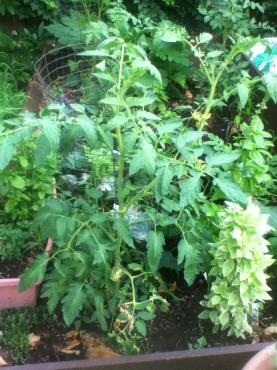
It is a rainy afternoon—the kind I always love for its ability to cool things down and set a calm mood, as if the world is moving at a bit slower or quieter pace. Nature is foremost, apparent, audible. And every drop makes the gardens happy, which allows me to skip watering duty.
This particular late spring in Maryland has seen more heavy rain than in my memory of growing up here. Sipping green tea at my desk, I listen and take it in, and wonder if it is part of the new normal. Melting icecaps and rising temperatures are gradually rearranging weather patterns, which in the mid-Atlantic region is manifesting, among other ways, as increased precipitation. A turning of the handle tells me my lovely fiancee is home from work.
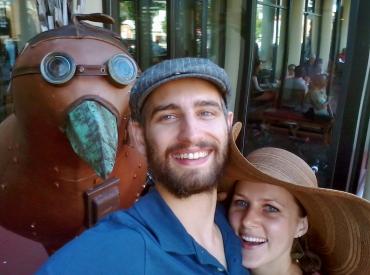
We smile widely at each other. She slumps off her heavy backpack of social work and art therapy gear, pulls her jacket off onto the chair, and plops down onto the bed. Instant savasana. I sense a little something more than just the tired, relieved, after-work bed dive.
Was it something difficult that happened with one of her therapy clients, who face troubling circumstances every day? Was it something existential, say about the “need” for the hustle and bustle of working full time? Was it a resurgent longing for world travel and exploration? I implore sweetly, now lying beside her.
“It’s Climate Change.” She turns to look at me with honest despair lingering in her usually happy eyes. I sigh deeply. It is the second time this month.
Knowing what I do, how can I console my wife-to-be in the face of this realization of such great magnitude, and of potentially ominous and far-reaching consequence? What can I say when what is happening has been so greatly unmatched by humanity’s awareness and action?
How can I protect her, our family, our homestead, and the community we wish to create, from a freaking changing ecosystem? As if life isn’t complicated enough, just add on the rapid undoing of weather predictability, temperatures, and sea levels. Not to mention the potential disruptions in public health, energy, water, crops, and the economy…just to name a few.
Responding to Climate Change
I start in on a measured answer.
I begin by empathizing that it can be scary to think about, and sad to acknowledge. I have definitely been there (more on this later).
I explain that it is true that we do not know exactly how climate change is going to unfold, and how much clean energy and sequestration technologies will be online fast enough to slow the effects, or possibly even to reverse them. We can, however be certain that some change is already baked into the equation. It does indeed suck, but at least we are aware of it and there is a lot of information to help us respond to it the best we can. We will have to accept what we cannot change, see what we can do to respond, and help others to respond as well. That we are paying attention already is most important.
In terms of safety, I explain that there will not likely be an event which we will not be able to respond to. If there is one that we have absolutely no chance to respond to, that is just our fate.
To feel more confident in this perspective, we launch into a mini research project to determine the patterns of natural disasters in the US, and how it is expected that temperatures, water levels, and storms will change in our part of the world.
What we discover is that where we are planning to settle, near the mountains in the wilderness and farmlands of western Maryland, is going to be a solid place which addresses all of our biggest concerns about climate change, all while being less than two hours from our parents, friends, and families. We couldn’t B’more* excited about being able to live our dreams while still being so close to home.
*[Editor’s Note: this Baltimore pun is intended.]
Also thankfully, many of our existing interests and plans, and likely those of many of the readers of Communities, are already lining up with what people can do to effectively respond to Climate Change.
● Practice self-sufficiency via gardening, composting, fermentation, sprouting, etc.
● Learn permaculture so you can work more effectively with land, plants, and animals, manage water resources, and foster ecological abundance.
● Pick up and use practical DIY skills, such as how to find answers and produce solutions.
● Nurture good relationships and build a stronger sense of community. For us it is not yet through an ecovillage, but through sharing a house with roommates, plus through work, family gatherings, hike clubs, and friends.
● Give back through the work that you do. Make sure that you, other people, and the world are better off and more happy because of the causes to which you dedicate yourself.
● Grow from successes and mistakes, develop your character, stay fit and healthy.
● Enjoy life, stay positive, and laugh, despite the circumstances. What are we alive for, if not to enjoy life!?
After exploring the topic from various angles, Karen and I start to breathe a collective sigh of relief, with cloudy uncertainty replaced by a brighter sense of resolve and creativity about our future. Little smiles around her eyes are a sight I am relieved to witness. She appreciates the talk, and reflects that it is so difficult because of how recent of a realization it is for her, the scope of it all, plus how it is compounded by planning to bring children into the world in a few years.
Through the difficulty of the topic and heaviness of the realization, I am so thankful that she is thinking about all of this, and that we have a plan together of how to respond. I encourage you, your family, and your community to talk about this issue and how you will respond as well.
Community Responses
Intentional communities are in a unique position to respond to climate change. First and foremost if they share strong bonds of respect, teaching, cooperation, and problem solving with their group, they will more likely be able to address new challenges with creative solutions.
Because of the way in which many intentional communities are organized, both ethically and practically, they already share many resources and create less waste. Communities have much smaller environmental footprints and therefore need less than their suburban counterparts.
Many communities also emphasize sustainability and self-sufficiency as core components of their purpose, and have programs that work to produce high quality organic food, harvest clean energy, and nurture a better relationship to the planet. These characteristics give communities the opportunity to thrive through climate changes.
Climate Crusaders
Another reason to be confident that we have a fighting chance against climate change is that there is a small army of exceptionally talented people out there working on this crisis from every different angle. Brilliant and skilled people who are passionate about making a difference are bringing together new energy innovations, multidisciplinary teams, and reimagined strategies to turn innovative potentials into realities today.
Over the last decade the headlines have steadily appeared about new game-changing energy technologies. In laboratories, universities, startups, garages, big companies, accelerator programs, and competitions around the globe, dozens of new ways to produce and store green energy have emerged. For example, using futuristic advancements such as lasers, nanotechnology, or biotechnology, scientists have more than doubled solar cell efficiency from where it has been lingering for close to 40 years, and cut the cost of producing solar power to a fraction of what it has been until now, making it even cheaper than coal-fired power. Tapping into the sun will be a new renaissance for humanity.
New biofuel technologies are allowing people to grow high yield, low cost, and low resource-intensive algae for producing biodiesel, ethanol, or biogas. You can find do-it-yourself guides and technology to produce it yourself on OrganicMechanic.com.
Tesla Motors is innovating to bring their $100,000 Roadster down to $35,000 for a pure electric performance plug-in car. They are aiming to further reduce that price by half over the next decade. Most of their charging stations use solar energy and the network is expanding. With the current stations one can now drive from LA to NYC on clean solar electrons alone!
Also promising, and seemingly completely under the radar from the public’s attention, the President and his team have laid a legal framework to make carbon pollution officially a dangerous poison that the EPA can regulate. Specifically this means that coal-fired power plants and other large polluters are going to have to reduce their dangerous emissions. This will spawn innovation to create and use energy more efficiently, as well as new sequestration technologies which could even repurpose waste into raw materials.
Nonprofits and other organizations are also bringing their weight to bear, and groups such as 350.org are advancing the cause and deserve much praise for rallying unprecedented support in demonstrations around the globe to bring attention to this issue. Many more initiatives to raise awareness exist, and they could all certainly use your help and support!
Turning Green Torment into Pathways Forward
I was definitely able to empathize with my fiancee’s fears and concerns about impending Climate Change. Yet since I have been working in the field of green technology for nearly a decade, and investing my heart, mind, and tears in environmentalism for much longer than that, I have already gone through a lot of torment surrounding the issue.
I wrestled with depression about the tragic degradation of our luscious planet Earth, and what this means for animals and future generations. I often worked through the night with chest-thumping anxiety due to the overwhelming feeling: that so few humans seem to care at all about the fate of our planet. I experienced anger at people, companies, institutions, and beliefs that perpetuate problems and stall solutions. I dealt with wrenching toxic guilt over my role in what to personally do about it all.
Through all of this I am now much more accepting and informed of what is happening, how to stay sane despite all of it, and how to play a realistic constructive role in the way forward.
After touring around the US on a biofuel powered school bus, teaching about biofuels to schools, local groups, and media outlets, and developing an easier way to filter vegetable oil along the way, I realized that the world was in need of a go-to place to learn about and to choose smart green solutions. This is why in 2005 I started OrganicMechanic.com, where you can find innovative green technologies, useful information, and friendly support, to help you save money on electricity and fuel. Benefits of green energy also include increasing your energy security, supporting localization, and reducing your carbon footprint.
If you go to the OM website you can sign up to receive a free guide called “Ways to Go Green” that provides the most high impact ways you can get a grasp on and cut your energy costs. You can also find biofuel equipment, electric bicycles, electric car conversion guides, solar and wind power, efficient heating and cooling, home and vehicle efficiency devices, and more.
Starting Organic Mechanic also addressed a conflict in myself between my passions for the environment and self-sufficiency on the one hand, and my natural interest and inclination for entrepreneurship, marketing, and business on the other. I have grown to see business as a tool, which like any tool can be abused, but which also can be applied constructively to change the world for the better. I am in a similar position now as the Business Manager for FIC, where I am applying business insights to make the organization more sustainable and effective, so that we may support and spread the communities movement even further.
Green businesses, also referred to as B Corps and the like, as with many nonprofit organizations, take into account the so called “externalities” that business-as-usual has ignored. The new bottom line measures not only profit, but purpose, including the real impacts on people and the planet. A responsible business or organization, and those running it, realize this truth and decide to be part of that better world.
We Can Change This
“To change something, build a new model that makes the existing model obsolete.”
―Richard Buckminster Fuller
To face the climate’s change we could sure use a culture change. Companies and industries that are poisoning the earth should be held accountable for their poor decisions. It will also take better representation in government to help to set a greener course, and enterprising individuals in nonprofits and businesses to pull people together. Ultimately individuals must seek more responsibility to pay attention to and take care of the world around them.
As harsh as it can be to realize the problems the world is facing, I hope that more people will go through the realization. It is better than ignorance or denial, and it raises hope that it could yield some positive response, for that person and their community, and also for the world at large.
As Greensburg, Kansas showed us (see the movie Within Reach or look online for more of that story), people can do breathtakingly incredible and imaginative things when joining together in the face of disaster. If we can show this same tenacity of unity, shared purpose, and creativity to reimagine the way things could be, even before there are disasters to face, we can do nearly anything.
Humanity has been short-sighted in its use of dirty fuels. It turns out that the high energy stuff in the ground was in fact too good to be true. We are collectively awakening to this reality, and to the potential consequences of continued inaction in the not-so-distant future. Will we work together to formulate a strategy big enough to match the challenge?
This has become the new human story. We must learn (remember) to love each other, in order to work together. We must learn (remember) to love our planet, in order to keep it.
● ● ●Greasing the Wheels
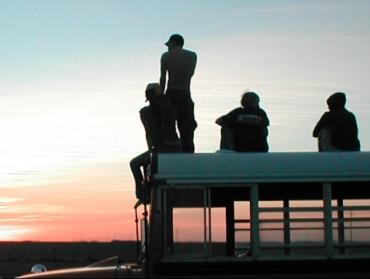
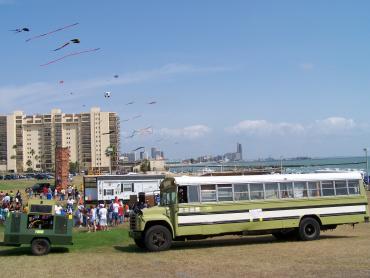
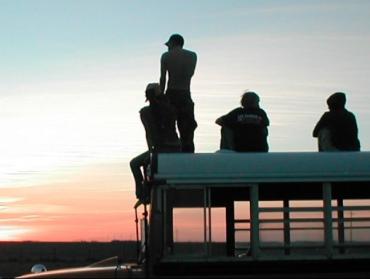
Before the green business was the green bus. It all started with an adventurous crew, a dream to travel, and a full-sized school bus converted to run on pure vegetable oil.
The five of us were college students in Corpus Christi, Texas who were looking for something exciting to be a part of. We all wanted to travel, and wondered if there was some way to reduce our fuel costs and emissions. After researching and finding out that Rudolf Diesel himself originally advocated vegetable oil to fuel his engine, we decided to pick up a bus from an auction. We then found and worked with a conversion company to install a heated fuel system that would allow us to fuel our journeys with used cooking oil filtered from restaurants.
Earth Tribe became our group name, as we found shared interest in alternative energy, healthy living, and cooperative culture. We decided to launch a campaign to create awareness and support. “Healthy Individual, Healthy Community, Healthy Planet.” We developed talking points and gave speeches to local environmental and political organizations, set up demonstrations at Earth Day, and presented at schools from K through College. We organized multiple media appearances, and had a party to raise funds for a great voyage across the country in the veggie-powered bus. Our enthusiasm was well received, and people were amazed learning about how minor vehicle adjustments could provide us with new energy sources today.
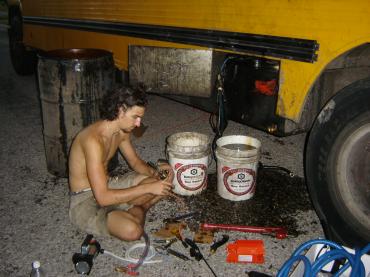
Over a few years of off-and-on trips, the bus saw over 20,000 miles of countryside and tight city streets, thanks mostly to recycled grease as fuel. Traveling on biofuels was not always a breeze, however. We did experience multiple breakdowns, and eventually became aware of how poorly constructed and installed our original vegetable oil system was. Far too many times we were stranded on the side of the highway, and in between the thunderous rumbling from trucks storming by, I was dreaming of how an ideal system would operate.
In addition to those trying issues, we also ran into a lot of hassle with collecting and filtering oil, at least at first. Anyone experienced in this will be able to reflect that while you can get it down to a science, it can be a messy learning curve—especially when you are collecting hundreds of gallons at a time for a bus. Waking up every few hours throughout the night to squirt a few more gallons of oil into a sock filter over a barrel was not only annoying, inefficient, and giving me weird dreams, it was also too expensive, and so there just had to be another way.
I started to research and developed an inline filtration system called the GreaseBeast. My business and life partner of that era, Dani Phoenix, now cofounder of the sustainability and education focused nonprofit D.r.e.e.m. Reality (DreemReality.org), took care of the customers, accounting, and taxes, while I guided strategy, improved the technology and access to suppliers, built the online marketing, and assembled filtration equipment in the rooms off of the kitchen.
We both did our share of packaging and hauling giant boxes in shopping carts to the post office. It involved a great deal of literal sweat investment and on-the-go learning, while we also went to school full-time for much of it. Through all of that, I found it very rewarding to run a company that was helping people to get free from the fuel matrix.
Over the years, working with friends and engineers I also designed a diesel conversion kit which solves some of the most challenging issues we faced on the bus. This system knows when to switch between fuels, tells you when to change fuel filters, lets you know if there is water in the fuel, and gives you a reminder to purge the fuel system on diesel fuel when you shut down. You can find these on OrganicMechanic.com/diesel-conversion-kit/ and the Support Manager Bob Karl can help you with any questions about how to convert, and how to find and filter oil.
We eventually decided to sell the bus, as new life chapters presented themselves. I cleaned and tuned her up very nicely, reminiscing all the while, and a beautiful synchronicity occurred when a group of five soon-to-graduate high school students from North Carolina found the veggie bus ad online. It was an opportunity for their dreams of a lifetime to come true, so they became the new caretakers, and the Legend of La Fonda Olive continues on the road today!
Keep the conversation going with these pieces
There are no available blogs
Subscribe to our newsletter for fresh stories and community updates delivered to your inbox.
Get unlimited access to courses, exclusive member events, and a supportive network of community builders
Access all courses, books, and premium content
Member-only workshops and community builders
Member-only workshops and gatherings
We use cookies to improve your experience on our site. By using our site, you consent to cookies.
Manage your cookie preferences below:
Essential cookies enable basic functions and are necessary for the proper function of the website.
These cookies are needed for adding comments on this website.
Statistics cookies collect information anonymously. This information helps us understand how visitors use our website.
Service URL: policies.google.com (opens in a new window)
A residential project: people live here as their primary home.
An institution, business, network, or project that isn’t a residence (e.g. a learning center, farm, or network with no one living there full-time).

{{ item.label }}
{{ item.value ? item.value : currencyFormat( item.amount ) }}
Subtotal
{{ currencyFormat( pricing_summary.total_amount ) }}
There are no results matching your search