

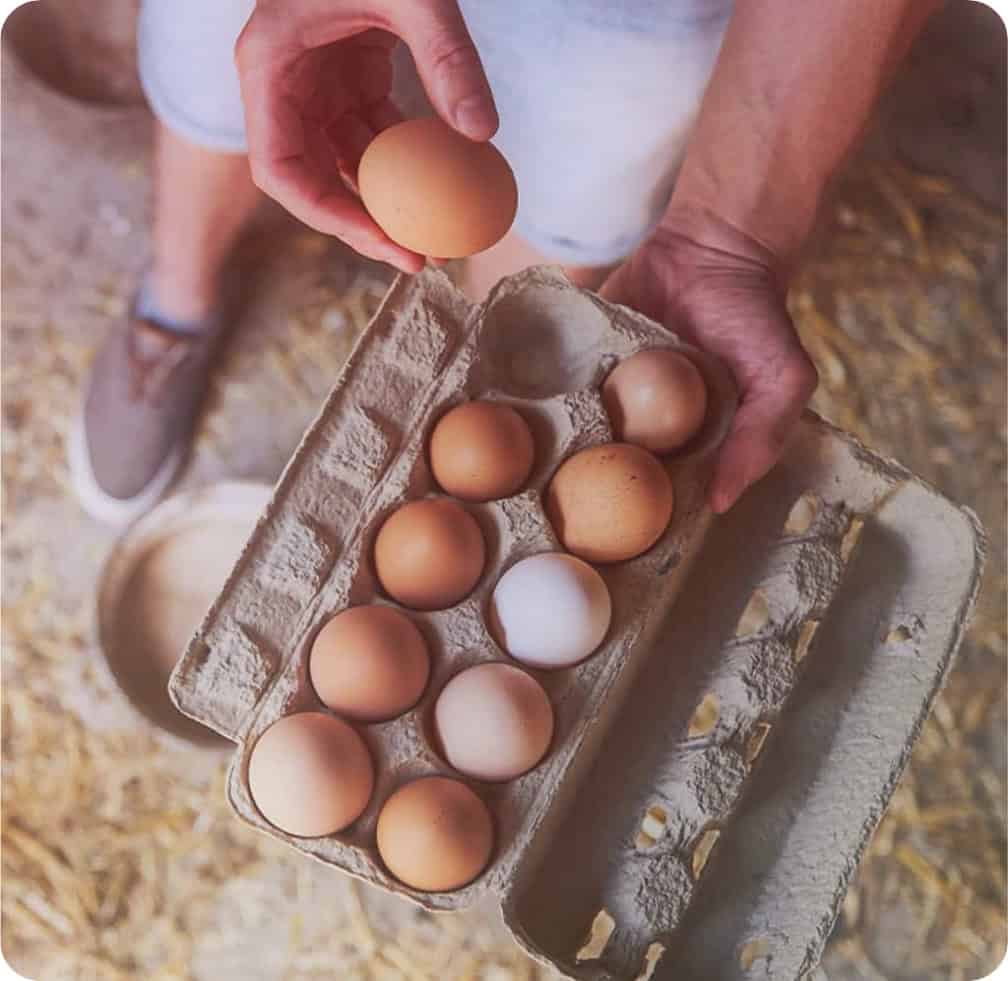
Just down the dirt road from our community in San Diego County is a woman named Kelly who raises chickens and pigs. One day she asked me if we wanted eggs from her chickens and I said “absolutely,” so she brought over a few dozen. I asked “how much?” and she said $3/dozen so I insisted on paying her $4/dozen. Pretty soon, the word got out about the farm-fresh eggs on the cheap and Kelly’s eggs were in high demand. Two dozen a week quickly became four, and now our community is up to eight dozen a week.
Kelly is now our egg vending machine, except that she’s not. Kelly doesn’t have a set schedule for when she delivers her eggs. It’s usually every week, but sometimes she goes eight or nine days in between deliveries, sometimes she brings seven dozen instead of eight, sometimes there are duck eggs, sometimes turkey eggs, she doesn’t always respond to texts right away, etc…. In other words, Kelly is a wonderful human but not a very good vending machine, yet we are very happy about the fact that her eggs are super local, and only cost $4/dozen vs. $8/dozen at the actual egg vending machines (i.e. supermarkets).
We get to choose. We can have Kelly and her inconsistencies at $4/dozen, or we can have supermarkets and the hassles that come with that at $8/dozen. What we cannot have is Kelly’s eggs with vending machine expectations, yet that’s what might happen if we’re not careful.
Internalized capitalism, meet community. Capitalism informs how we think about economic transactions, so whether it’s Amazon, Walmart, or our neighbor Kelly, we unconsciously assume a set of beliefs. We see everything as a vending machine and our ability to pay as the only thing we need to feel entitled to a given service or product. This is an appropriate assumption when it comes to big companies such as Walmart, but when applied to someone like Kelly or interactions within an intentional community it often breaks down.
If I’m shopping online at Amazon.com and I find a workaround that gives me a lower price, I’ll take it. Even if that method is a glitch in the system, or an unfair advantage, most people (including myself) will use that to get a better price without hesitation. The same goes in reverse. If big companies can charge a higher price and the customer will pay it, they will do it with no regard for whether they could feasibly offer that product at a lower price and still meet their financial needs. The game of capitalism essentially boils down to a mindset of “get yours,” often by whatever means necessary, and it’s a game played by both sides.
But what happens when this “get yours” mindset is consciously or unconsciously brought into a community? A better question is, what happens when there is an imbalance of “sharkey-ness,” meaning one person is playing the “get yours” game and one person is playing the “everyone wins” game? No one wins, and everyone loses. The “everyone wins” person will get taken advantage of, and the relationship will turn sour, often over a paltry sum of money or terms of negotiation.
My relationship to Target doesn’t matter, yet my relationship to the people in my community is critical to my well-being. I can take advantage of Amazon, or be taken advantage of, and it won’t affect my personal life or my close relationships because it’s an isolated system. Intentional communities are not, because everything and everyone is connected. What goes around, comes around.
Furthermore, when someone shows up to negotiate from a “get yours” mindset, there’s not much we can do to take things in a different direction. In my experience, internalized capitalism is just that — internal. It’s not a choice. Trying to suggest another way can feel like offering an alternative to gravity. Additionally, when someone is playing the game of capitalism and I’m trying to play the game of “let’s do what’s best for everyone,” I’m susceptible to getting taken advantage of. It’s like bringing a hug to a gunfight.
As much as it may hurt our hearts, often our only option in those scenarios is to come with a “get yours” mindset as well, yet this elevation in competition has a negative ripple effect. Selfish behavior can start a chain reaction, and quickly turn a culture of abundance into a culture of scarcity. It’s the reason so many indigenous groups went to great lengths to nip selfishness in the bud, because they saw how it could create a downward spiral and ruin everything. This is why communities reckoning with internalized capitalism is so important, because if we’re not careful, one person’s selfishness will drag the whole group down with it.
I’d like to share some more ideas about how internalized capitalism plays out and doesn’t play out in intentional communities, but first it’s important to acknowledge that for some people and communities this wisdom is innate, and they already get the joke. I come from upper-middle class suburbs of Boston, so adjusting to life in a rural intentional community was a reorientation of my conscious and unconscious values. I imagine this is true for many folks who move to intentional communities, and what I’ve also noticed is some people take longer than others to adjust, and that can cause tension and stress in the community, due to the reasons I mentioned earlier in the essay.
In the default market, the flow of gratitude goes from seller to buyer. Customers get praised for their consumption. When we walk into a department store we feel like royalty because we have the almighty purchase power. In a more communal environment, the gratitude is often reversed. Instead of money at the center, it’s the service provided that we ought to be grateful for.
In my example of Kelly and her eggs, our community shows gratitude for the service she offers. By asking $3/dozen for farm fresh eggs that get delivered to our doorstep, she is being generous with us, and we understandably want to be generous in return. Last month Kelly mentioned that she had to repair a fence because some predators got in and killed some of her chickens. In response, I offered some of our labor to help mend fences if she ever needed it. We have eight people and 16 hands, and I knew she could use the help. Under normal “rules” of capitalism, I could have offered our services at a cost (it’s valuable, after all), yet we can see how that could quickly spiral downward. An offer like that would be totally justified in the default market, yet it would be completely uncalled for in a communal environment.
In a “get yours” mindset, showing people your costs and being transparent is a bad idea. If your goal is to make as much profit as possible, then you would hide those figures, or maybe even lie about them to gain advantage. In a communal economy, transparency builds the trust needed to make sure everyone wins.
When I’m selling something in a community environment, I start by sharing my personal costs, and I’m transparent about the time, money, and effort that went into what I’m selling. I want the person I’m negotiating with to understand that I’m attempting to find a deal that works for both of us, so showing them my numbers is a means to that end. A good example of this on a larger scale is Mark Cuban’s new project, costplusdrugs.com. I swear I’m not being paid to promote this, I just really appreciate the approach he is taking to rebuild trust in a market that has been riddled by deception. His company breaks down the price of medication into the manufacturing cost, pharmacy labor, and a 15 percent markup. Every drug he sells shows that math. It’s beautiful, and simple. Transparency builds trust.
If it wasn’t obvious by now, there are challenges to a communal approach, versus a default capitalism approach. We need the ability to know our boundaries, to have difficult conversations, and to welcome people into our lives beyond an over-the-counter interaction with them. We need people skills, and for many people those skills have atrophied to a point where we would rather work more and pay extra to avoid each other.
At the end of the day, Kelly isn’t just not becoming our egg vending machine, she’s becoming our friend, because that’s how this works. Today I visited her property to pick up eggs, and spent time with her sister while our dogs played together. Soon I hope we are inviting her over for the holidays and bringing her chicken soup when she gets sick.
For older generations, these kinds of high-touch service providers was all they knew. They didn’t have a food delivery app, so having a relationship with the baker who made the bread, the plumber who fixed the sink and the local butcher was just part of life. It’s what everyone did. All of these services were people, not apps, and the relationships we had with them were real and often meaningful.
I was fortunate to grow up with a father who had an innate understanding of community-centered living. He was always nurturing relationships and being of service to his local community. He would even treat the person collecting tolls on a highway as a friend, back when that job was done by a person too.
I’ll be honest that I wasn’t sure if writing this essay was even worth it, because this is so painfully obvious to many people, and yet—it’s becoming less and less common. Our grandparents weren’t any more moral than us, they just had fewer options. As time has gone on and new opportunities for avoiding people have presented themselves, we’ve taken them. We are independence hoarders, and when given the chance for more privacy, more independence, or more autonomy, we scoop it up, no matter the cost.
Intentional communities are a natural boundary for some of the capitalist habits in mainstream culture that are slowly eroding our collective and individual well-being, so I hope that through increased awareness of our internalized capitalism we can continue to hold the line and create our own little micro-cultures of care, generosity, and consideration for everyone.
Dave Booda is a writer, musician and social entrepreneur currently serving on the board of directors for the Foundation for Intentional Community. He has published over 200 essays for boodaism.com and played over 1000 shows as a touring singer/songwriter.
This topic was inspired by an important piece by Sky Blue called “Intentional Communities and Capitalism” that I read several times. You can see it at incommunity.us/intentional-communities-and-capitalism.
This essay was written for the fall 2024 issue of Communities Magazine, which has been in print for 50 years! You can check it out at https://www.gen-us.net/communities/
Keep the conversation going with these pieces
There are no available blogs
Subscribe to our newsletter for fresh stories and community updates delivered to your inbox.
Get unlimited access to courses, exclusive member events, and a supportive network of community builders
Access all courses, books, and premium content
Member-only workshops and community builders
Member-only workshops and gatherings
We use cookies to improve your experience on our site. By using our site, you consent to cookies.
Manage your cookie preferences below:
Essential cookies enable basic functions and are necessary for the proper function of the website.
These cookies are needed for adding comments on this website.
Statistics cookies collect information anonymously. This information helps us understand how visitors use our website.
Service URL: policies.google.com (opens in a new window)
A residential project: people live here as their primary home.
An institution, business, network, or project that isn’t a residence (e.g. a learning center, farm, or network with no one living there full-time).

{{ item.label }}
{{ item.value ? item.value : currencyFormat( item.amount ) }}
Subtotal
{{ currencyFormat( pricing_summary.total_amount ) }}
There are no results matching your search


