

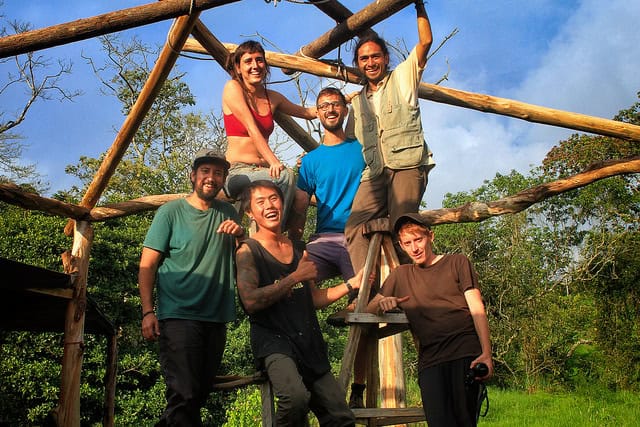
For many of us, intentional communities serve as experiential laboratories, examples of ways that people can come together to challenge the dominant systems that we’ve grown up with or have learned to put up with. It’s been great to see a rise in mainstream awareness of intentional communities, with more news and media outlets taking cohousing and co-living seriously.
This month, the academic community turns its attention toward intentional communities too, with an entire section of the Journal of Political Ecology focused on “Degrowth, Culture, and Power.”
The Journal of Political Ecology is an long-running peer-reviewed publication that is archived at the University of Arizona and offered for free online. Wikipedia defines political ecology as “the study of the relationships between political, economic and social factors with environmental issues and changes. Political ecology differs from apolitical ecological studies by politicizing environmental issues and phenomena.”
This issue covers a broad range of topics, including the Gross National Happiness metric in Bhutan, time-banking in New Zealand, and a squatter community in Brazil. It also explores “community, commons, and degrowth” at the Dancing Rabbit Ecovillage in Rutledge, MO, where FIC’s offices are based.
Here are just a few examples of the articles in this issue. You can read them all in PDF format here.
****
Community, commons, and degrowth at Dancing Rabbit Ecovillage
by Joshua Lockyer, Arkansas Tech University, USA
Abstract: “[T]his article uses ongoing ethnographic research to describe how one intentional community – Dancing Rabbit Ecovillage in northeast Missouri, USA – is forging such models by cultivating cooperative cultural values and behaviors, recreating the commons, and sharing their experiences and lessons with broader publics through media, research, and educational programs. Based on ongoing participatory action research, I present data on areas such as energy use, water use, solid waste production, and perceived happiness to illustrate that the community is achieving the decreased consumption patterns required for degrowth while maintaining a high quality of life for its members.”
****
Neo-monastics in North Carolina, de-growth and a theology of enough
by Amy Cox Hall, Amherst College, USA
Abstract: “Drawing on four years of research with one residential Christian community, I suggest that the most challenging aspect of sharing a life together and slowing down is not simply consuming less or pooling resources but rethinking and living social values not driven by a consumerist-growth paradigm. While some de-growth advocates, such as Serge Latouche, promote ideals of harmony and oneness, in practice, living simply and sharing a life together is challenging and conflictual, even when religiously inspired.”
****
Jonathan DeVore, University of Bonn, Germany
Abstract: “Drawing from several years of ethnographic research with rural squatters in the cacao lands of Bahia, Brazil, the author brings together alternative ways of conceptualizing property that can help overcome this lingering dichotomy and fruitfully inform new political projects. The article examines local practices of property-making through two cases focused on the private ownership and stewardship of natural springs, and the processes whereby squatters convert forest into agroforest.”
****
Timebanking in New Zealand as a prefigurative strategy within a wider degrowth movement
Emma McGuirk, University of Otago, New Zealand
Abstract: “A movement is gaining traction in New Zealand around timebanks, networks of support in which members exchange favors such as gardening, lifts to the supermarket, pet care, language lessons, career advice, or smartphone tutorials. An online currency is used to track these exchanges, with one hour of work earning one time credit. While each transaction may seem commonplace, when timebanks flourish they work to reshape motivations and opportunities for engaging in labor, and relocalize networks of solidarity, friendship, and resources. Participants reported examples of developing unexpected friendships and renewed enthusiasm for a larger collective project of building alternatives to the currently dominant growth-addicted economic model.”
****
Image by Adrian Felipe Pera (CC BY-NC-SA 2.0)
Keep the conversation going with these pieces
There are no available blogs
Subscribe to our newsletter for fresh stories and community updates delivered to your inbox.
Get unlimited access to courses, exclusive member events, and a supportive network of community builders
Access all courses, books, and premium content
Member-only workshops and community builders
Member-only workshops and gatherings
We use cookies to improve your experience on our site. By using our site, you consent to cookies.
Manage your cookie preferences below:
Essential cookies enable basic functions and are necessary for the proper function of the website.
These cookies are needed for adding comments on this website.
Statistics cookies collect information anonymously. This information helps us understand how visitors use our website.
Service URL: policies.google.com (opens in a new window)
A residential project: people live here as their primary home.
An institution, business, network, or project that isn’t a residence (e.g. a learning center, farm, or network with no one living there full-time).

{{ item.label }}
{{ item.value ? item.value : currencyFormat( item.amount ) }}
Subtotal
{{ currencyFormat( pricing_summary.total_amount ) }}
There are no results matching your search

We’re introducing new Plus features — including community reviews, Profile Match, and unlimited Needs & Offers posts — while keeping most of FIC free for everyone. Membership costs less than two coffees a month.

