

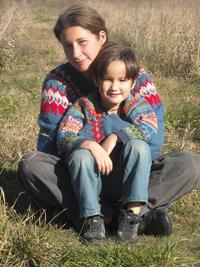
Our small rural land-sharing community, Black Bulga, comprises 13 people and is located in the forested, healthy, and clean headwaters of the Karuah River in the Hunter Valley in Australia, near the city of Newcastle, which is about 100 miles north of Sydney. We have been forming together as a community for seven years and have owned our land for five years.
We formed as an explicitly “service” or “activist” community having gotten to know each other mainly through social change activist networks. We are very fortunate. We enjoy a healthy environment in a country where there is relatively little violence or war. Being aware of our special luck, we were determined when we formed our community that our purpose was not to retreat from the world. Rather our purpose is to create a community that will sustain us, and inspire us to engage with the wider world to help make it a better place for our generation and those that follow.
Our shared commitment to activism gives Black Bulga a distinct purpose, and our commitment to service and activism is written into the vision and values sections of our bylaws: “Our vision is to act as custodians of the rural land upon which we live, working together to create a sustainable and just future in our immediate community and in the wider world.” The values written into our bylaws include commitments to use our collective resourcefulness and creativity to care for the land, and for each other, our neighborhood, region, and the planet. While we subscribe to no particular ideology, our politics is informed by ecological libertarian socialist values. We pay attention to how we can support each other to sustain our activism in the spirit of these values.
Our members’ activist work spans multiple roles and locations, including as frontline defenders joining local residents blockading proposed gasfields in the nearby town of Gloucester and elsewhere; as managers of social change organizations; as activist trainers, community organizers, and facilitators; as mentors and elders to a wide community of activists in multiple fields and in different places and age groups; as educators and researchers in a wide range of academic and activist programs including in family well-being and sustainability; in international community development and medical aid work; as practitioners in community arts and sustainable food growing; and as parents and allies to fellow parents, Our collective and individual activism inspires us, exhausts us, nurtures us—and challenges us.
We have found that our social change activism builds local community and connects us with our neighbors as well as the wider world. In fact, we did not need to go far to find opportunity to put our individual and shared passions for social change into practice. In our local valley, our service work gets literally “down amongst the weeds.” We are proud to have been instrumental in forming a local Landcare network to protect our river catchment from weed infestations. In Australia, this Landcare movement has been a powerful social movement that has brought farmers and environmentalists together at grassroots and national levels, with government funding support. As Landcarers we’ve worked and sweated in hot sun and along riverbanks with our neighbors, removing weeds and creating space for local native plants to regenerate. John Mac, the Black Bulga member who leads this work, reports the benefits:
“This service work builds local community networks to collectively protect our local environment. We have in our valley, between us, hundreds of years of land management knowledge. We share stories of about what is effective and efficient land management, and what doesn’t work and is a waste of time and effort. We also share lots of cakes and cups of coffee.”
We have among our members some very experienced activists who have spent decades campaigning around mining, environmental protection, and human rights, working with mine–affected communities locally and globally. When a gold mine was proposed upriver in upper reaches of the Karuah River in 2011, soon after we had bought our land, the mine-owners may not have realized who they were taking on. The whole catchment community saw the mine as a threat, with the risk of sediment pollution and, potentially, cyanide contamination jeopardizing local farming and tourism industries and the rural lifestyle and amenity.
We were quick to act, and with our neighbors, we used the extensive networks throughout the valley to bring farmers, eco-tourism business operators, oyster farmers, and other residents from the length of the Karuah River catchment together to learn about and fight the proposal. We formed the Karuah River Protection Alliance and together we spoke out strongly through local and national media, to government officials, and directly to the company. Following our extensive lobbying the proposal was dropped, and by winning the campaign, we helped secure the future of the valley for nature-based tourism and sustainable food growing.
Before the campaign we were known rather disparagingly as “The Commune,” but through the campaign our neighbors got to appreciate the campaigning skills of the “new kids to the block,” while we admired their skills and capacity to organize locally. The campaign sped up the process of us being accepted as part of the community. We now share farming knowledge, host our neighbors’ horses and cattle on our land, regularly have meals together, and celebrate family events such as children’s birthdays, Spring and Autumn (Fall) Equinox, and New Year’s Eve.
While our valley is mining-free, thousands of residents and farmers in neighboring valleys across the Hunter Valley are fighting the devastating impacts of vast open-cut (open-pit) coal mines and the threat of gasfields with severe impacts on their environments and health. The Hunter is one of the world’s largest coal-exporting regions, with hundreds of millions of tons of coal exported from the port of Newcastle annually to North and East Asia. The region is also the home of coal-fired power stations that have historically been the major source of Australia’s electricity. Together these industries make the Hunter region one of the world’s climate change hot-spots. Many times our members have joined frontline action against coal and climate change including blockading gasfields in the nearby town of Gloucester with local residents, and other peaceful blockades and lock-ons at coal mines and coal export terminals in Newcastle and elsewhere.
Balancing externally-oriented social change work with building a strong and viable intentional community poses many challenges. Our service and activist work takes our focus away from building our relatively new community and from working on our land. This challenge is compounded by the fact that actually living and working on our land is very difficult as it is quite remote and there are few jobs in the local area. We have had to find ways to transition from careers in large cities to work that we can do from the land or in nearby towns. Jemma, who manages a small international development organization as well as co-parenting three children under eight years old recently moved from Sydney to Newcastle, as part of her family’s strategy to be closer to the land and spend more time at Black Bulga, highlights the tension:
“To make Black Bulga grow and thrive in the long-term, it needs people there, planting through the seasons, working together, creating a hub. But it is a tricky tension to manage—how to be on the land while still being an active part of social change campaigns. At the moment, we are all in the transition to spending more time at Black Bulga. We have monthly community meetings, regular all-in working bees, and big social gatherings. There is a real network of friends and family—many of whom work in social change—who have a genuine connection to Black Bulga, who visit regularly, talk politics, get their hands dirty, dream and replenish. I love that the Black Bulga community is bigger than just the group of unit holders.”
The heavy demands and occasional heady excitement that comes from activist work—which in some cases allows us to travel the world, be in the national media spotlight, and confront powerful political and corporate interests—makes a stark contrast to the work of building community and caring for food crops, stock, and buildings. John, who is often away supporting local coal and gas campaigns around Australia and globally, reflects that “It is too easy for me to live in my head but Black Bulga helps to keep me grounded. The place has a wildness that replenishes the soul.”
Another member, James, who develops education programs for activists, also grapples with the challenge of balancing his external community and Black Bulga community focus: “I try to meet my own and my intentional community’s needs by being at Black Bulga as much as possible and when here, I get stuck into a hands-on project such as building work, and joining in the cooking and sharing of great food, and reading and playing with the children. Black Bulga helps me keep the relentless demands of work in its box. It’s not easy, but my fellow community members help me meet this challenge.”
As individuals, and as a community, we are still in transition when it comes to combining our activism with a rural farm-based lifestyle. We are trying to work part-time rather than full-time. We use internet, Skype, and email technologies as much as possible so we can work from the land. Our aim to make Black Bulga an arts and ecology education center is part of our community’s purpose but, like living on the land permanently, we recognize that this vision is long-term and is happening in small steps. Dan, who recently held a successful solo exhibition of paintings inspired by the vast and ever-changing Black Bulga skies, comments:
“The arts and ecology project is part of a lifelong journey of the community. We are giving effect to the vision by organizing arts and ecology events and activities on the land, even though we don’t yet have a building specifically for this purpose. Our community celebrates the equinox and solstice with gatherings that involve rituals that range from reverent to ridiculous. We have raced down the river on inflatable rafts, built clay pizza ovens and cooked seasonal feasts to eat under the stars, made beautiful lanterns and ugly effigies of ‘baddies’ to set alight, woven baskets from weeds, and healed a gully with plantings. Already many friends and community come here to draw, paint, and take photos; some have learnt blacksmithing; others have come to write, take nature walks, go bird-watching, and more.”
The community consciously works on integrating the service elements of our lives with the personal and community care elements of our lives in an intentional community. Deb, who works in family studies and relationship research programs at the region’s university and across Australia, as well as with academics and family relationship professionals and activists in India, Southeast Asia, and the US, identifies the need for balance here: “At Black Bulga we work hard at supporting each other to pay good attention to both our work and personal lives. The demands of managing complex decisions about the future of the community requires care and a strong commitment to listen to and support each other. We look out for each other. This work on building positive relationships helps us be whole, well-balanced people at Black Bulga and in our family, professional, and activist lives as well.”
Prue, mother of two-year old Blake, is a campaigner supporting communities trying to stop fracking for gas in various parts of the state. She is often away from home: “Activism work can be hard on the family. Luckily I have a very supportive partner, but the activist life requires a strong and constant focus on our own well-being individually and collectively, particularly on our work as parents. All members of the Black Bulga community are great support and allies to us as parents, and to Blake as a young toddler.”
As individuals and as a community we at Black Bulga know that service and activist work is incredibly important, rewarding, and challenging lifelong work. Our community is a vital support foundation for us being able to go out into the wider world as effective change agents. As many of our friends are also activists, we recognize they have the same challenges balancing service and personal lives as we do. We encourage them to get “out of the city and into the bush” and to use Black Bulga as a place to enjoy nature, and to swim, walk, and play together with family and friends. Reconnecting with the rhythms of nature—and enjoying collectively-grown and cooked food, fireside conversation under starry skies, and being woken by the sounds of the dawn chorus of birds—helps us see that service and activist lives are not all hard work.
Geoff Evans is a wannabe farmer. He keeps the Black Bulga dream alive through activism on mining, climate change, and community development, and working with the community to build a small house and grow an organic garlic crop each year on the land.
Keep the conversation going with these pieces
There are no available blogs
Subscribe to our newsletter for fresh stories and community updates delivered to your inbox.
Get unlimited access to courses, exclusive member events, and a supportive network of community builders
Access all courses, books, and premium content
Member-only workshops and community builders
Member-only workshops and gatherings
We use cookies to improve your experience on our site. By using our site, you consent to cookies.
Manage your cookie preferences below:
Essential cookies enable basic functions and are necessary for the proper function of the website.
These cookies are needed for adding comments on this website.
Statistics cookies collect information anonymously. This information helps us understand how visitors use our website.
Service URL: policies.google.com (opens in a new window)
A residential project: people live here as their primary home.
An institution, business, network, or project that isn’t a residence (e.g. a learning center, farm, or network with no one living there full-time).

{{ item.label }}
{{ item.value ? item.value : currencyFormat( item.amount ) }}
Subtotal
{{ currencyFormat( pricing_summary.total_amount ) }}
There are no results matching your search