

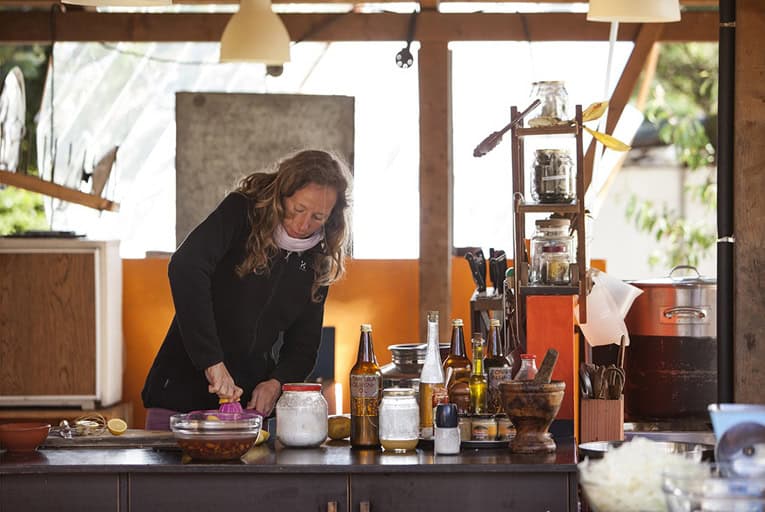
A few years ago, we prepared ourselves for a radical experiment in energy sovereignty here in the Tamera Solar Village (Portugal). We had everything we needed to take our Solar Kitchen off-grid. With a group of people committed to live from food prepared only by a combination of solar thermal, biogas, and human labor, we entered into a period of discussion and communitarian decision-making—and all the nerves and excitement that accompany such a revolutionary step.
When there was nothing left but to go for it, we took a deep breath and…it was easy. In fact, it’s hard now to remember what the fuss was all about, and the “experiment” never stopped. The Solar Kitchen is open to the elements and doesn’t operate during the rainy winter season, but otherwise it is now simply one of our community kitchens, preparing food for up to 50 people every day. When people think of the Solar Kitchen today, they think of the tasty vegan food; the quirky, charming chef; the airy and comfortable seating areas for meals and gatherings. Guests in Tamera love to join the cooking team, not for a chance at the noble suffering of low-tech food-prep, but because the Solar Village is a nice place to be. The Scheffler mirror and biogas systems are beautiful, easy-to-use technologies with personalities.
These technologies are a success in our decentralized energy research. They work, and not only in the technical sense. As I’ll describe, they support human beings living in cooperation with one another and with the cycles and rhythms of nature. These tools are firmly established in the life of the community, and they bring joy.
One of my jobs every day is to collect organic material to feed the biogas system…and already this puts me into contact with the logic of nature, in which nothing is wasted. What might otherwise be “trash”—kitchen scraps, leftovers, garden cuttings—have become valuable resources, wanted for the animals, for compost piles, and for our biogas system. I see, first hand, how this challenges the buying, using, then throwing away system of consumerism, and turns it into a flowing, regenerative cycle that supports the garden, the community, and the environment.
This job also brings me in contact with the other kitchens in Tamera, from which we get a lot of the raw materials for “Hulda” (the name of our biogas digester). I visit the large Campus Kitchen a few times a week, with its changing team of community members and guests. The biogas-food containers are well-labeled but look a lot like trashcans; I am constantly reminded—when I find cigarette butts and plastic wrappers in with the precious, energy-rich organic material—how deeply entrenched are the unconscious behaviors of disposable consumerism. The biogas system and I are educators, inviting people to participate in building a culture in which we take responsibility for everything we produce and consume…a world of closed natural cycles; a world without bottomless, throw-it-away-and-forget-it dumpsters; a society without hidden landfills on the edge of town full of toxic waste.
The Solar Kitchen interacts in a deep and dynamic way with the cooks and their helpers, too. New cooks typically think of the menu first, and then try to figure out how to make it. Often this is possible: thanks to the big mirror and Hulda, hot stoves are available almost all the time. But the Scheffler and the biogas do encourage some adjustment of styles; what ends up on the tables depends on the weather, the time of day, and Hulda’s feeding schedule and changing gas levels. Some cooks experience this as a limitation; for others—for example our main “kitchen chief” Jessica—it is a part of the natural rhythm of life, like the seasons that bring different fruits and vegetables from the garden.
These are some of the reasons why the Scheffler mirror and the biogas system are such success stories in our research: not merely because they work well on the technological level, but because they fit into a more holistic picture, of sustainable community life in cooperation with nature. In fact, they don’t only fit this new picture; they encourage and create it. They don’t just let people feel ecologically righteous; they help people feel happy. They represent, for me, a step towards a kind of spiritual ergonomics, of which engineering and efficiency are only a part.
Our work includes the engineering and efficiency too, but that work can be done anywhere. Here we have a functioning community with a commitment to peace and sustainability: we can experience how the technology fits into our daily lives, in a meaningful human, ecological, and political context. We see and experience how people use the tools, and then we can go back to the lab and workshop to make refinements. The result is relevant for communities throughout the world. What we learn about these relationships between people, community, and technology can further inform our active research in other technologies, such as Stirling motors, heat-energy storage, innovative solar collectors, and resilient systems combining these different elements. Other groups are doing good and important work, but few are doing this work, of developing community technology in community.
By the way, I don’t use the word spiritual lightly. For our aboriginal ancestors, it would have been natural for human-built objects to be inhabited by unseen beings, in the same way spirits lived in trees, stones, and streams. But the ancient creators of wells and fireplaces, hearths and spring houses, gardens and stone circles, would not have acknowledged the distinction between technology and art, between doctors and shamans. I don’t know if I believe in nature-spirits literally; what’s important to me is the idea that objects made by clever human hands remain part of the natural world, fully in the flow of the cosmos. The fashioning of tools would not have been labeled or compartmentalized as “technology,” but was rather a natural community activity. The ancient Celtic builders of Stonehenge—with all its marvels of stone-moving and astronomical precision—would not have been called astronomers or masons, but druids. Or probably just people.
This spiritual question is often with me, but I have to confess that the answers are still a long way away. I cannot claim to sense an invisible presence in the Scheffler mirror, the way I feel such a presence in a grandfather oak, or at our Oracle Spring pool. With its living, gurgling bio-mimicry, Hulda comes closer for some people; they sense it as alive. For my part, I can say that the question remains as a compass point, a question to walk with: How can we overcome the separation between human beings and the things they make? Sometimes I think we need to create rituals of inauguration, as our ancestors would have done, but I have a hard time really picturing what these would be. We are so deeply conditioned by industrial culture—in which people make tools to exploit nature—that it’s hard to imagine how anything else would feel. Technology has become so fundamentally violent that sometimes I have real doubts about my profession.
But there are positive role-models: gardeners for example, and more specifically the Permaculturists, who do not exploit living systems but instead cooperate with them, in a way that makes those systems more alive and abundant while better serving human needs. My goal as a technologist is therefore not to extract energy or exploit resources, but rather to intelligently and gently participate in the natural flows of energies, to serve life and my community. We can and do talk about the kilowatts per square meter of sunshine, the UV resistance of fluoropolymers, how to get the hydrogen sulfide out of the biogas, and so on, but these discussions can only lead to real, sustainable solutions if we get the human and spiritual basics right.
To put it another way: technology carries information. All technologies, and the ways we use them, emerge from specific beliefs and narratives. Unless the tools and techniques are chosen carefully, they will tend to reinforce those unconscious beliefs and narratives. An individual family kitchen with plug-in appliances and a fridge full of grocery-store food is like a guide to a particular lifestyle, and a library of information about Western culture. Whether we are aware of it or not, technology contains a culture’s answers to specific questions: What are the basic social units of civilization? What is energy and where does energy come from? What is the role of food in human relationships? What is the relationship between the human being and the living earth, from which all water, food, and energy come? Improving a technology that supports a lifestyle of alienated consumerism, to make it more energy-efficient for example, may be better than the alternative…at least in the short term. But it is not truly sustainable, because the lifestyle it serves is not sustainable.
The Solar Kitchen carries different information. It is a community kitchen, and this already is a revolutionary choice: we work together, cook together, share meals together. Our cooked food is prepared with the sun; we feel the immediate connection between our lives and the sky. Through the biogas system, we are in contact with the flowing rhythms of growth and decay. The tools can all be made with local materials and skills anywhere in the world, without relying on a globalized system of money and control. And simply by having our energy sources in our own hands, we are automatically more conscious of how we use energy.
My goal as part of the Technology Group is to support the emergence of a sustainable way of living which is not only more ethical, but truly more joyful and attractive than consumerism, with pleasures and luxuries that everyone on earth can have. And beyond this, we want to create awareness…through outreach and education of course, but also simply by sharing the technology itself. This automatically carries information: a community can build a kitchen for sure, but the right kitchen can also help build a community.
When I make morning coffee on the biogas, and watch Jessica elegantly swing the big gleaming mirror into place at the beginning of her cooking shift, ready to prepare lunch for gardeners, guests, students, craftspeople, technologists, and other community members, I know that this kind of kitchen can protect resources and nourish community anywhere. There’s still a lot to be learned, more work to be done. But we have already created something that we love, and something we can share; we are on a good path.
Frederick Weihe lives in Tamera, a community in southern Portugal. Born and raised in the United States, he has been living and working in Europe since 2000. He blogs occasionally at www.physicsforpeaceworkers.org.
Collaborators and Resources
Much of the technology used in Tamera has been developed in collaboration with cooperation partners. For more information about the Tamera Solar Village, please visit www.tamera.org/project-groups/autonomy-technology. For details about the Scheffler Mirror, see www.tamera.org/project-groups/autonomy-technology/scheffler-reflector, and visit the innovators behind it at Solar Bruecke: www.solare-bruecke.org. For more about our biogas system, see www.tamera.org/project-groups/autonomy-technology/biogas. For even more information about biogas as an energy solution for communities around the world, visit T. H. Culhane at www.solarcities.blogspot.com.
Keep the conversation going with these pieces
There are no available blogs
Subscribe to our newsletter for fresh stories and community updates delivered to your inbox.
Get unlimited access to courses, exclusive member events, and a supportive network of community builders
Access all courses, books, and premium content
Member-only workshops and community builders
Member-only workshops and gatherings
We use cookies to improve your experience on our site. By using our site, you consent to cookies.
Manage your cookie preferences below:
Essential cookies enable basic functions and are necessary for the proper function of the website.
These cookies are needed for adding comments on this website.
Statistics cookies collect information anonymously. This information helps us understand how visitors use our website.
Service URL: policies.google.com (opens in a new window)
A residential project: people live here as their primary home.
An institution, business, network, or project that isn’t a residence (e.g. a learning center, farm, or network with no one living there full-time).

{{ item.label }}
{{ item.value ? item.value : currencyFormat( item.amount ) }}
Subtotal
{{ currencyFormat( pricing_summary.total_amount ) }}
There are no results matching your search

We’re introducing new Plus features — including community reviews, Profile Match, and unlimited Needs & Offers posts — while keeping most of FIC free for everyone. Membership costs less than two coffees a month.

