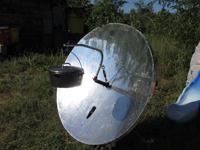


On a sunny day in a community setting, cooking using a solar parabolic cooker is no more difficult than using fossil energy.
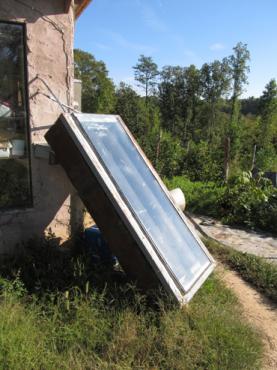
A solar hot water batch collector becomes economical when shared.
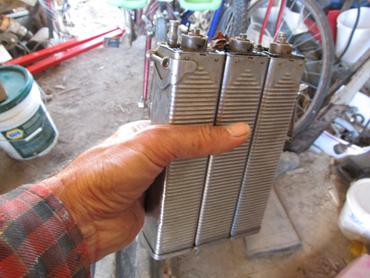
Ideal for powering DC LED lights, this nickel-iron battery, with Thomas Edison’s name on it, still works!
Renewable Energy is one of those terms that sound inherently virtuous, like peace or universal love. Once you start to look at how renewable energy is used in our time, the inherent virtue is washed away and a much more complex picture is left in its place.
That lesson was brought home to me recently when I was teaching a workshop about plant propagation. A fellow who had come to my workshop stayed afterward to chat. Turns out he works for the local power company, one not known for environmental thinking. He works in a generating facility that takes trees and burns them to make electricity. “The public doesn’t understand,” he was saying to me. He was upset to see the incredible volume of wood being consumed to produce only a tiny fraction of power demand. Indeed, if you study the issue, you realize that the United States burns far more energy than can be produced from bio-sources. (The estimates I have seen put our total current energy use at 25 percent higher than all the energy produced by all the green, photosynthesizing plants in our country in a single year, domestic and wild.) In spite of his concerns, he had to make a living, working in a facility that takes dozens of acres of forests every day and burns them to keep everyone’s air conditioners and tumble dryers running. And the power company is getting tax credits to make “green energy.”
The reality is that renewable energy cannot power the modern industrial economy—not even close. But there is another answer, and that answer is cooperative use. A few years ago I asked all of my environmentally minded friends to send me their domestic energy bills for three years. I added them up and compared them to American average residential energy use. I also collected energy bills for a number of cooperatives and communities. The results were staggering.
The average use of my conscientious friends, in spite of their efforts to insulate, moderate thermostat settings, etc., was above the American average usage. It turns out that if you own a house that stands by itself, even if you are saintly, you are likely to use more energy than a slob in an apartment that has other apartments around it. Lots of the apartment dwellers, slobs or not, are included in the American average. It was also surprising to look at the numbers from various communities. They dropped over a cliff from 60 percent of American average energy use all the way down to 9 percent. (That last number is for a group house that I built. That house is cooperative, strawbale, and solar heated.)
Fossil energy is concentrated stuff. Simple, cheap, small machines can convert fossil energy into heat or mechanical power. Renewable energy is, by comparison, slow and steady, dispersed, and intermittent. Every energy source has an optimal economy of scale. The political reality of modern environmentalism is that it is easier for the environmental groups to sell supply-side solutions than to tell people to change their lifestyles. But physics don’t care about politics, and the physics of renewable energy are that they don’t work well on an individual scale. They work really well on a community scale.
Even a simple solar hot water system seems expensive and uneconomical for someone living alone, or even a small family. But at the community level, the costs are divided by the number of users while the overall efficiency skyrockets. I have built quite a few renewable energy systems. I would not have believed the numbers had I not seen them so many times now, but the mathematics of solar energy do magic when solar systems are developed for cooperative use. Shared housing makes solar energy work because it creates a modest economy of scale. If solar energy is cross-pollinated with good insulation and design, you can get extraordinary efficiencies at very modest cost.
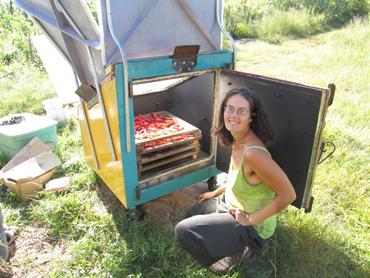
These lessons have been sharpened even further as I have been working on a project called Living Energy Farm (LEF, livingenergyfarm.org). (I am one among many working on LEF, so my perspectives are my own.) At LEF, we have a solar parabolic cooker. We refer to it affectionately as the “death ray.” That is because you can put a stick in front of it on a sunny day and the stick will burst into flames in about three seconds. No joke. The overall BTU (heat) output is similar to a gas burner on medium. We use it a lot. We also have a solar oven that we use for baking as well as solar drying. Particularly on a parabolic cooker, solar cooking is no more difficult than using fossil energy. You just hang the pot up there and off it goes, just like you put it on a gas burner. Community makes it work. In the commuter culture, people don’t have the time or space for solar cooking. In a community, a village, or a cooperative where one person can cook for others, solar cooking is simple, easy, and as sustainable as any technology could possibly be.
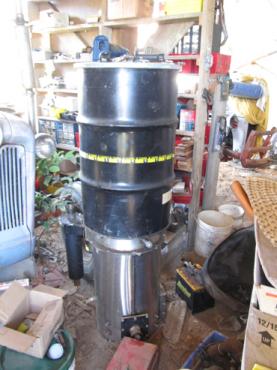
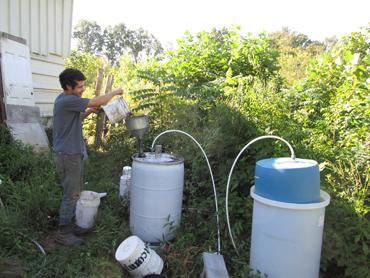
We also have a biogas system. We call that one Pedro, though I don’t have a clue how that bubbly little beast got its name. It’s like tending a woodstove. We have to feed Pedro and keep him warm. He makes gas pretty reliably at this point, though we will need a bigger system for the whole community. Fiddling with a gas digester is easy on a farm, in a community, or in a village. Community makes the technology viable in a practical sense.
At LEF, we also have a woodgas system for our farm tractor. Woodgas was used heavily in World War II in Europe. It allows you to run a gasoline engine off of woodchips. But the important part is not the technology, but how and for what it is used. Even during the short duration of WWII, parts of Europe started to see deforestation problems as the trees were being cut to run the machines. Our bylaws allow us to use woodgas on the farm, in the community, but not over the road. We are on the second version of our system, and also heading toward a second generation of draft animals. These technologies work in community. They do not work in individualized society.
At LEF, we have a few solar electric systems, of different configurations for different purposes. (It seems like we can do what we need to do for the whole community with about 2300 watts.) In general, we try to use electricity when the sun shines instead of trying to store it. That means pumping water during the day and using drip irrigation. We are still building the main house. The irrigation water will run through the main house and suck heat out during the summer before the water goes out to the fields. Free air-conditioning, more or less.
The house is also solar heated with both passive and active (pumped) features. Our commitment is to building reasonably cheaply so that our model can be replicated. Back in the 1970s, people built active solar houses. But they either used fluid systems, which require copper collection panels and are thus expensive, or they used air systems and tried to store the heat in rock beds for later use. Then they would have to store electricity to pump the heat back into the house later. They made complicated, expensive systems because they were working from a fossil-fuel paradigm. For us, we start with the assumption that we are designing our lifestyle to fit renewable energy, rather than trying to force renewable energy systems to meet an individualized lifestyle.
At LEF, the solar panels that run our irrigation system don’t do much in the winter as we don’t need much water, so they run our solar blowers in the house. This close integration of systems works in community but breaks down across barriers of separate ownership of separate structures. The heat is stored in a high-tech material under the house called dirt, where it naturally conducts its way up into the living space. The living space is assumed to be in regular use with inhabitants who are capable of opening and closing windows, thus eliminating a bunch of batteries, computer controllers, and pumps. The sharing of expenses and space makes it financially feasible, desirable even, to invest more effort and money into features such as active solar heat.
Our lighting at LEF uses DC LEDs powered by nickel-iron (NiFe) batteries. NiFe batteries are an old technology. We have one with Thomas Edison’s name stamped right onto the side of it, made by his company. The miraculous thing about that little battery is that it still works! Lead-acid batteries are much more popular, but they die after a few years and have to be replaced. (We ship them to the less-developed world where people are poisoned in the recycling industries.) The NiFe batteries are low-output. You can’t start you car with them. That’s why the lead-acid batteries are so popular, because the presumption of power needs is so high. But for us, NiFes are perfectly suited to DC LED lighting systems that draw modest amounts of energy over extended periods of time.
We intend LEF to be financially self-supporting. We want to make sure our renewable energy systems are not just mechanically adequate, but financially feasible as well. We are earning our living with agriculture, growing open-pollinated seeds. My personal passion is for “perennial food,” my term for fruit and nut trees. The individuation of the American lifestyle and the industrialization of agriculture to feed people disconnected from those farms has created many problems we need not recount here. Community-level agriculture creates opportunities for the integration of systems that supports renewable energy. Animal manure can feed a biogas digester. The chickens can eat bugs under the fruit trees, instead of using expensive and energy-intensive chemical sprays. Irrigation water becomes a heat-absorption medium. “Waste” biomass always finds a home. Machines parts, pipes, and various sundry mechanical widgets migrate from one project to another.
My experience with LEF has sharpened my understanding of the intrinsically supportive relationship between renewable energy and community. But even before LEF, the importance of using renewable energy at a community scale instead of a private household scale was very clear. I have traveled the country giving slideshows and presentations about these issues, and about the relationship of energy supplies and the evolution of our civil society. I will not delve into that latter point here, except to say that ecological stress will be the death knell of democracy if we don’t wise up.
Private ownership and control are deeply ingrained in the American psyche, and “the environment” is mostly an abstraction. If someone wants to invent a more efficient windmill or solar panel, that’s fine, but we don’t need it. If you want to blame the powers that be, you can do that, but we are all sinners in the ecological catastrophe of our time. Good policies would help, but they are not what is most important. What is most important is for you to take the tools you already have, the information you already know, and get together with other people and act on it. Our entire political, academic, and religious tradition taken in total is a grand project to make powerful people look important. The reality is that we have always been in charge, and we always will be so. If you want to solve the environmental crises of our time, you need to work in cooperation with others to build a truly sustainable infrastructure based on renewable energy systems applied at the community level. That’s where physics and politics meet. That is the path to a sane and sustainable future.
Keep the conversation going with these pieces
There are no available blogs
Subscribe to our newsletter for fresh stories and community updates delivered to your inbox.
Get unlimited access to courses, exclusive member events, and a supportive network of community builders
Access all courses, books, and premium content
Member-only workshops and community builders
Member-only workshops and gatherings
We use cookies to improve your experience on our site. By using our site, you consent to cookies.
Manage your cookie preferences below:
Essential cookies enable basic functions and are necessary for the proper function of the website.
These cookies are needed for adding comments on this website.
Statistics cookies collect information anonymously. This information helps us understand how visitors use our website.
Service URL: policies.google.com (opens in a new window)
A residential project: people live here as their primary home.
An institution, business, network, or project that isn’t a residence (e.g. a learning center, farm, or network with no one living there full-time).

{{ item.label }}
{{ item.value ? item.value : currencyFormat( item.amount ) }}
Subtotal
{{ currencyFormat( pricing_summary.total_amount ) }}
There are no results matching your search