

Author: Stephen Wing
Published in Communities Magazine Issue #152
“Growth is personal and individual; evolution is something we all do together.”
—The New and Improved Law of Evolution
I knew the honeymoon was over when my bride suggested I might look around for paying work.
Miraculously, the very first application I filled out in 1990 landed me in a stable, long-term job I loved—in the promotion department of a book wholesaler, where my education and skills in writing, editing, and design made me an asset.
Around the same time, a friend introduced me to the Lake Claire Community Land Trust, a semi-wild tract of land owned by a group of visionary neighbors near my apartment in Atlanta, Georgia. They had added a playground, a gazebo, a sauna, a bulletin board, and some garden plots. Their financial investment and hard work paid off; likeminded people began moving into the neighborhood. Before long, my wife Dawn and I had joined them.
A lifelong nomad, I had little experience with “community.” But when I finally realized what I’d been missing, I plunged in. I was elected to the Land Trust board, then became secretary, once more making use of my communication skills.
Then last fall I suddenly found myself unemployed. No hard feelings; the economy was down, the company was changing, and my expertise no longer needed. But what now?
After 20 years of doing what I had studied in college, it was tempting to consider my next step a “career move”—until I realized that such a move might involve actually moving. “Must be willing to re-locate,” as the want-ads say.
People no longer have communities, it seems; they have careers. We take for granted that a “career move” involves packing up and “re-locating,” leaving friends and neighbors behind. Going off to college is our initiation into the modern cult of mobility, separating us even from the nuclear family with whom we’ve spent our childhood, moving from town to town. Our “communities” have grown more and more interchangeable, and so have we.
Most of our ancestors were nomadic, following migrating herds or changing seasons. But they lived in tribes, growing up and growing old with the same extended family and friends. Real community is not so much a place as a group of people bonded by a common history and experience. Genetically speaking, community is what it means to be human; this is how Homo sapiens survived and evolved over the millennia. Like many other modern inventions, the nuclear family may not prove as beneficial as we think.
Gary Snyder, the Zen poet and ecologist, makes a helpful distinction. A network, he says, is a group of likeminded people who are geographically diverse, scattered across the map. A community is a group of people who live in close proximity but are diverse in other ways. Living in community means learning to get along with folks who are different from us, rather than just moving away. These relationships teach us, stretch us, strengthen us—a process called “growth.”
On a species-wide level, “growth” is called “evolution.” I believe the next phase in human evolution will require a shift from networks of Facebook “Friends” to communities of neighbors. Neither government bureaucracy nor global corporations can shelter us from climate change, peak oil, or economic decline. By necessity, “local” will trump “global.”
So I decided to focus my job hunt in Atlanta, and broaden it to consider any useful type of work. Of course I didn’t rule out the possibility of finding something in my field—but if I had to choose, staying in my community came first.
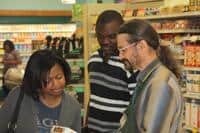
And once again, the very first application I filled out landed me a job—at Sevananda Natural Foods Market. I’m stocking shelves, bagging dried fruit, and feeling very much at home. I frequently ride my bike to work. Every day I mingle with members of my community, including friends and neighbors. Though the work is humble, I am conscious of helping to build an alternative economy, living the cooperative philosophy I believe in.
Not only does my new job supply healthy, organic, and often local foods to people who happen to live in Atlanta. Sevananda provides the modern equivalent of the market square where people gathered to barter, gossip, haggle, and spin the web of community over the millennia.
Ironically, the company I where I spent my first 20 years in Atlanta, New Leaf Distributing, started out in a broom closet at Sevananda. And come to think of it, when I first started there I stocked my share of shelves. Who knows where my new career path might lead?
This article originally appeared in the March 2011 issue of Co-Options, a publication of Sevananda Natural Foods Market, Atlanta, Georgia (www.sevananda.coop).
Keep the conversation going with these pieces
There are no available blogs
Subscribe to our newsletter for fresh stories and community updates delivered to your inbox.
Get unlimited access to courses, exclusive member events, and a supportive network of community builders
Access all courses, books, and premium content
Member-only workshops and community builders
Member-only workshops and gatherings
We use cookies to improve your experience on our site. By using our site, you consent to cookies.
Manage your cookie preferences below:
Essential cookies enable basic functions and are necessary for the proper function of the website.
These cookies are needed for adding comments on this website.
Statistics cookies collect information anonymously. This information helps us understand how visitors use our website.
Service URL: policies.google.com (opens in a new window)
A residential project: people live here as their primary home.
An institution, business, network, or project that isn’t a residence (e.g. a learning center, farm, or network with no one living there full-time).

{{ item.label }}
{{ item.value ? item.value : currencyFormat( item.amount ) }}
Subtotal
{{ currencyFormat( pricing_summary.total_amount ) }}
There are no results matching your search


